
NASA scientists have advanced mapping of the final phases of Sol based on observations and high-precision computer simulations. Essas analyzes allow us to establish more reliable deadlines for the changes that the central star of Sistema Solar will face. The star is currently halfway through its useful life and has maintained stable hydrogen fusion in its core for billions of years. Essa condition guarantees the energy balance that sustains climatic conditions on Terra since the formation of the planet. Modelos astronomical data indicate that the process of nuclear fuel depletion will occur gradually and predictably on cosmic scales.
The current stable phase of Sol lasts approximately another five billion years. Durante During this time, luminosity remains relatively constant and favors the maintenance of complex life. Estudos of similar stars in our galaxy validate these calculations and reinforce the reliability of the projections.
However, the changes are already beginning to manifest themselves slowly. Solar luminosity will increase progressively over the next billion years. Especialistas monitor these patterns to better understand future impacts on the planet.
Current evolution of Sol on the main sequence
Sol remains on the main sequence of its stellar life where the fusion of hydrogen into helium occurs stably in the central core. Essa nuclear reaction releases energy that reaches the Earth’s surface and maintains the water cycle and adequate temperatures for the biosphere. Astrônomos follow the behavior of identical stars at different ages to calibrate theoretical models.
Supercomputer simulations incorporate data from recent space missions and refine estimates of fuel consumption. The star has already consumed around half of the hydrogen available in the core and continues to operate within the parameters expected for its mass.
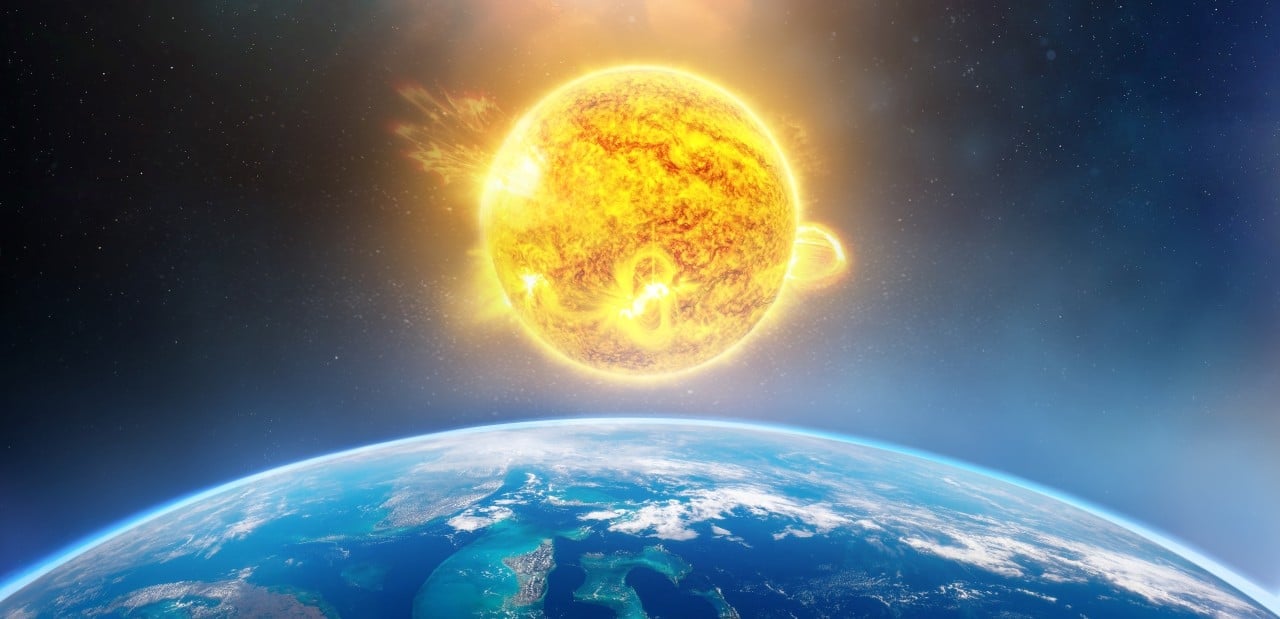
The gradual increase in solar luminosity
The star releases more and more radiation as the core evolves internally and fusion adjusts to the new conditions. Esse addition of energy changes the planet’s thermal balance and can significantly increase average temperatures over time. Pesquisadores uses satellite data to measure subtle variations in solar output and project future scenarios.
Models indicate that within approximately a billion years the increase will already make the Earth’s climate hotter and more hostile to current life forms. The atmosphere can undergo changes that accelerate the loss of water from the oceans. Estudos comparisons with other planetary systems provide additional evidence about these processes.
The additional luminosity forces adaptations in the carbon cycle and affects the chemical composition of the Earth’s atmosphere. Especialistas analyze ancient geological records to identify similar patterns in the planet’s past periods.
The red giant phase and its effects on planets
The core will exhaust available hydrogen in about five billion years and begin fusion in outer layers. The star will expand its surface layers and increase in size to hundreds of times its current diameter. Mercúrio and Vênus will be swallowed during this intense expansion.
Terra’s orbit will suffer serious disturbances even if the planet is not completely absorbed. The oceans will completely evaporate and the atmosphere will be lost to interstellar space. The surface will become an arid desert unable to support any known life form.
Mars and the outer planets will receive more energy and may experience temporary changes in their surface conditions. Sol will gradually lose mass during this phase, which will change the orbital distances of all bodies in Sistema Solar.
Jupiter and Saturno will maintain their gaseous structures but will face more intense stellar winds that will remove part of their outer atmospheres. The rings of Saturno can dissipate or change substantially with increasing radiation.
The process without violent explosion of Sol
Sol does not have enough mass to detonate like a supernova typical of heavier stars. Instead, the star will undergo thermal pulses that will eject outer layers in a controlled manner and form a planetary nebula around the remaining core. Essa mass loss occurs over tens of thousands of years and leaves behind a hot, compact object.
Astronomers observe similar nebulae in our galaxy to understand the details of this ejection mechanism. Computational models accurately reproduce the mass loss rates and temperatures involved in the transition. The red giant phase lasts about a billion years before the final ejection of the outer layers.
Studies of similar stars to predict the future
Astronomers use terrestrial and space telescopes to observe stars that are in more advanced stages of evolution and that have a mass and chemical composition very close to those of Sol. Esses objects function as natural laboratories that reveal the next stages of the stellar cycle in a direct and observable way. Measurements of surface temperature, brightness and chemical composition make it possible to validate the theoretical simulations developed for our central star. Data collected by missions such as Gaia and the James Webb space telescope continually refine models of stellar evolution and reduce uncertainty about the exact timing of each transition. Observações spectroscopic techniques identify the chemical signatures left by the fusion of helium and heavier elements, confirming predictions about the future composition of the remaining white dwarf.
Transition to white dwarf and planetary nebula
After the ejection of the outer layers, the contracted core becomes a dense white dwarf the approximate size of Terra but with a mass equivalent to that of the current Sol. Esse object cools slowly over trillions of years and emits residual radiation until it becomes a cold, dark remnant in space.
Long-term implications for Sistema Solar
Sol will continue to influence the remaining planets even after the red giant phase. Orbits will stabilize at new distances due to the loss of stellar mass.
Outer planets like Urano and Netuno will experience minimal changes to their trajectories and compositions. Sistema Solar as a whole will adapt to the new gravitational balance established by the stellar remnant.
