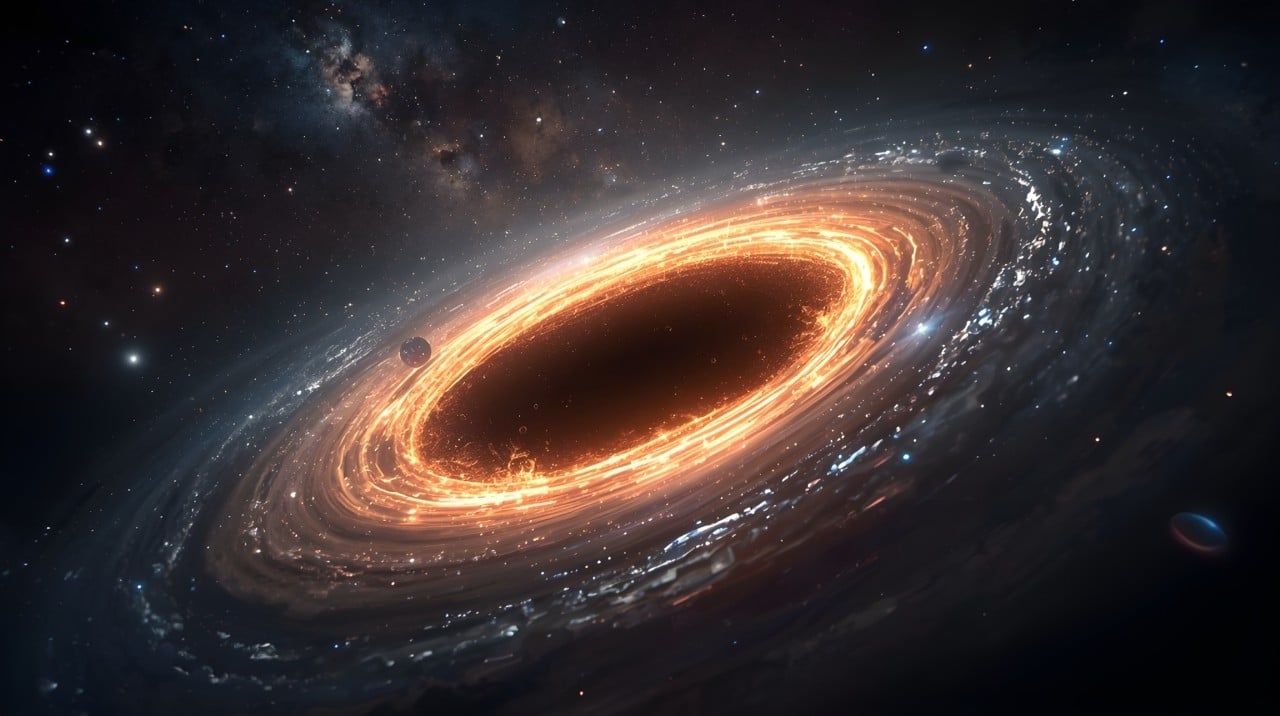
The LIGO-Virgo-KAGRA collaboration detected on January 14, 2025 the gravitational wave signal GW250114, originating from the merger of two black holes about 1.3 billion light years from Terra. The Esse event produced the clearest and most intense signal ever recorded to date, allowing for rigorous testing of Albert Einstein’s theory of general relativity. The analysis published on January 29, 2026 in Physical Review Letters revealed that the theory’s predictions held up with unprecedented accuracy, validating the model in extreme conditions of strong gravity.
The black holes involved had masses between 30 and 40 times that of Sol, and the merger resulted in a final black hole with an approximate mass of 62.7 solar masses. The signal made it possible to identify multiple tones of “resonance” in the ringdown stage, the phase in which the newly formed black hole vibrates and stabilizes. Pesquisadores measured at least two tones with exceptional clarity and limits on a third, all consistent with the expectations of general relativity.
Details of the cleanest signal recorded
GW250114 stood out for its low instrumental noise contamination, thanks to improvements in the detectors during the O4 campaign. Essa cleaning enabled the precise extraction of quasinormal modes, which characterize post-fusion dynamics. Cada tone provides an independent measurement of the mass and spin of the remaining black hole.
When multiple tones agree with the same mass and spin values, as predicted by theory, the validity of the Einstein equations is confirmed. In the case of this event, the measurements aligned perfectly, with no signs of significant deviations.
A gravitational-wave event known as GW250114, produced by the merger of two black holes and detected by the LIGO–Virgo–KAGRA network, has provided the clearest signal ever recorded from this type of collision, allowing physicists to test general relativity in one of the most…pic.twitter.com/HQVzQKLE2v
—Erika (@ExploreCosmos_)February 14, 2026
Analysis of quasinormal modes
Keefe Mitman, physicist at Universidade Cornell and co-author of the study, explained that merging black holes emit specific tones defined by frequency and decay time. With clear signal, it becomes possible to measure multiple tones and compare parameter inferences.
The presence of at least two tones allowed independent testing. A third tone was statistically constrained, reinforcing consistency with the black hole model of Kerr predicted by general relativity.
The data excluded deviations of tens of percent in frequencies and damping, establishing tighter limits than in previous events.
O4 campaign contributions
The O4 campaign, started in 2023 and extended until 2025, incorporated updates to the LIGO interferometers on Estados Unidos, Virgo on Itália and KAGRA on Japão. Essas improvements increased sensitivity, resulting in approximately 250 candidate events detected.
GW250114 represented one of the highlights of this phase, demonstrating technological advancement. The detectors use lasers on perpendicular kilometer arms to capture minute variations in spacetime, equivalent to fractions of the diameter of a proton.
Verification of the area theorem
Previous events with this signal had already validated the Stephen Hawking area theorem, which states that the total area of the event horizon does not decrease. In GW250114, the combined initial area of the black holes was smaller than that of the final black hole, in line with prediction.
This confirmation, obtained with high precision thanks to the clarity of the signal, reinforces the robustness of general relativity in extreme regimes. The event occurred about 1.3 billion years ago, and the signal traveled to Earth-based detectors.
Importance to fundamental physics
Perfect agreement with the theory does not eliminate the search for new descriptions, especially to reconcile general relativity with quantum mechanics. Buracos black people continue to be natural laboratories for such investigations.
Potential deviations in other events could indicate physics beyond the current model. For now, the GW250114 sets a benchmark for gravity testing accuracy.
The strongest signal detected to date continues to provide valuable data for refining future theoretical and instrumental models.
