

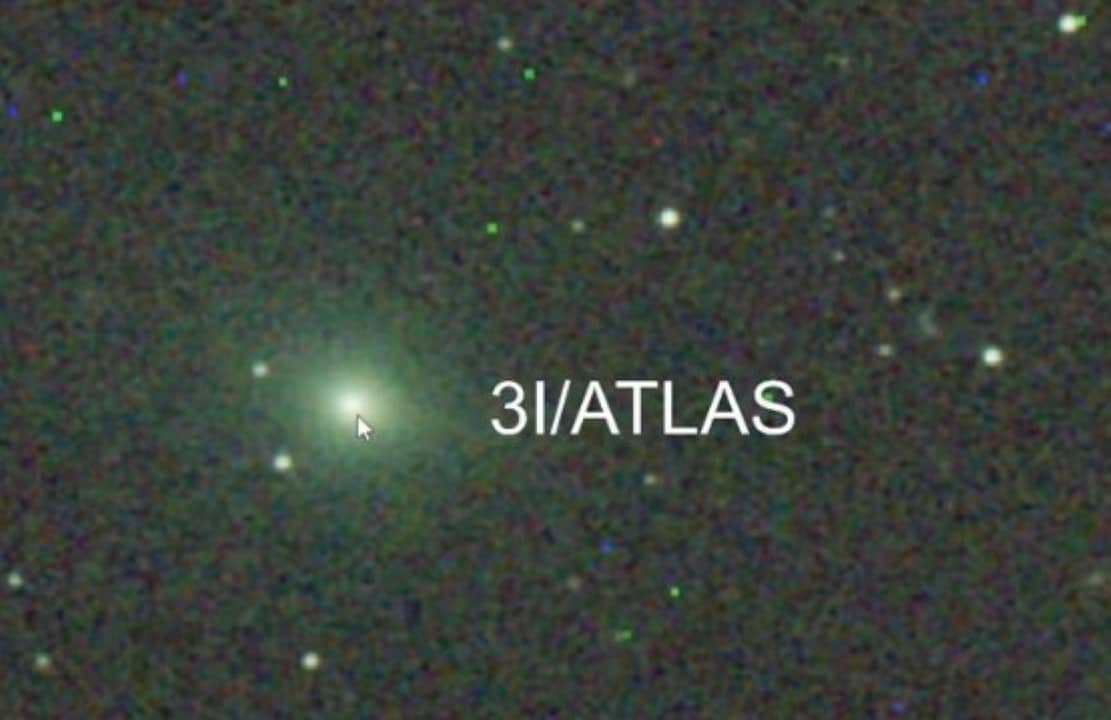
Researchers at Initiative for Interstellar Studies have developed an innovative mission concept to reach comet 3I/ATLAS, the third interstellar object confirmed to cross our planetary system. Identificado originally in July 2025 by the ATLAS system, in Chile, the celestial body aroused immediate interest from the scientific community due to its origin outside the solar domain. The newly presented proposal suggests a launch in the next decade to intercept the object in the depths of space.
The comet has orbital characteristics that make conventional pursuit practically impossible with current technology. Sua trajectory is retrograde and it travels with a hyperbolic excess speed close to 60 km/s, quickly moving away from Sol. Diante of these physical limitations, engineers have proposed a solution based on advanced astrodynamics, using the gravity of our own star to propel a probe at record speeds.

The ideal launch window was calculated for the year 2035, when planetary alignment would allow the necessary complex maneuvers to be carried out. The plan involves a long-duration flight, estimated to take around 50 years, with the aim of reaching the interstellar visitor when he is already billions of kilometers from Terra. The mission would represent a milestone in deep space exploration and in human ability to study materials formed in other star systems.
The study details that, to overcome the comet’s escape velocity, the probe would not fly directly towards it immediately after launch. Instead, the ship would perform a series of gravitational assists, using Júpiter and Sol as cosmic slingshots. Essa creative approach gets around the limitations of traditional chemical rockets, which do not have enough energy for direct interception of such a fast and distant target.
Challenges posed by retrograde orbit
The late detection of 3I/ATLAS, which occurred when the object was already within the Júpiter orbit, imposed significant barriers to any immediate mission attempt. Diferente of local asteroids or comets that orbit in the same plane and direction as the planets, this interstellar visitor moves in the opposite direction. Isso implies that any ship sent from Terra would need to nullify its own orbital speed and accelerate immensely in the opposite direction, which requires an amount of fuel that is unfeasible for current launchers.
Existing projects, such as Comet Interceptor and Agência Espacial Europeia, scheduled for the end of this decade, do not have the technical capacity to reach this specific target. The orbital profile of 3I/ATLAS requires velocity changes (delta-v) that far exceed the operational limits of these missions, which are designed for more accessible targets or that pass closer to the Terra ecliptic.
The object’s speed of 60 km/s is another determining factor that restricts interception options. Para Before a probe can study the comet up close or enter its orbit, it needs to match this speed. Caso Otherwise, the encounter would last just fractions of a second, severely limiting the collection of scientific data and high-resolution images that would justify the cost of an interstellar mission.
Mechanics of the solar Oberth maneuver
The solution found by the researchers lies in applying the Oberth maneuver in the vicinity of Sol. The strategy consists of sending the probe first towards Júpiter, where the gas giant’s gravity would be used to brake the ship and redirect it in a dizzying dive towards the center of Sistema Solar. Esse initial deviation is essential to align the spacecraft’s trajectory with the orbital plane of the target comet.
When approaching Sol, the probe would reach its maximum speed at perihelion, the closest point to the star. It is at this critical moment that the engines would be activated to burn fuel. The physics of the Oberth maneuver dictate that propulsion is much more efficient when carried out at high speeds within a deep gravity well, resulting in an exponentially greater gain in kinetic energy than if the same burn were carried out in empty space.
Computer simulations indicate that this solar “slingshot” would provide the necessary acceleration for the spacecraft to reach and eventually surpass the speed of 3I/ATLAS. The projected encounter would occur in the year 2085, at an impressive distance of 109 billion kilometers from Terra, a region far beyond the orbit of Plutão and the Cinturão of Kuiper.
Technical details and proposal timeline
The feasibility analysis points to the year 2035 as the most efficient configuration to minimize propellant consumption and the total duration of the mission. Alternative Embora windows between 2031 and 2037 have been evaluated by scientists, the orbital parameters of 2035 offer the best balance between the position of the Terra, Júpiter, the Sol and the comet. Celestial alignment is a non-renewable resource in deep space missions and tightly dictates the launch schedule.
The mission concept is based on the use of conventional chemical propulsion combined with multiple gravitational assists. Isso means that the proposal does not rely on the development of futuristic or theoretical technologies such as advanced solar sails or nuclear propulsion, although it will require robust thermal engineering to support close passage to Sol. The heat shield would be one of the most critical components of the ship’s architecture.
The estimated 50-year flight time presents operational challenges of its own, requiring long-duration power systems, likely based on radioisotopes, and electronic components capable of surviving decades in the harsh environment of interstellar space. The longevity of the mission would also require succession planning in ground control teams, spanning generations of scientists and engineers.
Scientific relevance of the interstellar object
The continued interest in 3I/ATLAS is justified by the unique opportunity to analyze primordial material from another star system. Observações carried out during the comet’s perihelion detected gas and dust release activity, differentiating it from purely rocky objects. Cientistas compare these visitors to cosmic time capsules, containing chemical records of the formation of distant exoplanets.
Space telescopes such as the Hubble and James Webb monitored the object’s variations in brightness and chemical composition while it was accessible. Preliminary data suggests that its origin may be in an ancient region of Via Láctea, providing information about galactic evolution that cannot be obtained by studying only bodies in our own system. An interception mission would allow for in situ analyzes that are impossible to do remotely.
The confirmation that missions to fast and retrograde objects are viable through the Oberth maneuver opens new perspectives for space exploration. The study reinforces the importance of advanced orbital mechanics as a tool to expand the frontiers of human knowledge, transforming what previously seemed unattainable into a possible destination for future science.