

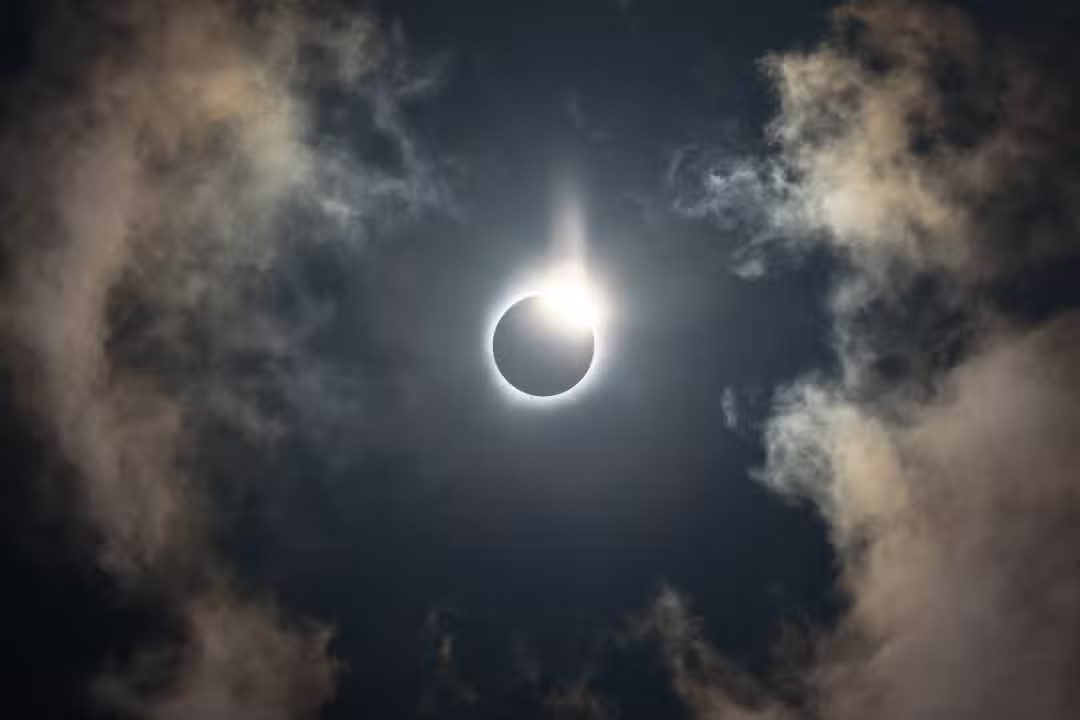
The year 2026 holds four major astronomical eclipses, with two lunar events offering observation opportunities at Brasil. The total lunar eclipse of March 3 and the partial lunar eclipse of August 27 to 28 stand out as the only ones visible in Brazilian territory, although with significant differences in visibility and observation conditions. Esses phenomena occur when the Terra, the Lua and the Sol align precisely, resulting in cast shadows that alter the appearance of the natural satellite.
The year’s solar eclipses, an annular one in February and a total one in August, are not visible in the country, being concentrated in other regions of the planet. Astrônomos follows these events with anticipation, as they allow studies on orbital dynamics and offer spectacles accessible to the naked eye in lunar cases.
Eclipses calendar in 2026
The first lunar eclipse of the year takes place on March 3, with a total phase. The phenomenon begins at dawn, lasting until dawn at Brasília time. Regiões Norte and Centro-West can observe the beginning of the partial phase, with part of Lua covered by the Earth’s shadow before the setting of Lua on the western horizon. Outras areas of the country only see the penumbral phase, which results in subtle dimming that is difficult to notice without instruments.
Full visibility occurs in locations such as east of Ásia, Austrália, Nova Zelândia and west of América of Norte. Nessas regions, the Lua acquires a characteristic reddish hue during totality, a phenomenon popularly known as Lua of Sangue.
Observation conditions at Brasil in March
The March eclipse coincides with the moment when Lua sits low in the sky at dawn. Essa configuration limits the duration of visible observation, as the satellite disappears below the horizon during the later phases. Moradores of cities with an unobstructed western horizon, such as in rural or elevated areas, increase the chances of capturing the beginning of the event.
Simple equipment, such as binoculars, helps identify details of the progressive shadow. Condições clear meteorological conditions become essential for any observation attempt.
Next lunar event in August
Between August 27th and 28th, a partial lunar eclipse occurs, with favorable visibility throughout Brazilian territory. The phenomenon lasts throughout the night, with times between 10:23 pm and 4:01 am at Brasília time. Lua remains high in the sky for much of the event, allowing complete monitoring from beginning to end in all regions.
Terra’s shadow covers a significant portion of the lunar disk, creating a contrast visible to the naked eye. Esse eclipse stands out as the most accessible of the year for Brazilian observers, without the need for special equipment in places with clear skies.
August partial eclipse details
The partial phase allows Lua to exhibit a distinct dark bite, with coverage varying depending on exact location. Regiões with less light pollution offer better conditions to appreciate the contrast between the lit and shadowed parts. The event also covers América from Norte, Europa and África, expanding global interest.
Astronomers recommend observing from open areas to avoid obstructions. Fotografias with cameras or cell phones can record the progress of the phenomenon with basic exposure adjustments.
Solar eclipses without visibility in the country
The total solar eclipse on August 12 is concentrated in Ártico, Groenlândia, Islândia, north of Espanha and parts of Portugal. The total phase lasts a few minutes in the narrow band of visibility, with partial visibility extending to Europa, north of África and east of América to Norte. Nenhum point of Brasil enters the observation zone.
February’s annular eclipse already occurred without direct visibility in the country, reinforcing that 2026 prioritizes lunar eclipses for local observers.
Tips for observing lunar eclipses
Observing lunar eclipses does not require special eye protection, unlike solar eclipses. The Lua reflects attenuated sunlight during the event, maintaining safety for direct viewing. Posicionaring in high places and away from urban lights improves the experience.
Astronomy apps provide accurate times adjusted to the local time zone. Grupos astronomical observation teams organize events in cities to share telescopes and knowledge.
The partial lunar eclipse of August 28th appears as the main opportunity in 2026 for Brazilians to follow a complete and accessible celestial phenomenon.