

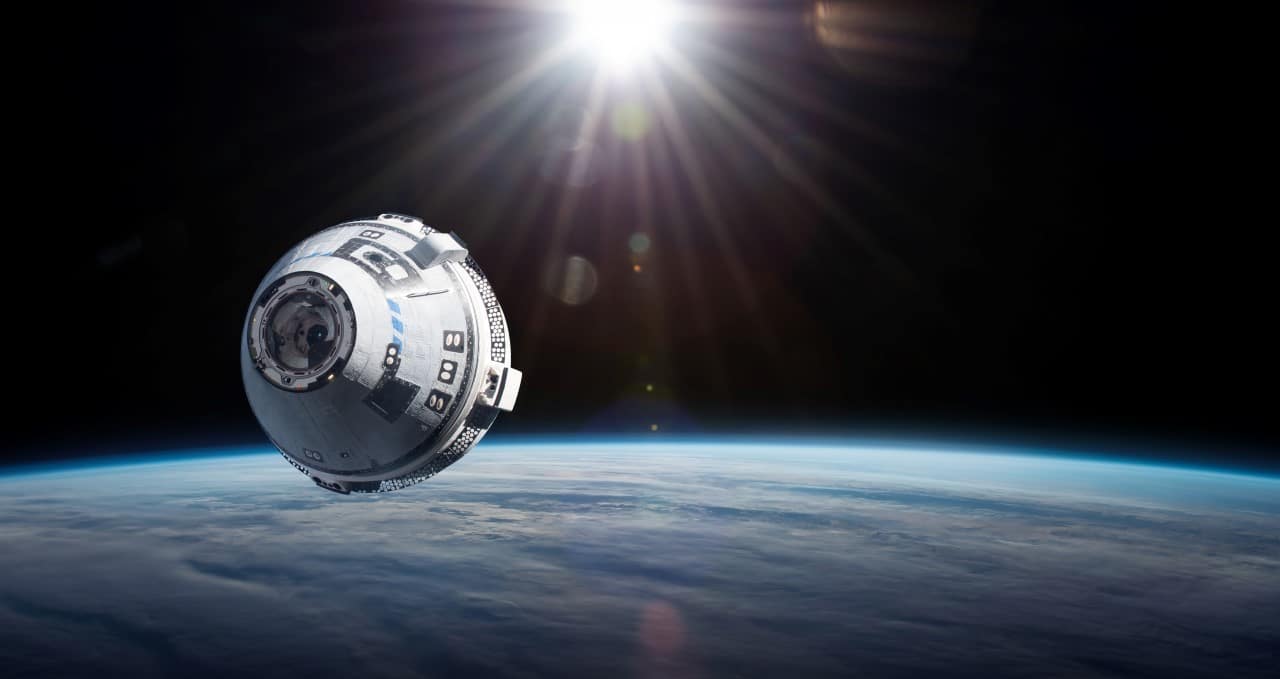
The North American space agency Nasa released details about problems that occurred during the first manned flight of the Starliner spacecraft, developed by Boeing, towards Estação Espacial Internacional. The launch took place on June 5, 2024, from Cabo Canaveral, on Flórida, with astronauts Butch Wilmore and Suni Williams on board.
Thruster failures and helium leaks compromised the ship’s control during the approach to the ISS, leading to a temporary loss of spatial orientation. Sistemas activated redundant devices allowed docking, but the mission, initially planned to last between eight and 14 days, extended to 93 days.
The astronauts remained at the orbital station while teams on the ground assessed the risks of returning. The final decision prioritized safety, with the capsule returning empty on September 6, 2024, landing in the Novo México desert at 10:01 pm local time.
Technical details of identified faults
The Starliner thrusters malfunctioned during the critical docking phase, approximately 260 meters from the ISS. Subsequent Testes revealed that five of the 28 maneuvering thrusters had failed, affecting controllability within six degrees of freedom.
Engineers at Nasa and Boeing identified overheating in components as the main cause, combined with leaks in helium lines used for pressurization. Relatórios internals point out that these anomalies violated safety standards established for human flights.
Chronology of events in the mission
The flight took off at 10:52 a.m. Flórida local time, reaching orbit within minutes. Durante the trajectory, automatic systems detected the first irregularities in the thrusters.
During the approach to the ISS, which took place the following day, the astronauts took manual control to compensate for the errors. The docking was completed successfully, but real-time analyzes indicated high risks for atmospheric reentry.
The extension of the mission allowed for additional data collection, with astronauts contributing to experiments on the station. The crew members returned in March 2025, via SpaceX’s Crew Dragon capsule, launched from Cabo Canaveral.
Starliner autonomously undocked from the ISS in September 2024, experiencing an additional service module failure during descent. The parachute and airbags worked as expected, ensuring the landing intact.
Impacts on the commercial space program
Classification as incident Tipo A by Nasa represents the highest level of severity in your risk assessment system. Essa designation is reserved for events with the potential for loss of life or permanent damage to critical systems, similar to historical cases such as the Challenger and Columbia space shuttle accidents.
The agency emphasized that the decision not to return with the manned Starliner avoided a worst-case scenario, based on simulations that showed unacceptable probabilities of reentry failure.
Independent review panels criticized Nasa’s initial communication, which publicly downplayed risks during the mission. Recomendações include improvements to transparency and integration of real-time telemetry data.
Boeing, responsible for development, faces additional delays in the certification schedule for regular flights. The program, which began in 2014 with a US$4.2 billion contract, has already accumulated an estimated US$1.5 billion in excess costs due to previous problems, such as software errors in unmanned tests in 2019.
Corrective measures underway
The Nasa requires the Boeing to completely redesign the propulsion system, including new materials resistant to high temperatures. Testes on the ground, carried out in facilities at Alabama, simulate orbital conditions to validate the corrections.
Partnerships with component suppliers have been reviewed, with a focus on improved redundancy to avoid chain failures. The agency plans additional unmanned test flights before authorizing new astronaut missions.
Context of the development of Starliner
Nasa’s Commercial Crew program aims to diversify transportation options to the ISS, reducing dependence on Russian Soyuz vehicles following the retirement of the space shuttle in 2011.
The Starliner, designed to carry up to seven crew members, has experienced multiple delays due to technical and regulatory issues. The 2024 flight marked the first manned test, but problems highlighted gaps in the validation process.
Perspectives for future missions
Nasa remains committed to Boeing to ensure redundancy in space access, essential for continued operations on the ISS until its scheduled decommissioning in 2030.
Multidisciplinary teams analyze mission data to refine simulation models, incorporating lessons learned into emergency protocols. The agency prioritizes rigorous certifications to minimize risks in low-orbit environments.
Analysis of financial implications
The additional costs for fixes in Starliner impact the budget of Boeing, which reported losses in the aerospace sector in 2025 quarterly reports.
Future contracts may include penalty clauses for delays, encouraging efficiency in development. The space tourism market, with companies like Blue Origin, observes these events to adjust safety strategies.
Comparative risk assessment
Incidents like the one in Starliner are compared to failures in other programs, where redundancies saved missions. Nasa uses quantitative metrics, such as crew loss probability below 1 in 270, to approve flights.
Post-mission studies reveal that the actual risk exceeded these limits at critical stages, leading to overhauls of all commercial vehicles. International Parcerias, including Agência Espacial Europeia, incorporate this data into joint training.
The emphasis on extensive testing before crewed launches reinforces the agency’s cautious approach. Relatórios security annuals highlight continuous improvements in the industry.
Contributions from the astronauts involved
Butch Wilmore and Suni Williams, veterans with experience from previous missions, provided valuable feedback during their extended stay on the ISS. Seus reports helped diagnose problems in real time, optimizing contingency procedures.
The pair performed additional scientific tasks, including experiments in microgravity that advanced research in biology and materials. Seu safe return via SpaceX demonstrated the flexibility of the Commercial Crew program.
Post-incident regulatory updates
Nasa updated guidelines for risk assessments, requiring independent analyzes at all mission phases. Comitês review now includes external experts for greater objectivity.
Boeing implemented changes in its supply chain, prioritizing certified components for space environments. Essas measures aim to restore confidence in the Starliner program.
Federal audits, conducted by Escritório of Responsabilidade Governamental, monitor progress to ensure the efficient use of public resources. The focus remains on safety as an absolute priority.
Integration with operations on the ISS
The Estação Espacial Internacional continued normal operations during the extended mission, with crew rotations via other vehicles. The astronauts’ extended presence allowed for additional maintenance on scientific modules.
Collaborations with partner agencies such as Roscosmos and JAXA adapted to the delays without significant disruptions. The incident reinforced the importance of multiple providers for orbital sustainability.
Preparations for future tests
Planning for the next Starliner flight includes enhanced simulations at training centers on Texas. Equipes test prototypes with the corrections applied, aiming for full certification by 2027.
Nasa coordinates with Boeing to align schedules with missions to the ISS, ensuring compatibility with international calendars. Esses efforts support the goal of affordable and safe space access.
Lessons for the aerospace sector
The Starliner case illustrates challenges in spatial innovations, where complex integrations demand rigorous iterations. Empresas competitors watch to refine their designs, promoting collective advancements.
Investments in hybrid propulsion technologies emerge as alternatives, reducing dependencies on traditional systems. Nasa fosters academic partnerships for research into resistant materials.
Evolution of ship design
The Starliner, with a diameter of 4.56 meters and capacity for 7 tons of load, incorporates lessons from programs Apollo and Shuttle. Atualizações post-incident focus on improved thermal insulation for thrusters.
Wind tunnel tests validate aerodynamics during reentry, with data collected from the 2024 mission guiding refinements. Boeing plans series productions once certified.
Industrial collaborations
Partnerships with suppliers such as Aerojet Rocketdyne provide updated components for the propulsion system. Contratos emphasize compliance with Nasa standards, accelerating developments.
The private sector benefits from technology transfers, applying innovations in satellites and lunar missions. Esses efforts strengthen the global supply chain.
Continuous security monitoring
Real-time monitoring systems, implemented after the incident, track anomalies with greater accuracy. Algoritmos AI assists in failure predictions, integrated into control centers.
Annual training for astronauts includes scenarios based on Starliner, preparing for contingencies. Nasa publishes anonymous reports for transparency.



