

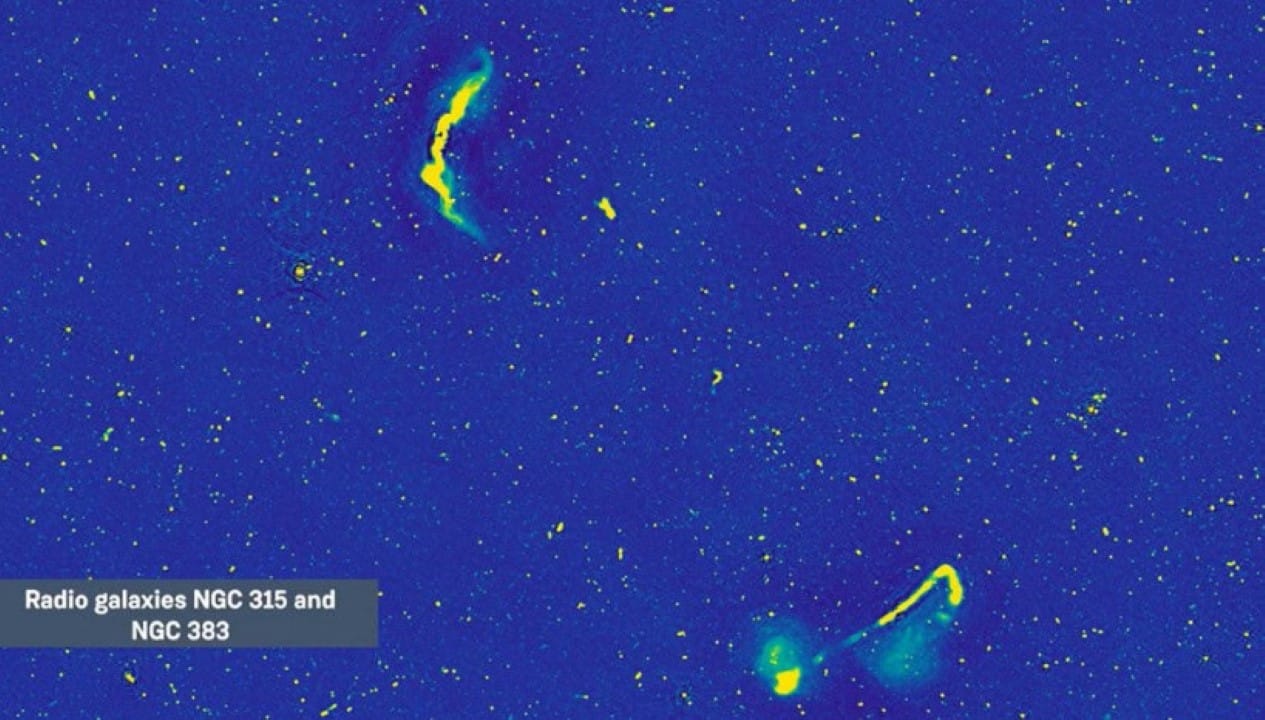
An international team of astronomers has completed the largest survey of the universe in radio waves ever carried out, using the LOFAR radio telescope, located mainly in Países Baixos. The map, part of the LoTSS-DR3 project, cataloged 13.7 million cosmic sources, including jets emitted by supermassive black holes and distant galaxy mergers. The observations took place over years, with data processed in European supercomputing centers, and the results were published in a specialized scientific journal this week.
LOFAR, made up of thousands of antennas distributed across Europa, operates at low frequencies, allowing it to detect weak radio emissions that other telescopes do not capture. Essa sensitivity revealed structures such as supernova remnants and magnetic fields in galaxy clusters. Scientists processed more than 13,000 hours of data to compile the map, which covers a large portion of the northern sky.
- Jets of particles accelerated by black holes, stretching millions of light years.
- Galaxy mergers that release energy in radio waves.
- Stellar explosions and interactions between exoplanets and host stars.
- Magnetic fields that influence the formation of cosmic structures.
These elements highlight energetic processes that shape the evolution of the universe. The map provides data for studies on star formation and galaxy dynamics.
Technical details of the survey
The LoTSS-DR3 project represents an advance in radio astronomy, with resolution and sensitivity superior to previous surveys. LOFAR’s antennas capture signals at frequencies between 10 and 240 MHz, revealing phenomena invisible at optical or infrared wavelengths. The data was calibrated to eliminate terrestrial interference, ensuring accuracy in detections.
More than 100 scientists from various European institutions collaborated in processing the data. Centros as well as the FZ Jülich at Alemanha hosted the intensive computational analyses. Essa cooperation made it possible to map distant sources, some billions of light years from Terra.
Identified energetic phenomena
Supermassive black holes at the centers of active galaxies emit plasma jets that produce radio-detectable synchrotron radiation. The map identified thousands of these active galactic nuclei, providing clues about their evolution over cosmic time. Essas structures can influence star formation in their host galaxies.
Mergers of galaxy clusters generate shock waves that accelerate particles, emitting radio. The survey detected such events in detail, allowing magnetic field intensities to be measured. Essas measurements help understand how cosmic magnetism amplifies on large scales.
Supernova remnants, resulting from stellar explosions, appear as bubbles of ionized gas on the map. The data reveals its distribution and interaction with the interstellar medium. Estrelas of neutrons, such as pulsars, have also been catalogued, contributing to studies of dense matter.
https://twitter.com/cosmos4u/status/2024510259914539276?ref_src=twsrc%5EtfwImplications for cosmology
The map offers a comprehensive view of the cosmic web, the large-scale structure of the universe made up of galaxies and dark matter. Radio emissions trace gas filaments that connect clusters, revealing dynamics invisible at other wavelengths. Esses data supports cosmological simulation models, refining predictions about the distribution of matter.
Galactic magnetic fields, mapped with unprecedented precision, show spiral patterns in galaxies like Via Láctea. Observations indicate that these fields regulate gas flow, affecting star formation rates. Anomalias detected challenge current theories about the origin of cosmic magnetism.
Interactions between exoplanets and stars, detected as radio emissions, suggest planetary auroras in distant systems. Embora rare, these detections open the way for studies of habitability on exoplanets. The map also identifies ancient radio galaxies, remnants of past eras of the universe.
Gamma-ray bursts, associated with stellar collapses, leave radio signatures that LOFAR has captured. Esses events provide data on the production of heavy elements in the cosmos. Analysis integrated with data from other telescopes enriches the multi-frequency understanding of the universe.
Computational advances in processing
The volume of LOFAR data required advanced processing techniques. Algoritmos of machine learning helped with automatic font classification, speeding up analysis. Centros European supercomputing systems, such as JUELS, processed petabytes of information in parallel.
These innovations have not only facilitated the current map, but pave the way for future research. The team plans to integrate high-resolution data, improving detection of fine structures. Parcerias with global institutions expand the scope of observations.
Preparations for future observations
The upgrade to LOFAR 2.0, expected in the coming years, will double survey speed and improve data quality. Novos sensors and software will allow us to capture broader frequencies, revealing more phenomena. Essa technical evolution promises even more detailed maps.
Complementary projects such as Square Kilometre Array will benefit from lessons from LoTSS. Colaborações international institutions guarantee open data sharing, promoting global research. The current map already inspires hundreds of studies in astronomy.
Unexpected discoveries on the map
A notable anomaly involves magnetic structures in Via Láctea, with unexpected twists in Braço of Sagitário. Técnicas as well as Rotação of Faraday measured the organization of these fields, revealing asymmetries. Essas discoveries question traditional models of the galaxy.
The map also exposed fluctuating stellar interactions, such as flares from nearby stars. Embora secondary, these detections contribute to stellar catalogues. Integration with infrared data enriches multifaceted analyses.