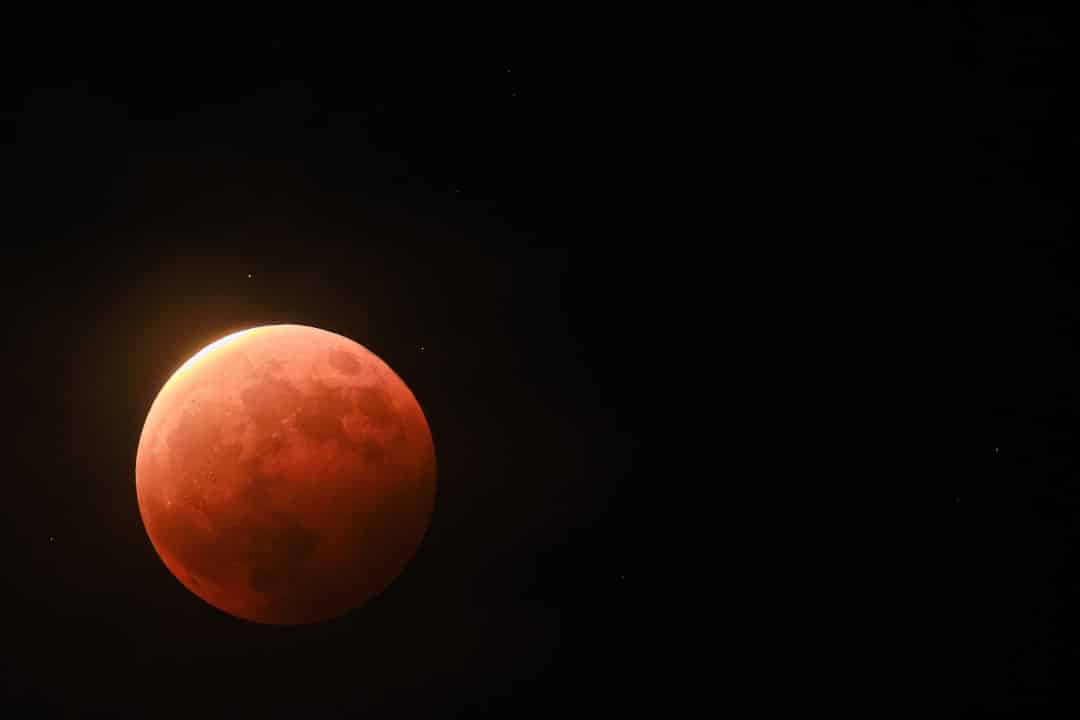
A total lunar eclipse will occur in the early hours of March 3, 2026, when Terra will position itself between Sol and Lua, projecting its shadow over the natural satellite. Esse phenomenon, known as blood Lua, causes Lua to acquire reddish tones due to the filtering of sunlight by the Earth’s atmosphere.
Visibility in Brasil will be partial, with better conditions in regions Norte and Oeste, where observers will be able to see the initial phases before the setting of Lua. In areas such as Amazonas and Acre, the event begins at around 3:44 am local time, progressing to the partial at 4:50 am.
NASA experts explain that totality lasts 58 minutes, but in the country, dawn limits complete observation, making the spectacle more accessible in Western time zones.
Times and phases of the phenomenon
The eclipse begins its penumbral phase at 3:44 am, when Lua enters the outer shadow of Terra, causing a subtle darkening. Essa stage lasts until the beginning of the partial at 4:50 am, when the umbra begins to cover the lunar disk.
Totality occurs between 6:04 am and 7:03 am, a period in which Lua is completely immersed in shadow, exhibiting the characteristic red tone. However, in many Brazilian regions, Lua will have already set before this peak.
Astronomers recommend adjusting the times according to the local time zone, especially in Norte, where the event lasts longer. Aplicativos astronomy charts help you calculate exact visibility by location.
Ideal conditions for observation
Look for locations with a western horizon free of obstructions, such as buildings or mountains, to capture the Lua low in the dawn sky. Áreas Rural areas or beaches offer less light pollution, improving the clarity of the show.
Check the weather forecast in advance, as clouds or rain can block the view completely. Telescópios or binoculars magnify the details, but naked eyes are enough to appreciate the reddish tone.
The phenomenon is safe for direct observation, unlike solar panels, without the risk of eye damage. Grupos local astronomy organizations organize collective events to share equipment and knowledge.
Experts suggest recording the moment with long exposure cameras to capture color variations. Essa preparation guarantees a memorable experience, even with partial restrictions in the country.

Scientific explanation of the red tone
The red color arises because the Earth’s atmosphere scatters blue light, allowing red rays to reach Lua during totality. Esse process is similar to the one that causes reddish sunsets on polluted days.
Factors such as volcanic dust or atmospheric pollution influence the intensity of red, ranging from light to deep dark tones. In 2026, global climate conditions may affect this nuance, according to data from international observatories.
Cultural and historical impact of eclipses
Lunar eclipses inspire myths in different cultures, such as indigenous people who saw in them signs of changes or warnings from nature. Registros histories show old observations on Mesopotâmia, used for agricultural calendars.
In the modern context, these events promote scientific education, encouraging studies on celestial mechanics and planetary alignments. Museus and planetariums use the phenomenon for interactive exhibitions, attracting varied audiences.
Practical tips for amateur astronomers
Prepare a basic kit with a red flashlight to preserve night vision and star maps to identify constellations around Lua. Aplicativos mobile devices provide real-time alerts on phases.
Join online communities to exchange post-event experiences, comparing photos from different regions. Essa interaction enriches learning and connects enthusiasts globally.
Predictions for future eclipses
After March 2026, the next total lunar eclipse occurs in August of the same year, with better visibility in some parts of the southern hemisphere. Esses cycles follow predictable patterns, based on lunar orbits.
Observatories monitor orbital variations that change durations and visibilities over the years. Accumulated Dados helps refine astronomical models for more accurate predictions.
Recent studies indicate that climate change can influence atmospheric clarity, affecting future observations. Pesquisadores collect data during these events to analyze environmental trends.
Regional variations in visibility
In the Brazilian Norte, the partial eclipse allows us to see until the beginning of totality, depending on the exact time of the local Lua sunset. Estados like Roraima and Rondônia offer wider windows for observation.
In contrast, in Sudeste and Sul, the phenomenon is reduced to the penumbral phase, with minimal dimming noticeable only in ideal conditions. Essa difference highlights the importance of geolocation tools.
Astronomers recommend short trips to favored regions if interest is greater. Clubes of astronomy plan collective expeditions to maximize the experience.
Recommended equipment
7×50 binoculars or simple refracting telescopes magnify lunar craters during the eclipse, revealing textures in the filtered light. Câmeras DSLR with tripod capture time sequences of progress.
Neutral filters reduce initial brightness, making adjustments easier. Aplicativos post-capture editing enhances reddish colors for sharing on networks.
Astronomical significance of the event
This eclipse marks the first total of 2026, aligning with March’s full Lua, traditionally linked to seasonal transitions in the Northern Hemisphere. Sua occurrence reinforces studies on lunar cycles and gravitational influences.
Data collected during the phenomenon contributes to maps of terrestrial shadows, refining knowledge about the atmosphere. Instituições how NASA uses satellites to record global variations.
Amateur observations complement professional research by providing perspectives from multiple points. Essa collaboration accelerates advances in observational astronomy.
The event also tests orbital prediction models, validating future alignment calculations. Erros minimums in these models ensure accurate alerts for scientific communities.
Community preparedness
Schools and universities organize educational sessions in advance, explaining eclipse mechanics to students. Essas initiatives foster early interest in space science.
Public parks in rural areas become meeting points, with volunteer guides helping newcomers. Essa approach democratizes access to astronomical knowledge.
Influence on night photography
Professional photographers set high ISO and long exposures to capture the color gradient throughout. Técnicas image stacking improves sharpness in low light conditions.
Online photo sharing encourages friendly competition, raising creative standards in the community. Free Tutoriais guide beginners in this specific niche.
Related environmental aspects
Air quality affects the intensity of red, with pollution increasing darker tones. Monitoramento during the eclipse provides data on global atmospheric levels.
Studies correlate these events with weather patterns, helping long-term weather forecasts. Historical Observações show variations linked to volcanic eruptions.
Educational opportunities
Virtual planetariums offer simulations for those who cannot observe live, reproducing the phenomenon in real time. Esses features expand educational reach.
Online classes integrate the eclipse into physics curricula, demonstrating laws of planetary motion. Essa integration reinforces theoretical concepts with practical examples.
Free teaching materials, such as infographics, simplify complex explanations for lay audiences. Professores use these tools to engage students.
Challenges of morning observation
Early hours require planning, with alarms and pre-defined routes to ideal locations. Fadiga can affect appreciation, so prior rest is essential.
Unpredictable weather conditions require alternative plans, such as online live broadcasts. Plataformas streams transmit from regions with full visibility.
Contributions to citizen science
Reporting applications allow observers to submit visibility and color data, contributing to global databases. Essa participation accelerates collective analysis.
Citizen science projects map regional variations, enriching academic datasets. Voluntários receive recognition for valuable contributions.
