

The geopolitical scenario in the Oriente Médio suffered a dramatic rupture this Saturday, February 28, marking one of the most critical moments in the region’s recent history. A coordinated offensive operation, involving forces from the Estados Unidos and Israel, reached high priority targets on Iranian soil, with a specific focus on the capital Teerã. The magnitude of the bombings, which directly targeted the power structures of República Islâmica, triggered an immediate chain reaction, raising fears of a widespread conflict that could transcend regional borders and impact global stability.
Preliminary reports and intelligence analyzes confirm that the central objective of the offensive was the government complex linked to Líder Supremo, Aiatolá Ali Khamenei. The action was justified by Western leaders, including statements attributed to Donald Trump, as a necessary and decisive measure to neutralize the nuclear and military capabilities of Teerã, after the country’s successive refusals to interrupt its uranium enrichment programs. The Iranian response was not long in coming, with the launch of multiple waves of projectiles against American installations in Golfo and Israeli cities.

The situation in Teerã remains chaotic and shrouded in uncertainty, especially regarding the integrity of the country’s leadership. The absence of immediate official announcements from the regime regarding the whereabouts or health status of Aiatolá Khamenei only fuels speculation and tension in world capitals, while anti-aircraft defense systems continue to be in constant operation.
Defense authorities in Washington and Tel Aviv maintain a state of maximum readiness, anticipating that Saturday’s exchange of aggression may be just the prelude to a more extensive campaign. The international community watches with apprehension as trade routes and the planet’s energy security hang in the balance of this direct confrontation.

Structural damage to the leadership complex
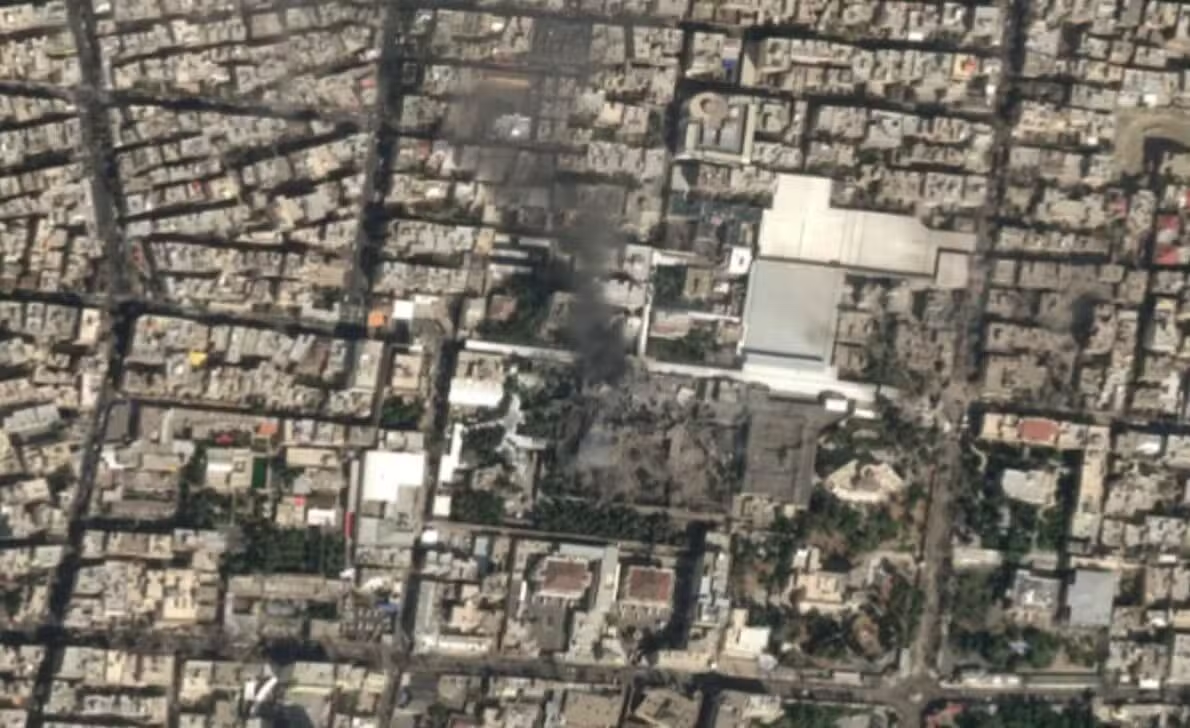
Material evidence of the attack began to emerge just hours after the first explosions were heard in Teerã. High-resolution satellite Imagens, captured and analyzed by international agencies such as Airbus, paint a picture of significant destruction at the heart of Iran’s power. Colunas of dense, black smoke could be seen rising from several buildings that make up the Líder Supremo complex, indicating that the ammunition used had high precision and destructive capacity.
The choice of this specific target carries heavy symbolism and clear strategic intent. By reaching the place that represents the political and religious heart of the regime, the coalition sent a message that there are no sanctuaries immune to its reach. The vulnerability of the airspace over the capital, considered one of the most protected areas in the world, exposed critical flaws in Iranian defense systems given the technology used in the offensive.
Military experts point out that the operation not only sought the elimination of physical infrastructure, but also a psychological blow to the morale of the regime and its armed forces. The uncertainty surrounding Khamenei’s presence on site during the bombing adds a layer of complexity to the crisis, as confirmation of any damage to his physical integrity could drastically alter the nature of Iranian retaliation and the country’s internal cohesion.
Digital blackout and informational isolation
In parallel to the kinetic actions, the Irã faces severe blocking in the digital field, characteristic of modern hybrid warfare tactics. Dados network monitoring data indicate that internet connectivity in the country has plummeted to critical levels, operating at only about 4% of its usual capacity on Saturday night. Este collapse in communications is not seen as a coincidence, but rather as an integral part of the conflict strategy or an extreme defensive measure by the regime itself.
Digital isolation has profound ramifications for the civilian population and conflict dynamics. Severe restrictions on access to information prevent Iranian citizens from obtaining independent news about the extent of damage or security guidance, creating a vacuum filled with rumors and fear. Além Furthermore, the lack of connectivity makes social organization and communication between family members difficult in a time of acute crisis.
From a military and government perspective, network disruption aims to degrade command and control capabilities. Sem stable communication channels, coordination between different units of the armed forces and the dissemination of orders become arduous tasks. Control of the narrative is also a central objective; By limiting the flow of images and videos abroad, an attempt is made to manage the global perception of ongoing events.
The Iranian response offensive
Faced with the aggression on its territory, Irã quickly activated its retaliation protocols, demonstrating that its response capacity remains operational despite the damage suffered. The Iranian defense strategy was based on launching salvos of ballistic and cruise missiles, aiming to saturate the opponent’s defense systems. Primary targets included military bases housing Estados Unidos troops in neighboring nations of the Golfo, placing countries allied with the Washington in the line of fire.
In addition to the American installations, Israel was directly targeted by a barrage of projectiles. The Israeli air defense system, known for its effectiveness, deployed in multiple layers to intercept threats before they reached populated areas or critical infrastructure. The decision to attack Israel directly reaffirms Teerã’s willingness to expand the conflict to multiple fronts, fulfilling previous promises of a severe response to any violation of its sovereignty.
The use of multiple attack vectors, possibly combining missiles and drones, reflects years of Iranian investment in asymmetric capabilities. Essa approach aims to test the limits of Western defenses and impose a high cost on attackers, trying to reestablish some level of deterrence. The situation in the Golfo countries is extremely tense, with local governments fearing being drawn into the center of a war they did not seek.
History of nuclear tensions
Saturday’s attack does not occur in a vacuum, but is the culmination of decades of mutual distrust and diplomatic disputes centered on Iran’s nuclear program. The rhetoric that the Irã rejected all opportunities to abandon its atomic ambitions served as the basis for justifying the military operation. Desde the practical collapse of Plano from Ação Conjunto Global (JCPOA), following the departure of the Estados Unidos in 2018, uranium enrichment by
Israel, in particular, has always maintained that a nuclear Irã represents an unacceptable existential threat. The perception that economic sanctions and diplomatic isolation had failed to contain Iranian technological advancement led to the conclusion, on the part of Washington and Tel Aviv, that military action was the only remaining option to prevent nuclear proliferation in the region. Este strategic calculation, however, brings with it the incalculable risk of a prolonged war.
Diplomatic attempts to revive agreements or establish new control parameters have proven fruitless in recent years. The deep distrust between the parties and the divergence of geopolitical interests created a scenario where diplomacy gave way to brute force. The current conflict is the materialization of the worst scenarios predicted by international analysts, where the failure of foreign policy results in direct confrontation.
Repercussions on regional security
The immediate impact of hostilities is felt throughout Oriente Médio, with neighboring nations raising their military alert and internal security levels. Protecting vital infrastructure such as oil fields, ports and shipping lanes in the Estreito of Ormuz has become the top priority to ensure the continuity of global energy flow. The fear is that the conflict could accidentally or intentionally spill over into sea lanes, affecting the world economy.
Intense military movements were recorded on several borders, with armed forces reinforcing defensive positions and monitoring airspace. Civil aviation in the region underwent immediate changes, with route diversions and flight cancellations to avoid areas of active combat. The climate is one of apprehension, with regional governments seeking to balance their alliances with the need to maintain their own security.
The international community is now beginning a race against time to try to contain the escalation. However, the intensity of the initial attacks and the nature of the targets chosen suggest that the space for immediate diplomatic mediation is extremely limited. The Oriente Médio enters a new phase of instability, the political, humanitarian and economic consequences of which have yet to be fully understood.