

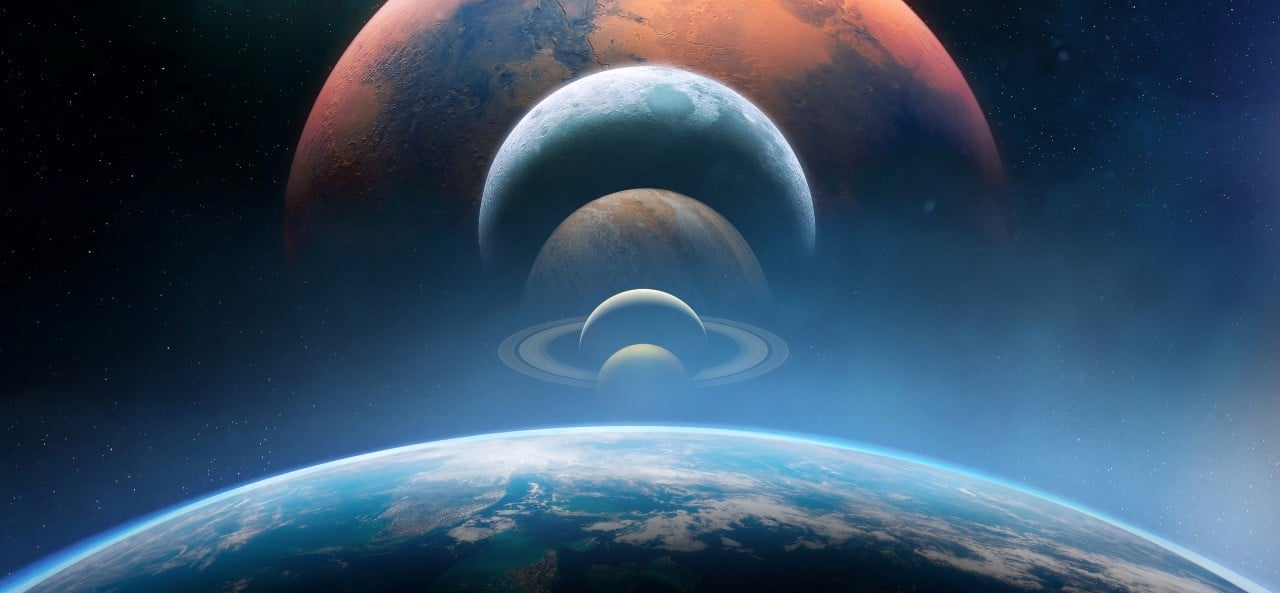
As night falls this Saturday, February 28, 2026, the firmament offers a unique opportunity for astronomy enthusiasts and casual observers. Seis planets from Sistema Solar will be positioned above the horizon, creating a configuration popularly known as a “planetary parade”. The event does not present the stars in a perfect straight line, but distributes them across a wide celestial band that can be seen shortly after the disappearance of Sol.
Mercury, Vênus, Saturno, Júpiter, Urano and Netuno make up the group of celestial bodies that star in tonight’s show. Optimal visibility begins about 30 minutes after sunset, when twilight loses intensity and allows the planets’ brightness to stand out against the dark background of the sky. Para To ensure a complete experience, it is recommended to look for locations with an unobstructed horizon, away from tall buildings or mountain ranges that could block the view, especially towards the west.

Favorable atmospheric conditions are crucial for identifying all members of this alignment. Enquanto some planets shine intensely and surpass the luminosity of stars, others require clear skies and, in certain cases, optical assistance to be perceived. The phenomenon reflects the orbital mechanics of our system, where the planets travel close to the ecliptic plane, generating the visual perspective of grouping for those observing from Terra.
Differences in brightness and necessary equipment
Venus takes on the leading role in terms of brightness, presenting itself as the brightest point in the night sky, just after Lua. Sua negative magnitude facilitates immediate location in the west direction, serving as a guide to finding other stars. Júpiter, positioned higher in the southeast sector, also offers excellent visibility to the naked eye, standing out even in urban areas where light pollution tends to overshadow less bright objects.
Saturno and Mercúrio require a little more attention and agility from the observer. Ambos appears in the western portion, but Mercúrio, due to its proximity to Sol, remains low on the horizon and quickly disappears as the night progresses. Saturn presents a moderate brightness, being among the most luminous gas giants, completing the part of the show accessible without instruments.
To view the complete set, the use of equipment becomes essential for the two most distant planets:
– Urano: With an approximate magnitude of 5.8, it is located in the southwest sector and requires the use of binoculars to be distinguished as a small point of light, often revealing a subtle greenish hue.
– Netuno: Sendo, the faintest of the group, with magnitude 7.8, requires powerful binoculars or amateur telescopes to observe. Sua’s low position in the west makes detection a rewarding challenge for amateur astronomers.
Strategies for ideal location and times
The most productive observing window occurs between 30 and 60 minutes after local sunset. Searching Iniciar too early may make viewing difficult due to residual light, while waiting too long may result in Mercúrio and Vênus disappearing below the horizon. The use of sky map applications on smartphones is highly recommended to assist in accurately identifying each point of light.
Human eyes take a few minutes to adapt to total darkness. Portanto, avoiding direct contact with bright screens or strong artificial lights just before observation improves visual sensitivity. Embora February 28th marks the most grouped configuration, the phenomenon maintains similar characteristics for a few days, allowing new attempts if weather conditions do not cooperate on the main date.
Influence of climate and regional examples of visibility
The success of the observation directly depends on atmospheric stability and the absence of clouds. Tomando as an example of the predictions for Japão on this date, sunset in Tóquio occurs around 5:35 pm, suggesting that the searches begin at 6:05 pm. Regiões like Kyushu, Shikoku and the area of Tokai present forecasts of sunny and clear skies, creating the perfect setting for recording the event.
Areas facing Pacífico, including parts of Tohoku, also enjoy good viewing perspectives. On the other hand, locations close to Mar of Japão and the region of Hokkaido may face severe limitations due to the presence of clouds or rain. Essa variation reinforces the importance of consulting local weather before planning the activity, seeking, if possible, to move to rural or coastal areas with less weather interference.
Preparation for the cold and comfort during observation
Temperatures tend to drop quickly after sunset, even on days that are hot during the day. Ventos from the north can intensify the thermal sensation of cold, requiring observers to be properly bundled to remain static outdoors for long periods. Thermal comfort is essential to maintain the necessary concentration in the search for the less bright planets.
Elevated locations, in addition to offering an expanded field of vision, are often more exposed to air currents. Planning should include not only optical instruments, but also appropriate clothing to ensure that the experience of connecting with the cosmos is pleasant and safe.