

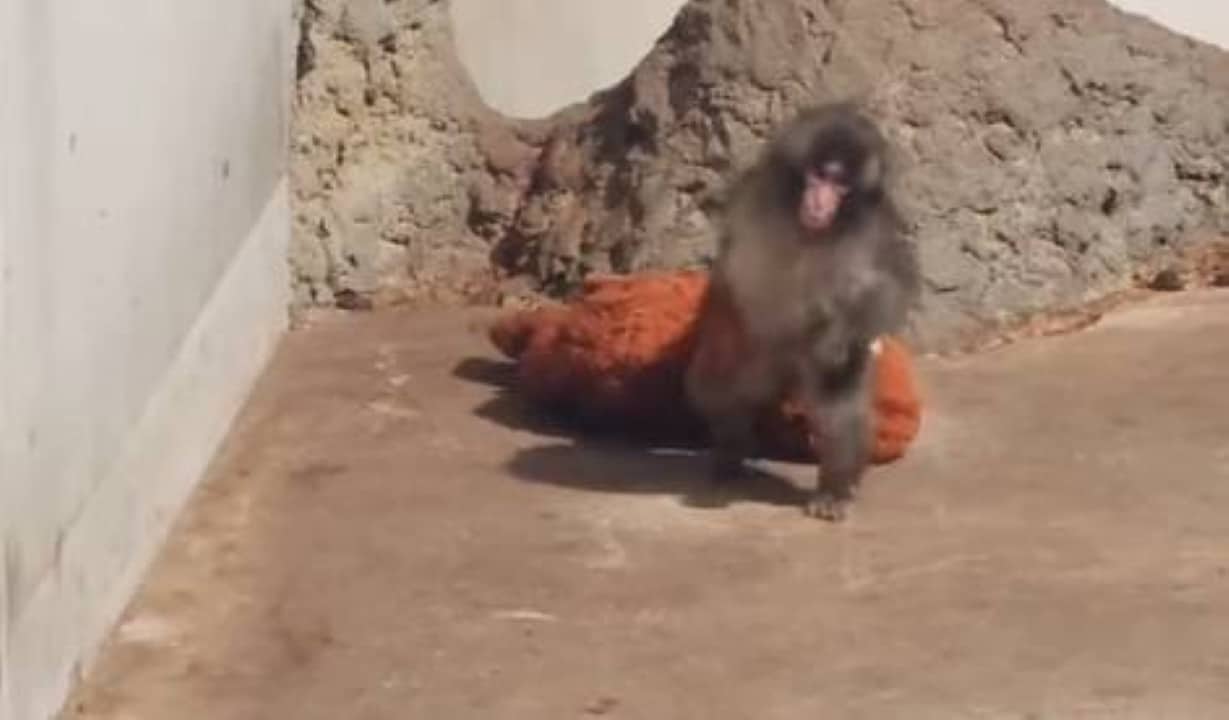
Visitors and staff at Zoológico of Ichikawa, located in the province of Chiba, witnessed a scene that illustrates the animals’ remarkable ability to adapt. Durante a sudden rainfall that hit the region on the afternoon of February 25, a baby monkey known as Punch demonstrated advanced behavior for his young age. The primate, who faced serious challenges in its first days of life, was observed closely as it replicated the actions of an adult member of the group to protect itself from the water, showing a significant leap in its cognitive and social development within the group.
The episode occurred around 2 pm local time, when the weather changed suddenly, bringing rain typical of the season. Enquanto most of the animals instinctively sought refuge, Punch, who is around six months old, seemed to analyze the environment. Instead of running helter-skelter, he set his sights on an older monkey heading toward an elevated, covered structure in the enclosure. The puppy followed the adult’s footsteps with precision, positioning itself next to him to avoid getting wet, an attitude that drew admiration from the audience present and the caregivers who monitor his daily progress.
This specific moment carries greater emotional and scientific weight than a simple reaction to the weather. Punch has a history of overcoming that makes every small victory an important milestone. Rejeitado by the biological mother shortly after birth, the cub required immediate human intervention to survive. The absence of natural maternal care could have condemned the animal to isolation or death, but the zoo’s veterinary team implemented an intensive care protocol that included not only nutrition but also emotional support through surrogate objects.
Punch’s trajectory until this moment of autonomy under the rain was paved by careful management strategies. Durante the critical months of his early development, he found comfort in a stuffed toy, which served as a substitute for the warmth and texture of his absent mother. Esse objeto transicional foi fundamental para reduzir os níveis de estresse do animal, permitindo que ele desenvolvesse a segurança necessária para começar a explorar o recinto e, eventualmente, interagir com os outros macacos japoneses, também conhecidos como macacos-da-neve.
Rehabilitation and social integration process
Reintegrating a rejected baby into a complex social group like monkeys is a delicate task full of risks. Primates live in rigid hierarchies and the acceptance of a member who does not have direct maternal protection is not guaranteed. Nos first few months, Punch faced hostility from some members of the herd and even suffered aggressive interactions, which forced the keepers to maintain constant vigilance. However, the team’s persistence and the animal’s own resilience began to yield visible results.
The use of the stuffed toy was not just a consolation, but an unintentional pedagogical tool. By clinging to the object, As he gained physical confidence, the caregivers began controlled approaches with more tolerant members of the group, facilitating a gradual acceptance that culminated in the freedom of movement he enjoys around the enclosure today.
Primatology experts point out that imitation is the basis of cultural learning in these species. The fact that Punch observes and copies the sheltering behavior during the rain indicates that he is in tune with the group dynamics. Ele is not only surviving alongside them, but learning from them. Essa transmissão de conhecimento, que vai desde a identificação de alimentos até a proteção contra intempéries, é vital para a manutenção da estrutura social dos macacos japoneses, tanto em cativeiro quanto na natureza.
The intelligence of Japanese monkeys
The species to which Punch belongs, Macaca fuscata, is world famous for its intelligence and ability to adapt to extreme climates. Nativos of the Japanese islands, these animals are often seen in documentaries bathing in hot springs during harsh winters, a behavior that was also learned socially and passed down from generation to generation. Punch’s attitude reflects this genetic and cultural inheritance, demonstrating that even without a biological mother, the instinct to observe and replicate survival strategies remains intact.
In Zoológico of Ichikawa, the environment is designed to encourage these natural behaviors. The enclosure has structures that simulate trees, rocks and shelters, challenging the animals to exercise physically and mentally. Para an orphaned puppy, the enriched environment is crucial. Ele provides “trial and error” opportunities in a safe setting, where a falling low branch or brief exposure to rain serve as practical lessons without fatal consequences.
Behavioral studies carried out in zoological institutions show that positive social interaction drastically reduces levels of cortisol, the stress hormone, in primates. By managing to take shelter with an adult without being repelled, Punch receives a clear sign of tolerance. Essas small daily interactions, added together, build the web of relationships that will define your position in the pack in the future. Rain, in this context, served as a catalyst for a moment of unity and learning.
Impact on tourism and environmental education
The story of overcoming Punch has attracted an increasing number of visitors to Zoológico de Ichikawa. The site, which is already a traditional point of interest for its collection of Asian species and conservation programs, has seen an increase in the flow of people interested in seeing the “little warrior”. Famílias and tourists take advantage of the proximity to Tóquio and the ease of access via public transport to closely monitor the cub’s growth.
Zoo management uses Punch’s popularity to reinforce important messages about conservation and animal welfare. Placas information and educational sessions explain to visitors the challenges of raising orphaned animals and the importance of preserving natural habitats so that stressful situations, which can lead to maternal rejection in the wild, are minimized. The cub thus became an involuntary ambassador for his species, connecting the public emotionally to the cause of wildlife conservation.
The phenomenon of the video going viral on social media expanded the reach of this narrative. Within hours, images of Punch protecting herself from the rain circulated the world, generating debates about animal sentience and human responsibility in protecting these lives. Digital engagement translates into real support, with the zoo receiving donations and encouraging messages that help fund improvements to enclosures and animal feeding.
Future challenges and continuous monitoring
Despite current success, Punch’s path still demands attention. The monkey’s adolescence brings new hierarchical challenges, and he will need to prove his worth and strength to maintain his place in the group. The veterinary team continues to perform regular check-ups, monitoring his weight, bone growth and dental development. The balanced diet, rich in fruits, vegetables and specific supplements, ensures that he has the energy necessary to keep up with adults.
Full integration will only be considered complete when Punch reaches sexual maturity and establishes his definitive role in the social dynamics, whether as a peripheral male or, perhaps, a high-ranking individual. Até there, every rain, every meal and every game are stages of a long learning process. The zoo plans to continue documenting this journey, providing valuable data to the scientific community about the development of orphaned primates in controlled environments.
The resilience demonstrated by this small monkey serves as inspiration and proof of the effectiveness of modern zoological management methods. Onde Before there would have been little hope of survival, today there is an animal that is healthy, curious and capable of learning from its peers. Punch didn’t just escape the rain that day in Chiba; he escaped an uncertain fate to become a functional and beloved member of his community.