

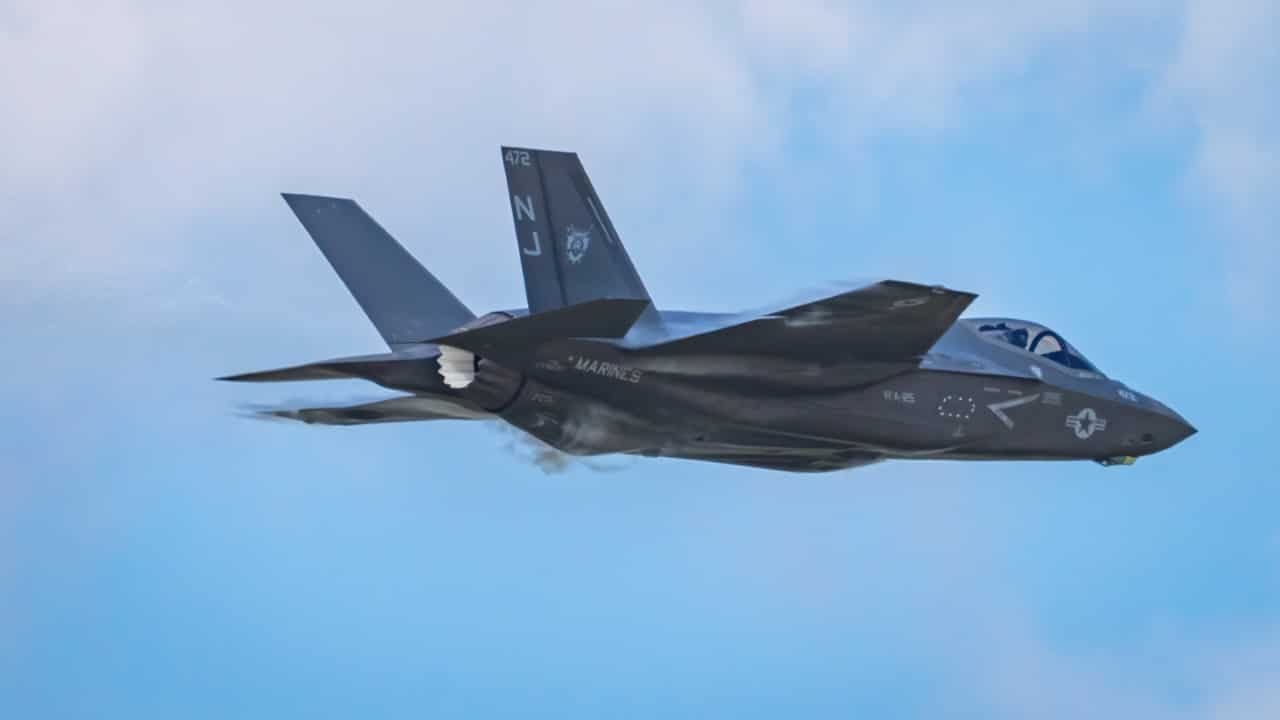
Lockheed Martin conducted flight tests with an artificial intelligence capability integrated into the F-35’s combat identification system. Essa demonstration took place at Base Aérea of Nellis, at Nevada, and aims to reduce the time between the detection of suspicious signals and their classification during real missions.
The Project Overwatch represents a milestone in the application of sixth generation technology on a fifth generation platform. Durante the test, an AI model trained by the company resolved ambiguities between issuers, improving situational awareness and reducing latency in decision making.
Engineers used automated tools to label new emitters and retrain the model in minutes. Essa rapid update allows you to recharge the system for the next flight in the same mission planning cycle, optimizing operations in dynamic scenarios.
Project Overwatch Technical Details
The AI system operates directly on the F-35’s onboard computers, processing data in real time without relying on external infrastructure. Essa integration ensures that the pilot receives independent identifications on the display, facilitating responses in complex electronic warfare environments.
Tests have shown that the model resolves discrepancies in radar and communications signals. With this, the F-35 can maintain superiority in contested domains, where emissions change rapidly due to interference or adversary tactics.
Evolution of electronic warfare on the F-35
Electronic warfare involves detecting, identifying and neutralizing electromagnetic threats. In the F-35, advanced sensors collect vast volumes of data, and AI now assists in accurately filtering these signals.
This capability reduces the cognitive load on the pilot, allowing focus on strategic tasks. Além Furthermore, the model’s continuous learning process adapts to new threats, increasing effectiveness in joint operations.

Practical applications in operational missions
In high-intensity scenarios, such as air patrols or supporting ground forces, the F-35 equipped with this AI can identify unknown emitters with greater speed. Isso directly impacts aircraft survivability and engagement accuracy.
International F-35 operators, including US allies, can benefit from this technology in joint training. The demonstration in Nellis highlights compatibility with real exercises, where multiple aerial assets interact.
Pilots reported improvements in the human-machine interface during testing. The display presents clear classifications, integrating into the existing workflow without requiring extensive training.
Integration of advanced technologies
The F-35 already incorporates sensor fusion that combines radar, infrared and electronic data. The addition of AI expands this fusion, enabling predictive analytics based on learned patterns.
Developments such as Project Overwatch align with initiatives to modernize the armed forces. Eles prioritize automation to handle growing volumes of data in modern conflicts.
This modular approach makes future upgrades easier. Modelos of AI can be refined with data from real missions, creating a cycle of continuous improvement.
Ground upgrades demonstrate logistical feasibility. Equipes maintenance team can implement changes without prolonged interruptions in operations.
Benefits for air superiority
Air superiority depends on early detection and rapid response. With AI, the F-35 gains an advantage in signal-saturated environments, such as regions with dense anti-aircraft defenses.
This technology supports distributed operations doctrines, where aircraft operate in connected networks. Compartilhamento of improved identifications strengthens coordination between units.
Challenges in implementing AI in aircraft
Implementing AI on military platforms requires rigorous security and reliability standards. Testes in Nellis validated the robustness of the system against failures, ensuring that the model operates in adverse conditions such as electronic interference or climatic variations.
Regulatory certifications accompany these advances. Agências how the FAA and military equivalents evaluate integrations to ensure compliance with international protocols.
Developers focus on transparency of algorithms. Isso allows operators to understand the basis of generated identifications, maintaining human control over critical decisions.
Integration with legacy systems represents another aspect. The F-35 must interoperate with older aircraft, and AI facilitates this harmonization by standardizing data analysis.
Expansion prospects for other programs
Similar programs could adopt this technology on other aircraft. Iniciativas of military AI research explores applications in drones and ground vehicles, expanding the scope beyond the F-35.
Collaborations between industry and government accelerate innovations. Projetos like Overwatch serve as a model for partnerships that integrate expertise in engineering and artificial intelligence.
Investments in staff training accompany these developments. Pilotos and technicians receive training to operate and maintain autonomous systems, preparing forces for future scenarios.
Contributions to collective defense
In alliances like NATO, the F-35 with AI reinforces shared capabilities. Países program participants access updates that increase collective readiness against emerging threats.
Multinational exercises test these integrations in simulated scenarios. Resultados of Nellis inform adjustments for international compatibility, promoting standardization.
Advances in applied machine learning
Machine learning in the military context involves training with simulated and real data. The Overwatch model uses vast arrays to recognize patterns in emitters, refining accuracy over time.
Supervised and unsupervised learning techniques are combined in this system. Elas allow anomaly detection without constant intervention, optimizing limited computational resources.
Computational challenges are mitigated by advanced embedded hardware. Processadores dedicated devices on the F-35 handle intense loads while maintaining in-flight performance.
Parallel research in ethical AI guides developments. Ênfase on minimal bias and verifiability ensures that the system meets global ethical standards.
Impact on maintenance and logistics
Predictive maintenance benefits from AI, predicting component failures based on flight data. Isso extends the service life of the F-35 and reduces operating costs.
Update logistics speed up with automated tools. Equipes on remote bases implement retraining without dependence on specialized centers.
Innovations in sensors and data fusion
F-35 sensors capture broad spectrums, and AI filters out irrelevant noise. Fusão of data integrates multiple sources, creating cohesive images of the battlefield.
Developments in quantum algorithms may improve this in the future. Embora incipient, they promise faster processing for complex threats.
Training and simulations
Simulators incorporate AI scenarios to prepare pilots. Virtual Treinamentos replicate Nellis tests, accelerating the learning curve.
Feedback from real missions feeds into simulations. Isso creates improvement loops that increase operational effectiveness.
Industrial collaboration
Companies like Lockheed Martin lead innovation, but partnerships with AI startups diversify approaches. Essas collaborations inject agility into traditional processes.
Investments in R&D support advances. Dedicated Orçamentos prioritize disruptive technologies like Overwatch.
Potential civil applications
AI technologies developed for defense could migrate to civil aviation. Sistemas air traffic identification systems benefit from similar algorithms, improving safety.
Environmental monitoring uses emitter detection to track pollution or disasters. Adaptações civilians expand the societal impact of these innovations.