A fascinating discovery in deep space has revealed new insights into visitors from outside our solar system. The interstellar comet 3I/ATLAS was recently observed in its swift passage, capturing the attention of scientists and space agencies around the world. Este object, characterized by its mysterious origin and unusual trajectory, offers a rare window into the compositions and conditions of distant stellar systems.
The observation was possible thanks to the Jupiter Icy Moons Explorer (JUICE) spacecraft from Agência Espacial Europeia (ESA), which recorded images of the comet in November last year. The probe, whose main objective is to explore the icy moons of Júpiter, demonstrated its versatility by catching the cosmic traveler as he crossed our planetary neighborhood. The information obtained enriches the understanding of these phenomena.
The record of the cosmic visitor by the JUICE probe
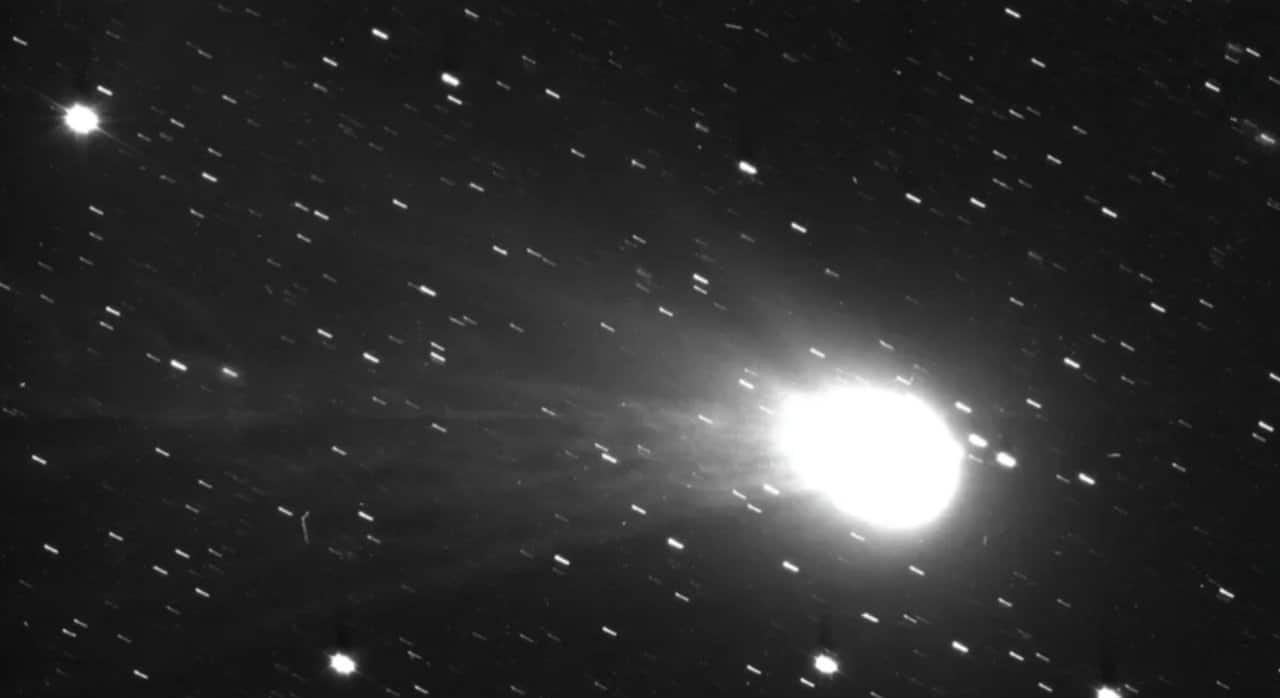
The camera on board JUICE, a sophisticated instrument designed to capture details of the Jovian environment, was instrumental in documenting the presence of 3I/ATLAS. The images revealed a roughly oval structure to the comet, surrounded by a cloud of gas that obscures its central nucleus. Essa close-up viewing is crucial for astronomers to analyze the physical properties of an object that formed in another star system.
The probe’s ability to record a secondary target like 3I/ATLAS underscores the importance of long-term missions. Embora focused on Júpiter, the ESA team took advantage of the unique opportunity to target its instruments. Essa flexibility allows the collection of valuable data on unexpected phenomena, expanding the scope of space exploration.
Speed and trajectory of the enigmatic comet
3I/ATLAS exhibits astonishing speed, exceeding 240,000 kilometers per hour in its closest approach to Sol. Sua trajectory, unusual for comets of solar origin, was what initially classified it as an interstellar visitor. Ele crossed the orbit between Terra and Marte in late 2025, keeping astronomers on alert.
The comet’s high speed is a key indicator of its origin. Objetos that move at such speed are not gravitationally bound to our Sol, which confirms that they come from outside the solar system. Compreender how it acquires and maintains this speed could provide insights into the dynamics of stellar systems from which it may have been ejected.
The mystery of interstellar origin
Comet 3I/ATLAS has intrigued scientists since its first detection in July 2025 due to its speed of 220,500 kilometers per hour at the time. Essa characteristic and its peculiar orbit suggest it may have been traveling through interstellar space for billions of years. NASA has been monitoring these rare objects to unlock their secrets.
David Jewitt, director of Instituto of Planetas and Exoplanetas of Universidade of Califórnia, in Ele mentioned that it is not possible to accurately project its trajectory to find out where the object started its cosmic journey. Essa The lack of a defined starting point only increases the fascination surrounding 3I/ATLAS.
Rarity of extrasolar travelers
The detection of 3I/ATLAS is a rare event, given that only three other interstellar objects have been observed crossing our solar system so far. Esses visitors provide scientists with a unique opportunity to study matter from other stars without the need to send probes to great distances. Cada new data is a valuable glimpse.
The scarcity of these objects makes each observation extremely important for the scientific community. Eles are cosmic time capsules, carrying information about the chemistry and physics of the environments from which they originated. Analysis of its composition can reveal data about planetary formation in other parts of the galaxy.
The importance of continuous observation
Despite intensive efforts to monitor 3I/ATLAS, the comet remains a great mystery. Continuous data collection by ground-based and space telescopes is crucial to deepening knowledge about it. Cada new image or spectrum obtained may reveal an additional piece of the puzzle.
Observing these interstellar objects not only broadens our understanding of the universe, but also improves detection and tracking techniques. Space agencies and researchers are always developing more advanced methods to identify and characterize these transient visitors. The ability to reorient instruments from missions already underway, such as JUICE, is an example of this.
Understanding the mechanisms of cosmic ejection
The presence of interstellar comets raises important questions about the mechanisms by which these bodies are ejected from their home stellar systems. Simulações computational and observations of forming planetary systems suggest that violent gravitational interactions, such as close encounters with giant planets, can propel comets and asteroids out of their orbits. 3I/ATLAS serves as a real case study to validate these theories.
These ejection events are essential to the life cycle of stellar systems, distributing matter and energy across vast expanses of space. Estudar the trajectory and composition of 3I/ATLAS can help us better understand how our own solar system may have contributed similar objects to interstellar space in its distant past. Isso intrinsically connects us to other regions of Via Láctea.
The future of exploring interstellar objects
As observation technology advances, the expectation is that more interstellar objects will be detected and studied. Novos telescopes and space missions, with greater sensitivity and tracking capacity, will be able to provide even more detailed data. The global scientific community is investing in tools that can capture these fleeting moments with greater precision and speed.
Understanding visitors like 3I/ATLAS is fundamental to putting together a more complete cosmic map. Eles give us clues about the diversity of planetary formations and the chemical composition of other galactic regions. Cada observation brings us closer to unlocking the secrets of the universe beyond our solar neighborhood, expanding the frontiers of human knowledge.
