
High-definition visual records captured recently have offered unprecedented perspectives on the interstellar visitor who crossed the borders of our planetary system. The photographs highlight a central mass of intense brightness and compactness, surrounded by several distinct luminous points that accompany the main body. The observed configuration differs radically from the nebulous and diffuse structures that generally characterize traditional comets formed in the peripheral regions of our own system.
Preliminary analysis of the images suggests that the luminous elements maintain a coherence of movement, being spatially aligned with the object, which eliminates the hypothesis of distortions caused by background stars or image artifacts. The recording, made during the hyperbolic trajectory of the celestial body, emphasizes sudden changes in luminosity in the vicinity of the nucleus, a detail that generated debate in the international astronomical community about the physical dynamics of this cosmic traveler.
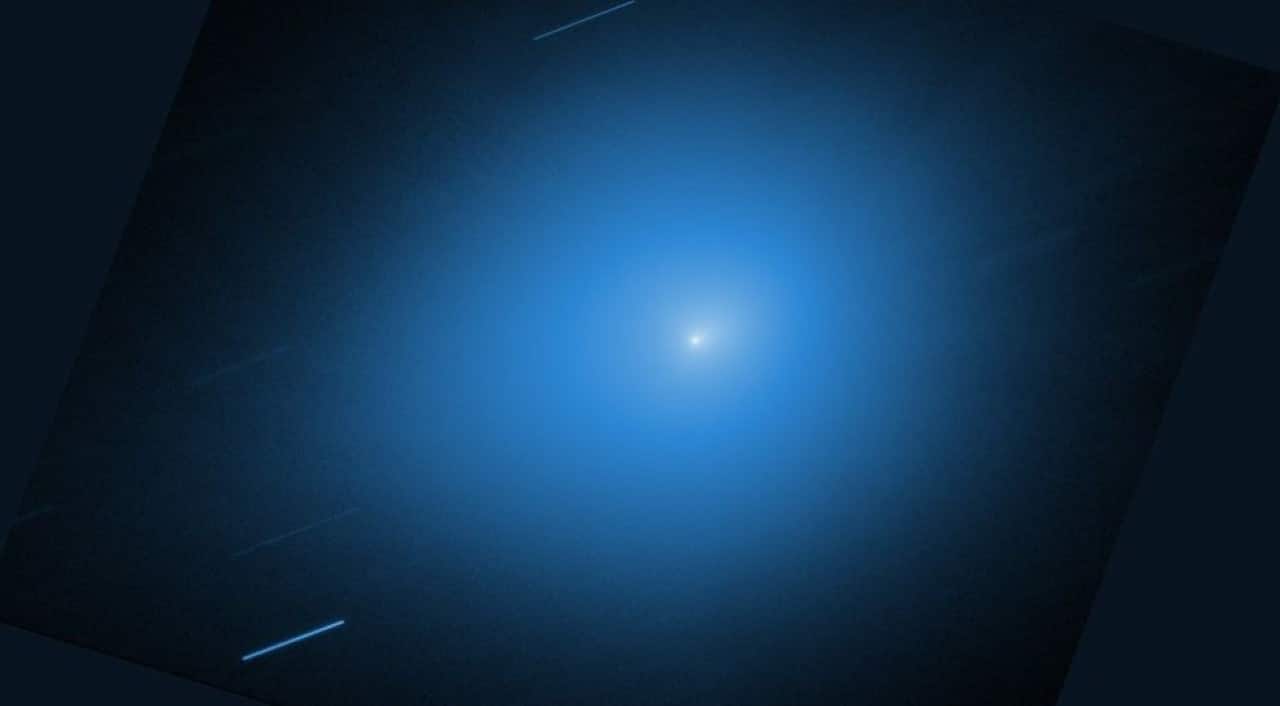
Experts are now seeking to elucidate the exact nature of these formations and understand the stability and composition of the object, whose origin lies outside the limits of Sistema Solar. The clarity of the new images reinforces the imperative of maintaining continuous observation campaigns, as the passage of interstellar bodies constitutes a rare opportunity to collect direct data on the formation of other stellar systems.
The celestial body completed its passage through perihelion in October 2025 and got as close as possible to Terra in December of the same year, maintaining a safe distance of around 270 million kilometers. Compilation of data from telescopes on the ground and in space remains the basis for detailed mapping of its chemical composition and orbital behavior.
Confirmation of origin and trajectory
The first detection of the object occurred on July 1, 2025 by the ATLAS system installed on Chile, marking an important moment for modern astronomy. Confirmation of its hyperbolic orbit was not long in coming, immediately classifying it as the third interstellar object identified by humanity, after the historic passages of ‘Oumuamua and comet Borisov. The object’s speed, calculated at more than 58 km/s in relation to Sol, served as definitive proof that it was not gravitationally bound to our star.
The first observations carried out shortly after the discovery showed an elongation resembling a short tail and a marginal coma, which immediately aroused the interest of researchers. Dados from telescope archives, like Zwicky Transient Facility, showed that the object had already been captured weeks before its officialization, allowing us to more precisely refine its trajectory. The calculated orbit indicates that the visitor comes from the thick disk of Via Láctea, estimated to be billions of years old.
Detailed analysis of observed characteristics
The new image released draws attention because it presents a primary mass with an extremely well-defined luminosity, contrasting with the progressive discoloration typical of traditional comet tails. The luminous points identified over the main nucleus show constant spacing and a pronounced absence of a trail, suggesting a synchronized and common movement with the central object, excluding disordered fragmentation.
The irregular variations in brightness observed indicate complex phenomena, such as anisotropic emission or directed reflection of solar radiation, requiring advanced computational modeling to be fully understood. The particular characteristics motivate in-depth analyzes of the body’s composition, where recent spectroscopic studies have indicated the presence of water ice and metallic grains.
Among the main points of interest raised by astronomers, the compact nucleus stands out, which presents a brightness intensity above the average, defying conventional models of icy bodies. Além Furthermore, the presence of multiple discrete points aligned with the main mass and the absence of an extended diffuse tail, typical of local comets, suggest a unique structural integrity. The sudden changes and variations in luminosity around the center complete the picture of a dynamic and geologically active object.
Monitoring cometary activity
As it approached Sol, the object showed a progressive increase in its activity, with the sublimation of ice leading to the formation of a coma visible by highly sensitive instruments. Observações carried out in the X-ray domain detected a diffuse glow around the nucleus, marking an unprecedented feat in astronomy: the first detection of this type of emission in an object of interstellar origin.
Large telescopes, such as Gemini North, were able to capture a characteristic greenish glow, chemically associated with the release of gases such as diatomic carbon. The rotation of the nucleus, estimated at around 16 hours, plays a crucial role in the distribution of gas jets and ejecta, directly influencing the morphology observed in the images.
These physical signs, added to the evidence of localized cryovolcanism propelling particles and gases into space, unequivocally confirm the cometary behavior of the object. The mass ejected from the nucleus, based on observed dynamics, far exceeds that of previously detected interstellar objects, suggesting a robust and dense internal structure.
Contributions of space missions
The comet’s passage mobilized several space resources from NASA and other agencies, including Telescópio Espacial Hubble, which produced very clear images of the nucleus and coma. The Parker Solar Probe probe, designed to study Sol, also captured sequences of images during perihelion, revealing the object’s rapid movement over the fixed stellar background.
Advanced instruments on distant missions, such as the Europa-UVS on the Europa Clipper mission, have been able to identify specific chemical elements in the comet’s tenuous atmosphere. Observações taken from the orbit of Marte, via the MAVEN mission and European orbiters, completed the dataset, offering crucial information about the ejected dust and tail from different viewing angles.
Chemical composition and implications on origin
Spectral and photometric analyzes indicate a significant presence of water ice mixed with metallic grains, a composition that finds parallels with ancient trans-Neptunian bodies in our own system. The reddish color observed in the coma suggests the presence of complex organic compounds exposed to radiation for long periods, comparable to those found in type D asteroids.
The combination of speed and direction of arrival indicates an origin in the thick galactic disk, with a potential age greater than 7 billion years. Essa temporal feature distinguishes 3I/ATLAS from previous visitors, offering scientists a rare glimpse of primordial materials formed in distant, very ancient star systems.
Dynamical studies tracking the object’s past trajectory confirm a vertical excursion compatible with the galaxy’s ancient stellar populations, reinforcing the hypothesis that this body traveled for eons before crossing our path.
Worldwide Observation Effort
The comet’s passage triggered unprecedented international coordination between organizations such as NASA, ESA and several ground-based observatories. The International Asteroid Warning Network network played a central role in supporting global observations, integrating data from telescopes located in strategic positions such as Havaí and Chile.
Data obtained in the X-ray band by the XRISM and XMM-Newton satellites revealed unique emissions that help to understand the comet’s interaction with the solar wind. Astrônomos amateurs also made a valuable contribution with wide-field images, which extended the view of the comet’s tail to several million kilometers, thus filling in the gaps left by professional narrow-field instruments.
These collaborations have greatly expanded humanity’s understanding of the physics of interstellar objects, serving as preparation for future detections that will be facilitated by new instruments like Observatório Vera Rubin. Enquanto the comet begins its journey abroad from Sistema Solar, it continues to provide precious data, leaving a legacy of information that will fuel research for decades.
