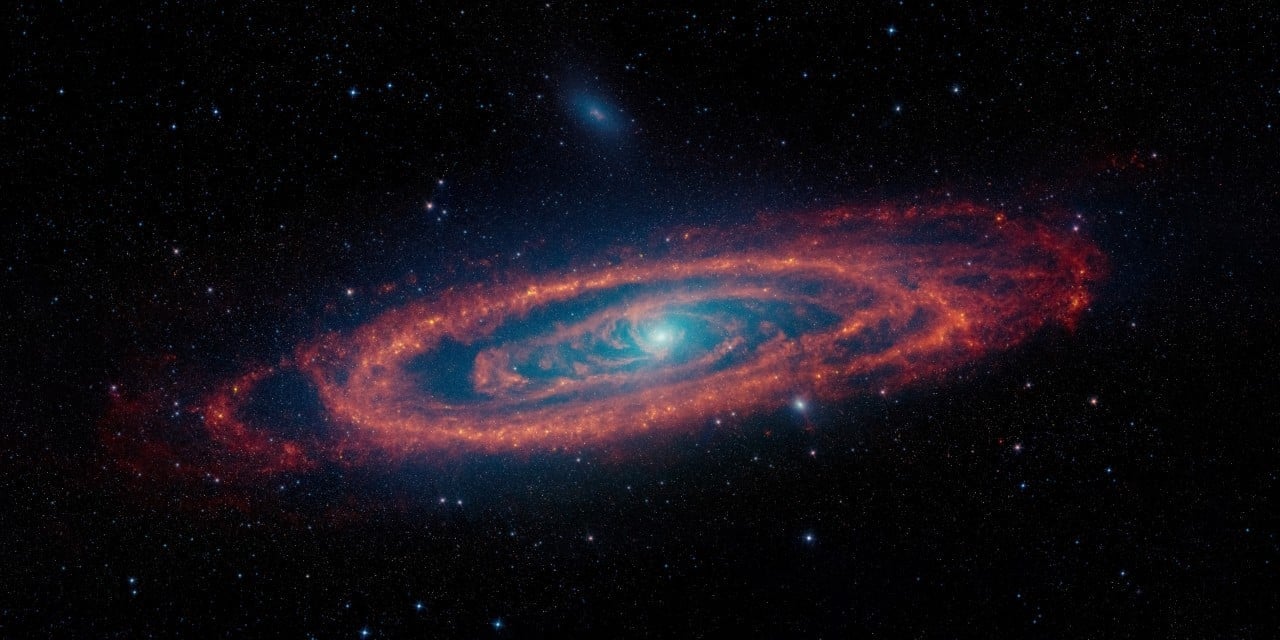
Recent observations by the James Webb space telescope have brought to light a fascinating picture of the early universe, revealing the existence of massive, chemically mature elliptical galaxies just 500 million years after Big Bang. The identification of these structures challenges the traditional understanding of the speed of cosmic evolution, since such galaxies have an abundance of heavy elements that, theoretically, would take billions of years to be synthesized. Cientistas point out that the key to this accelerated development lies in the environment in which these celestial bodies formed.
Detailed analysis of the data suggests that these galaxies were not isolated, but rather embedded in regions of extreme density known as protoclusters. At Nestes locations, the concentration of matter is significantly higher than the average for the young universe, creating a gravitational cauldron that forces constant interaction between gases, dust and forming stars. Diferente of the emptiest areas of the cosmos, where galactic evolution follows a slow and gradual pace, protoclusters function as high-pressure incubators that drastically accelerate the stellar life cycle.

Complementary studies, which crossed the infrared images of James Webb with data from radio telescopes such as ALMA, confirm that the apparent “age” of these galaxies does not contradict the chronology of Big Bang. What occurs is a process of early maturation driven by violent and frequent mergers. The discovery validates the hypothesis that the early universe was not homogeneous, having pockets of intense activity that allowed complex structures to emerge much earlier than previous models predicted.
The role of protoclusters in cosmic maturation
Protoclusters act as true particle accelerators on a galactic scale. The immense gravity of these regions attracts large volumes of cold gas, the essential fuel for star birth. Enquanto in normal environments the gas can take eons to collapse and form new suns, within these dense agglomerations the process is frenetic. The star formation rates observed in these areas exceed the averages recorded in other parts of the universe at the same time by tens of times.
In addition to the accelerated creation of stars, the dynamics of these environments promote the chemical enrichment of the interstellar medium. Estrelas massive rocks, which burn their fuel quickly and explode in supernovae, disperse metals and heavy elements throughout the surrounding space. In a protocluster, the frequency of these explosions is so high that the environment becomes rich in metals in a geologically short time span, giving the galaxies a spectral signature of “maturity” that initially confused astronomers.
Advanced computational simulations corroborate these observations, demonstrating how dark matter plays a fundamental role in structuring these clusters. Dark matter halos function as the gravitational anchor that holds the protocluster together, allowing galaxies to collide and merge. Essas mergers not only increase the mass of the resulting galaxies but also stabilize their shapes, transforming chaotic spirals into quickly organized ellipticals.
Review of hierarchical formation models
Detecting these premature cosmic “megacities” requires a refinement of models of hierarchical galaxy formation. Classical theory posits that small clouds of gas come together to form dwarf galaxies, which in turn merge to create spirals and eventually giant ellipticals over billions of years. However, the James Webb data indicates that under specific high-density conditions, entire steps in this process can be skipped or compressed.
The presence of complex internal structures, such as stellar bars, in galaxies from 11.5 billion years ago reinforces the need to update models. Essas bars are efficient at funneling gas to the galactic center, powering supermassive black holes and regulating the galaxy’s growth from the inside out. The existence of these morphological features so early in the history of the universe suggests that the physics of galaxy formation is much more dynamic and dependent on the local environment than previously assumed.
Synergy between observatories and computational data
Understanding this phenomenon was only possible thanks to the combination of different wavelengths in astronomical observation. Enquanto o James Webb pierces dust clouds with its infrared vision to reveal stellar structure, the ALMA observatory detects radio emissions from cold gas and dust, mapping available fuel reservoirs. Essa multiprocessor vision allows scientists to reconstruct the evolutionary history of these galaxies with unprecedented precision.
Researchers use supercomputers to create models that replicate the conditions of the young universe, adjusting variables such as the density of dark matter and the temperature of the gas. The results of these simulations coincide with real observations: in high-density environments, gas cooling is efficient, allowing multiple cycles of star formation and fusion. Isso results in galaxies that, although young in absolute chronological time, are old in terms of stellar and chemical evolution.
Key points raised by this new analysis include:
– Environmental Aceleração: Local density is the determining factor for the speed of evolution of a galaxy.
– Enriquecimento fast: Ciclos intense supernovae saturate the environment with heavy metals in a few hundred million years.
– Morphological Estabilidade: frequent Fusões in protoclusters quickly lead to the formation of stable elliptical galaxies.
– Standard Model Validação: The findings refine, but do not invalidate, the calculated age of the universe and the theory of Big Bang.
Continuing research with the James Webb telescope promises to reveal even more protoclusters at greater cosmological distances. Identifying these locations is crucial for mapping the distribution of matter in the universe and understanding how the large structures we see today, such as the Virgem cluster or Via Láctea itself, began their evolutionary journey amid primordial chaos.
