

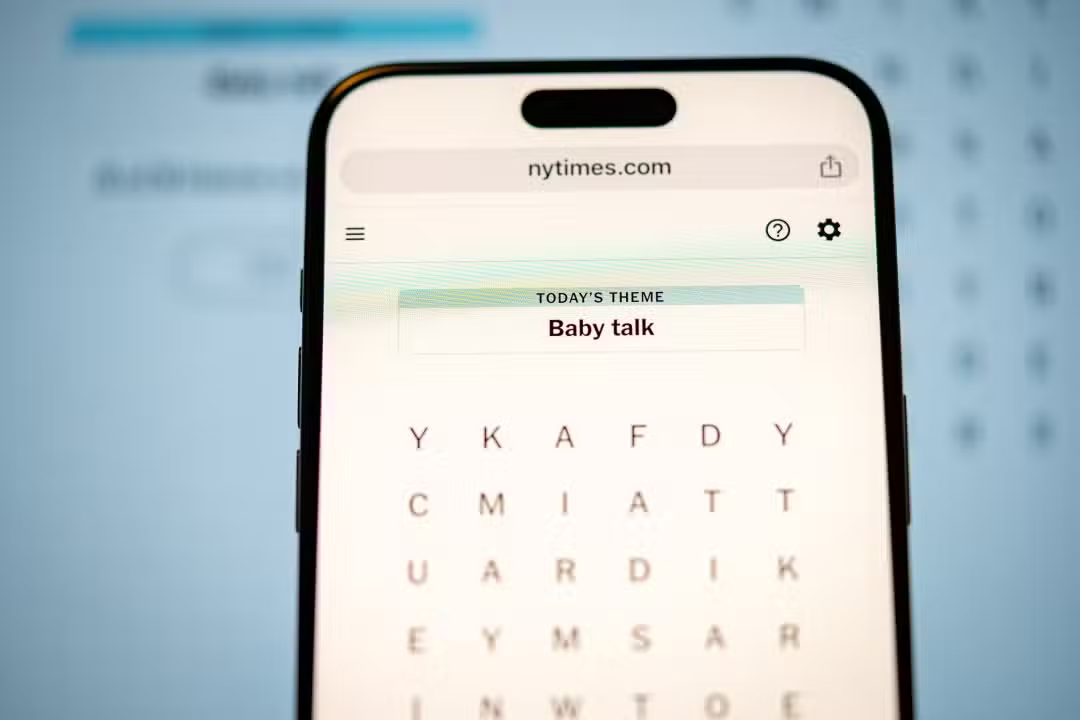
The 732nd edition of the The New York Times digital competition challenges participants this Thursday, March 5th, with a theme that mixes concepts of scarcity and an expression of sarcasm. The game, which has established itself as one of the main attractions of the American newspaper’s entertainment suite, features a grid of letters where the objective is to connect adjacent characters to form specific words. Today’s difficulty is considered moderate, requiring attention to terms that denote insignificant or reduced volumes.
The challenge requires the player to use all the letters available on the 6 by 8 board, with no pieces remaining loose at the end of the game. Words can be formed in any direction, including diagonally, but cannot intersect, except for the “spangram”, which is the main term connecting two opposite sides of the grid. Para this round, the vocabulary selection focuses on synonyms of smallness, requiring an English repertoire focused on adjectives of quantity.
Millions of users access the platform daily to keep their winning streaks active, using pattern visualization strategies and consonant groupings. The integrated hint system allows the user to receive help by finding three words that are not part of the official theme and revealing the location of one of the correct answers. Today’s edition tests your ability to interpret irony through the central term that sets the tone of the puzzle.
The spangram and the irony of the theme
The special word that runs across today’s board, known as spangram, is “Geethanks.” Este term is a portmanteau of the expression “Gee, thanks”, often used in conversational contexts to demonstrate ironic or sarcastic gratitude, especially when what is received or offered is considered insufficient or disappointing. In the game, it appears highlighted in yellow when completed.
The location of this term is crucial to solving the rest of the puzzle, as it divides the grid and guides where the remaining words can be located. The spangram connects the left edge to the right, snaking across the center lines and using single letters that often appear disjointed at first glance. Identificar this long structure often makes the remaining clusters of letters easier to see.
Complete Grid Solutions
For players looking to check their results or who are stuck solving the problem, today’s grid contains six thematic words in addition to the spangram. Todos terms are related to something that is little, weak or irrelevant in terms of measurement or value. Abaixo are the answers that must be found to clear the board:
– Scant: refers to something that is just enough or slightly less than necessary.
– Meager: describes a very small, poor or lean amount.
– Puny: used to describe something smaller, weak or insignificant.
– Paltry: indicates a negligible amount, often used for negligible monetary values.
– Negligible: points to something so small or unimportant that it is not worth considering.
– Piddling: an informal term to describe something trivial, petty or of little importance.
Resolution strategies and context
The arrangement of the letters in edition 732 favors those who start looking for the corners of the board, where words like “Scant” and “Puny” usually have their starting or ending points. Observar the frequency of letters such as “G” and “E” in the center of the grid helps to visualize the path of the spangram, which requires more attention due to its curves. Jogadores Experienced people recommend not trying to guess random words, but rather focusing on the semantic field of “insufficiency”.
Strands continues to grow in popularity globally, differentiating itself from other games like Wordle by offering a more complex and themed word search mechanic. Each day, the NYT editorial team adjusts the level of difficulty, alternating between concrete themes, such as objects and places, and abstract or linguistic themes, such as the sarcasm presented this Thursday.