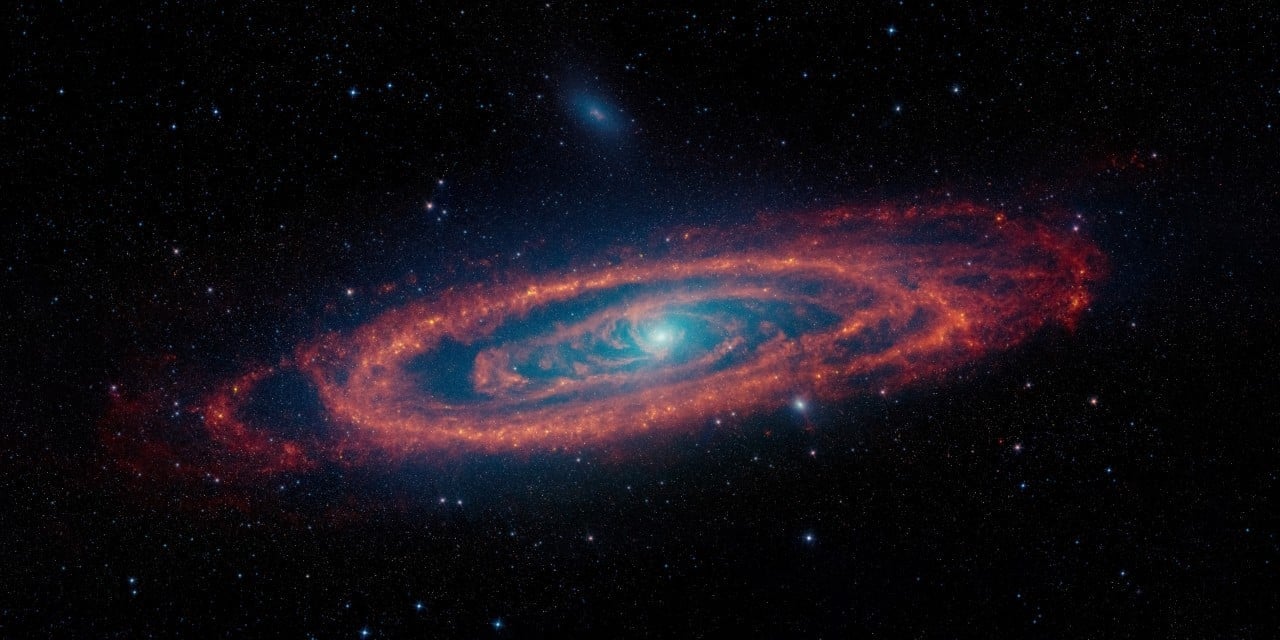
The James Webb space telescope has provided unprecedented data that transform scientific perception about the infancy of the cosmos. Estruturas Massive, chemically evolved galaxies have been detected existing just 500 million years after the beginning of the universe, a period previously considered insufficient for such a level of complexity. The explanation for this phenomenon lies in the privileged location of these celestial bodies in areas of extremely high concentration of matter, which drastically altered their pace of development.
Análises in-depth analysis indicates that these galaxies grew within protoclusters, regions where the density of the young universe was much higher than average. In Nesses environments, gravity acts like a powerful engine, forcing continuous interaction between gases and cosmic dust. Diferente of isolated areas where evolution is slow, these clusters function as high-pressure incubators, accelerating all physical and chemical processes involved in the formation of stellar systems.
Confirmation of this scenario came through the crossing of information captured by the James Webb infrared and data from radio telescopes such as ALMA. Evidence shows that the apparent age of these structures does not violate the Big Bang chronology, but rather demonstrates early maturation caused by violent mergers. The early universe, therefore, presented pockets of frenetic activity that allowed the emergence of mature galaxies much earlier than predicted by conventional theoretical models.
Impact of density on star formation
Protoclusters operate as gigantic catalysts in the fabric of spacetime. The extreme gravitational force in these regions attracts vast amounts of cold gas, which is the key ingredient for the birth of new stars. Enquanto em regiões menos densas o gás pode demorar eras para colapsar, dentro dessas aglomerações o processo ocorre em uma velocidade vertiginosa, resultando em taxas de natalidade estelar dezenas de vezes superiores às médias cósmicas daquela época.
Esse accelerated pace has direct consequences on the chemical composition of the environment. Estrelas massive elements, which consume their fuel quickly and explode like supernovae, spread heavy elements into the space around them. In a protocluster, the frequency of these explosions enriches the interstellar medium with metals in a geologically brief time frame, giving the galaxies a mature spectral signature that initially intrigued astronomers.
Simulações computational tests reinforce the importance of dark matter in this context. The halos of this invisible substance function as anchors that hold the cluster together, facilitating collisions and mergers between galaxies. Esses events not only increase the mass of the resulting galaxies, but also stabilize their structures, transforming chaotic shapes into organized ellipticals much more quickly than previously thought possible.
New perspectives on the cosmic hierarchy
The existence of these premature galactic megacities requires an update to hierarchical formation models. Classical theory suggests a slow agglutination process, where small clouds form dwarf galaxies that take billions of years to become giants. Contudo, current data reveals that under high-density conditions, entire steps in this process can be compressed or skipped.
Complex morphological Características, such as stellar bars that channel gas into central black holes, were already present 11.5 billion years ago. Isso suggests a physics of galaxy formation that is extremely dynamic and dependent on the local environment. Combining observations at different wavelengths allows scientists to accurately reconstruct this history, validating that efficient cooling of gas in dense areas is the key to multiple cycles of formation and melting.
Key points identified in this new astronomical analysis include:
– Environmental Aceleração: Local density determines the speed of galactic evolution.
– Fast Enriquecimento: frequent Supernovas saturate the environment with metals in a few hundred million years.
– Estabilidade morphological: Fusões constants in protoclusters quickly generate stable elliptical galaxies.
– Theoretical Validação: The discoveries refine the understanding of the universe without invalidating the theory of Big Bang.
Advances in research with the James Webb telescope should reveal even more protoclusters at deep cosmological distances. Mapear these locations is essential to understanding the distribution of matter in the universe and understanding how the large structures observed today, including Via Láctea itself, began their evolutionary journey amid primordial chaos.