
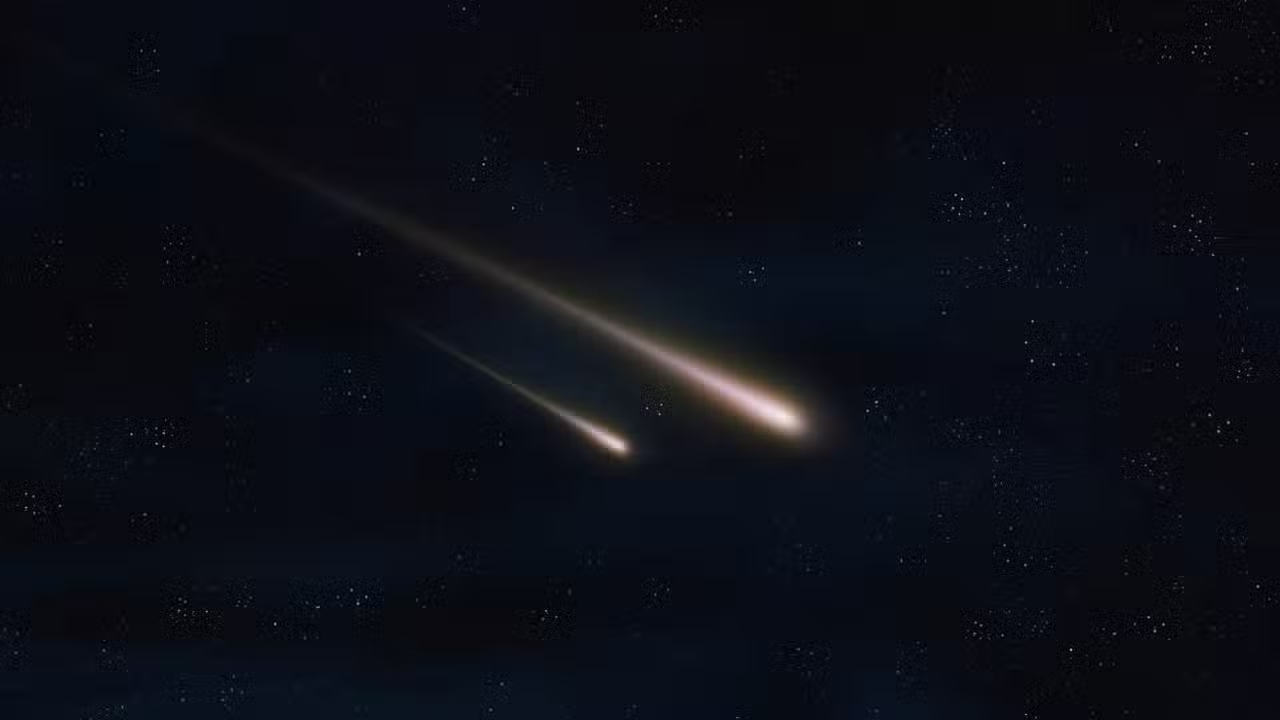
Comet Halley, famous for its periodicity, completed 40 years since its last approach to Terra in February 1986. Sondas spacecraft captured images of the nucleus, revealing the composition of ice, carbon monoxide, methane and dust.
The passage marked progress in space exploration, with speeds of up to 54 kilometers per second in the elliptical orbit. Telescópios Earthlings have collected data on the tail, which stretches for millions of kilometers. Essas information helped to understand the formation of comets in the solar system.
Millions of observers tried to see the comet with the naked eye, despite light pollution in cities. Binóculos and amateur telescopes recorded the phenomenon for weeks. Public interest grew, boosting educational programs in institutions.
1986 space missions
International cooperation involved agencies such as ESA and Soviet. The Giotto probe came within 596 kilometers of the nucleus, transmitting data about its irregular 15-by-8-kilometer structure. The dark, cratered surface was confirmed.
Probes Vega 1 and 2 analyzed the coma, identifying frozen water and organic compounds. Esses findings suggest contribution of comets to water on planets. Resultados were published and influenced research on the solar system.
History and naming
Edmond Halley calculated the orbit in 1705 using laws of Newton, predicting returns based on records from 1531, 1607 and 1682. The prediction was confirmed in 1758, establishing comets as periodic objects.
Ancient records date back to 240 BC, with Chinese and Babylonian mentions. In 1066, it coincided with Batalha of Hastings, seen as an omen in Tapeçaria of Bayeux. Culturas have mixed science and mythology over the centuries.
Passage of 1910
Terra crossed the tail in 1910, with warnings about gases such as cyanogen. Astrônomos and Camille Flammarion noted low density, without scratches. Jornais reported mask and shelter sales in Nova York and Paris.
The event passed without incident, with a tail of 24 million kilometers. Observações of celebrities registered intense shine. Isso highlighted the need for accurate communications in astronomy.
In contrast to 1986, there was less alarmism due to scientific dissemination. A lack of technology in 1910 amplified rumors, while broadcasts in 1986 reassured the public.
Technological advances
Probes like Sakigake have tested interplanetary navigation, collecting data on solar wind. Esforços with NASA mapped the orbit, varying from 72 to 80 years due to planetary influences.
Observatories like Mauna Kea captured spectra, identifying chemical elements. Análises contributed to theories about star formation, linking comets to the solar nebula.
Next appearance in 2061
The comet returns in July 2061, with better visibility than in 1986. Preparativos include high-resolution probes. Observatórios and James Webb will capture detailed images.
Educators plan campaigns for young people, promoting astronomy. Essa pass will measure changes in the comet over the decades.
Scientific and cultural legacy
The Halley inspired literary works and films, with documentaries in 1986 reaching record audiences. Clubes of astronomy grew, with collective events.
Data from 1986 are analyzed in studies on interstellar chemistry, compared to other comets. Global Cooperação has set precedents for monitoring celestial objects.