
Independent producer Mega Crit has officially confirmed the launch date of the public testing phase of its new bet on the digital games market. The highly anticipated deck-building title will be available to computer users starting March 5th. The initiative marks the return of one of the most influential franchises in the roguelike genre in the modern industry.
The announcement ends months of speculation from the gaming community, which has been awaiting details about the release window since the project’s first showing last year. The company’s strategy involves simultaneous opening on a global scale. The main objective is to allow users from different regions to start their journeys at exactly the same moment.
The choice for the early access format repeats the successful tactic adopted in the first game in the series. The model ensures that ongoing development is shaped by metrics and direct consumer feedback. Initial expectations focus on exploring new combat mechanics and server stability during the first hours after activation on digital platforms.
Global server synchronization and release times
To organize the flow of accesses and avoid system instability, the developer established rigorous planning based on coordinated universal time, ensuring that the activation of the purchase and download button occurs simultaneously, which results in different local dates and times depending on the user’s geographic position. On the American continent, residents of the west coast of Estados Unidos, such as the city of Los Angeles, will have the game released promptly at ten o’clock in the morning on March 5th, while on the east coast, in metropolises like The release advances across global time zones, demanding the attention of European and Asian players, as in Tóquio the title will go online at three o’clock in the morning the following day, and in Sydney, at Austrália, the servers will receive the first enthusiasts from five o’clock in the morning, establishing a massive test of network infrastructure in the first minutes of public availability.
Complete reconstruction of the graphics engine and software architecture
The technological base of the new iteration has undergone a total overhaul compared to its predecessor, abandoning the limitations of the original graphics engine that restricted more complex expansions. The programming team chose to rewrite the code from scratch using contemporary software development tools. Essa architectural decision allows for the implementation of substantially improved visual effects, more fluid animations and a highly optimized user interface that responds more agilely during turn-based confrontations.
This profound structural change ensures that the addition of new cards, enemies and random events occurs in a modular manner, without compromising the integrity of the system or causing compatibility issues that affect players’ saved progress. The new source code also makes it easier to port the title to other entertainment platforms such as desktop consoles and mobile devices. Modernizing the technical base paves the way for long-term support, allowing the team to scale the project according to market demand and hardware innovations.
Native optimization for portable devices
The adaptation for Steam Deck was treated as an absolute priority during the game’s production cycle. The development team recognized the preference of a large portion of the public for consuming strategy games on mobile systems. The graphical interface has been completely redesigned to ensure readability in any situation.
Card texts, item descriptions, and status icons can be read perfectly on smaller screens. The physical controls of the Valve device received native mapping, eliminating the need for manual configurations by users. Navigating through menus and selecting routes on the map responds instantly to commands.
Rigorous energy efficiency tests were conducted to prevent excessive battery drain during extended sessions. The technical teams adjusted the frame rate and graphics processor consumption to deliver a fluid experience. The objective was achieved without causing the portable hardware to overheat at any time.
Combat animations and particle effects generated when executing complex combos have been optimized to maintain visual stability. The studio’s stated goal is for the experience on the mobile device to be identical to that obtained on high-performance desktop computers.
Implementation of multiplayer mechanics
The most profound change to the franchise’s traditional formula is the introduction of a cooperative system for up to four simultaneous participants. Diferente from the solitary experience that defined the first title, this new option requires players to time their actions precisely. It is necessary to combine the effects of your decks and establish joint tactics to defeat bosses.
Elite enemies and end-of-act bosses have attributes that scale proportionally to group size. The turn system has been adapted to accommodate multiple actions without the pace of matches becoming dragging. The combat dynamics maintain the agility that characterizes the series, even with the addition of new participants to the arena.
To support this interaction, the developers created exclusive support and synergy mechanics between the available classes. A penalty applied by one player can create a vulnerability exploitable by the next ally. Cartas defenses can be cast to protect team members who are low on energy, turning exploration into an exercise in constant communication.
Cast renewal and resource management
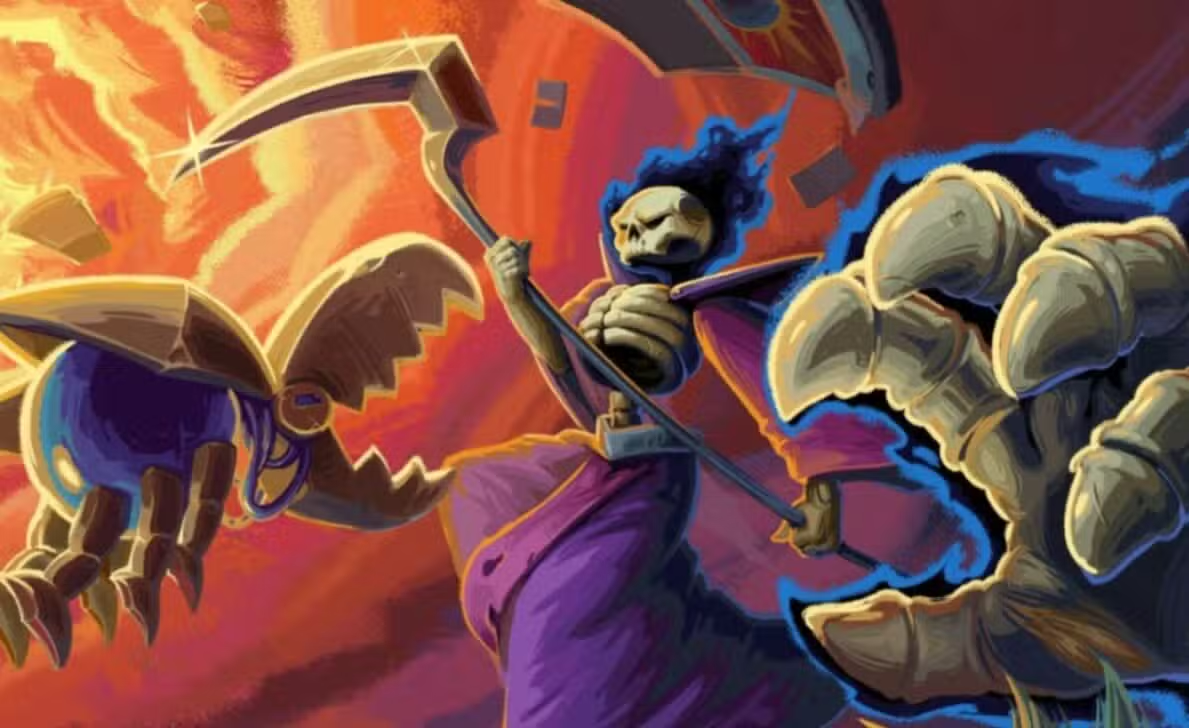
The catalog of playable characters mixes figures already known to the community with new additions that completely change the way you interact with opponents. Classic classes return with their fully updated skill trees, incorporating new keywords and mechanics that reflect the evolution of the combat system. Entre the latest news, highlights the figure of Necrobinder, a fighter focused on managing vital resources.
This new hero has the ability to summon auxiliary units to dominate the battlefield, requiring a different learning curve than the others. Cada protagonist has his own progression tree, exclusive relics and specific narrative events, ensuring a high replayability factor. The diversity of play styles aims to suit both franchise veterans and newcomers looking for different strategic approaches.
Data collection and continuous balancing
The initial testing phase will allow the producer to collect telemetry data on the performance of each card used in matches. Esse Real-time monitoring enables fine-tuning of damage values, energy costs, and rare item appearance rates. The technical team will analyze player behavior to identify unbalanced strategies or unwanted difficulty spikes.
The studio’s promise is to make frequent updates based on crash reports and win rates recorded on global servers. The creation of a fair and dynamic environment directly depends on this exchange of information. Continuous balancing is critical to maintaining user base engagement throughout the open development period.
Evolution of the access and expansion model
Purchasing the game during its testing phase guarantees access to all future updates, including the final release version. The producer encourages first-time buyers to use the official forums to report technical problems and suggest improvements. Existe the possibility of readjusting the commercial value of the product as the volume of content increases, establishing a transparent relationship that aims to strengthen public trust in the continuous development cycle.