

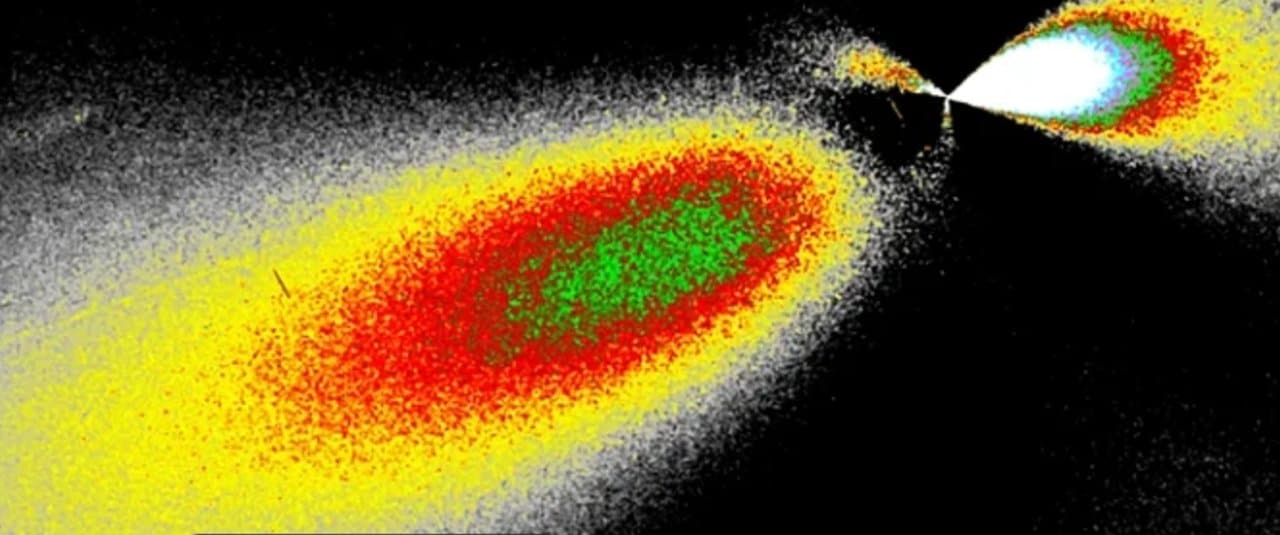
The interstellar object 3I/ATLAS continues to intrigue the global scientific community, especially in light of its imminent and crucial approach to Júpiter. Descoberto in July 2025, the interstellar comet presents a series of anomalies that defy conventional explanations, fueling an intense debate about its true nature. Sua peculiar trajectory, geometric anomalies and the atypical composition of its gas and dust raise fundamental questions about the possibility of an unnatural origin. The attention of researchers like the professor of Harvard Avi Loeb turns to the astronomical event that will occur on March 16, 2026, when the object will pass closer to the gas giant in our system.
The unusual features of 3I/ATLAS, from its prominent Sol-facing antitail to a symmetric system of three jets observed near its core, have been thoroughly documented. Tais findings, resulting from Telescópio Espacial Hubble observations and other analyses, drive the need for in-depth investigation. Este complex scenario puts humanity before a test of its ability to recognize and react to cosmic phenomena that transcend the familiar.
The anticipation surrounding the encounter with Júpiter is palpable, as the planet’s proximity offers a unique opportunity to observe the behavior of 3I/ATLAS in a distinct gravitational environment. Scientists hope new data may emerge, perhaps unraveling more mysteries or bolstering speculation about the alien technology that some believe is behind its anomalies. Essa critical phase of the object’s journey could redefine our understanding of visitors from other stars.
Interstellar object 3I/ATLAS: enigma persists
The discovery of 3I/ATLAS, initially rated 4 on the Loeb scale for interstellar objects, immediately highlighted its peculiarities. The scale, which ranges from 0 (natural comet) to 10 (threatening alien technology), reflects the object’s degree of anomaly. Entre features that caught attention were its trajectory towards the inner solar system, less than 5 degrees from the planets’ orbital plane, and an axis of rotation almost aligned with the direction of the Sol. Essas geometric singularities already indicated that 3I/ATLAS did not behave like an ordinary comet.
Another intriguing aspect was the presence of a prominent anti-tail, facing Sol, a marked contrast to the usual cometary tail, formed by dust and gas repelled by solar radiation and wind. Analysis of the gas plume around 3I/ATLAS, before perihelion, revealed nickel with much less iron than that found in industrially produced nickel alloys. Após perihelion, methane (CH4) was detected, a biosignature whose volatility is positioned between carbon dioxide (CO2) and carbon monoxide (CO), both detected well before methane. Essas atypical chemical compositions reinforce the idea of an object with non-standard characteristics.
Anomalies and the scale of Loeb: scientific reassessment
The forty post-perihelion images captured by Telescópio Espacial Hubble added more pieces to the 3I/ATLAS puzzle. The photographs revealed a circular glow of reflected sunlight, accompanied by a symmetrical system of three jets, equidistant from each other, surrounding the nucleus. The question remains whether these jets represent technological propellants, indicating an artificial origin, or whether they are mere coincidences of random pockets of ice on the surface of a rocky iceberg. The observed symmetry is a factor of great curiosity.
Considering the vast volume of accumulated data and the eighteen anomalies listed, the 3I/ATLAS classification was revised, reducing it to 3 at Escala from Loeb. Essa reassessment considers that, although the object exhibits natural cometary behavior, it is accompanied by multiple and inexplicable anomalies. The hypothesis that 3I/ATLAS could be a “Horse of Troia”—an interstellar iceberg containing technological equipment installed by an extraterrestrial civilization and guided by a specific trajectory—continues to be debated, adding complexity to its identification.
Cosmic coincidence: the Uau signal! and the 3I/ATLAS
One of the most fascinating and discussed anomalies is the 9-degree alignment between the direction of arrival of 3I/ATLAS and the point of origin of the “Signal of Rádio Uau!”, captured in 1977. The rare match suggests to some that it could not just be a fluke, but a hint of something more significant, although not yet proven.
Since the discovery of 3I/ATLAS, attempts have been made to detect direct radio transmissions from the object towards Terra, on specific dates in the last six months, but without success. The nature of “Signal Uau!” remains a mystery; it could have been a transmission from a 3I/ATLAS auxiliary device, or even from its primary transmitters. The lack of new radio detections, however, does not rule out the possibility of a link, keeping the 1977 event a “rare anomaly” added to the 3I/ATLAS portfolio of mysteries.
Approaching Júpiter: date and potential developments
The high point of 3I/ATLAS’s journey through our solar system is scheduled for March 16, 2026, when the object will reach its minimum distance of Júpiter, around 53.6 million kilometers. Esta approach is not just a chronological milestone, but a moment of great scientific expectation. The object’s orbit takes it to a region close to the radius of Hill of Júpiter, a gravitational limit where the attraction of the gas giant overcomes the tidal influence of the
Within this zone of influence, the gravity of Essa possibility raises the question of whether the interstellar object could have left “observers” or other devices in orbit.
To date, observatories have not recorded evidence of the release of such objects. However, the scientific community plans to verify, through image data obtained by the Juno, Juice and Europa Clipper probes — which are already operating or will be activated in the vicinity of Júpiter — whether new and small satellites have been added to the planet’s orbit. Essa Close monitoring is crucial to understanding the full implications of the 3I/ATLAS passage.
Propagation of Life: The Interstellar Gardener Scenario
After perihelion, 3I/ATLAS released organic molecules that are considered biomarkers, reigniting the debate about panspermia and the possibility of the object harboring or transporting life. Essa detection fuels the “interstellar gardener” hypothesis, which suggests that an advanced civilization could intentionally deposit microbes within natural icebergs that contain the essential nutrients for life. The idea is that, upon approaching a star like Sol, these icebergs would release their “seeds” into a potentially fertile environment, like the primitive Terra.
More on this story: Scientists debate how interstellar objects could be sources for autonomous spacecraft
Our own civilization, in the distant future, could devise a similar strategy, depositing capsules with microbes, heated by energy sources, on future interstellar icebergs. The cost of such an undertaking would be compatible with space agencies’ budgets, making the concept an intriguing possibility and a fertile field for scientific and technological imagination.
However, it is important to highlight that the organic material expelled by 3I/ATLAS, due to its trajectory and the action of radiation and solar wind, should not reach Terra. The object passed through the opposite side of Sol in relation to our planet, which prevents the released particles from reaching here. Essa limitation is an important factor for theories of “infection” or biological colonization of the solar system by 3I/ATLAS life, mitigating ecosystem invasion scenarios.
Although the expelled material does not reach Terra, the release of biomarkers by an interstellar object maintains the relevance of 3I/ATLAS in the discussion about the distribution of life in the universe. Cada new discovery about these cosmic visitors allows us to refine our theories about abiogenesis and the possibility of life on other worlds, and how such life could propagate across the vast interstellar distances. Understanding these complex interactions is fundamental to astrobiology.
Interstellar travel: artificial intelligence and biological passengers
Travel between stars, with durations that can span billions of years, raises crucial questions about the nature of the “travelers.” The prevailing expectation is that artificial intelligence (AI) would be the main guide for these interstellar missions. AI’s ability to operate for long periods without the need for biological resources such as food and oxygen, and its resilience to extreme conditions in space, make it the ideal candidate for managing such prolonged and complex journeys. The autonomy and adaptability of AI systems would be indispensable for such an undertaking.
On the same topic: 3I/ATLAS presents organic molecules and methane on a trajectory close to the Solar System
However, the possibility of biological passengers is not entirely ruled out. If your lifespan could be extended indefinitely by significant advances in AI-assisted medicine, or by states of suspended animation, then biological civilizations could indeed undertake such journeys. Essa combination of AI and biological life represents a richer scenario for the exchange of knowledge and culture. Essa hypothesis opens the door to scenarios of coexistence between organic and artificial intelligences on long exploratory missions, redefining the limits of what is possible in terms of cosmic exploration and survival.
Earth preparation: the challenge of human civilization
The arrival of objects like 3I/ATLAS exposes the unpreparedness of Terra for an encounter with other civilizations. The scientific community, although engaged in in-depth debates, is still divided and sometimes immersed in mutual accusations, highlighting the lack of a unified approach. Descobrimos that we are incapable of contacting 3I/ATLAS, of reaching it and, to a certain extent, even of expressing a collective will to do so. Essa inertia and fragmentation can be interpreted as an initial failure in a cosmic “test”, the implications for the future of humanity are vast and still unknown.
The prospect that Observatório Rubin, in Chile, will discover dozens of new interstellar objects in the coming years reinforces the urgency of a coordinated scientific effort. It is mandatory to develop the ability to detect anomalous objects, such as 1I/`Oumuamua or 3I/ATLAS, 6 to 12 months in advance of their approach to Terra. Essa time window would be vital for planning and executing interception space missions, allowing for in situ data collection and deeper understanding of these visitors.
To achieve this, a comprehensive network for the discovery and characterization of interstellar objects is essential. Data collected by this network would enable policymakers to calibrate future objects in Escala from Loeb with greater precision and to initiate an adequate defense of Terra against potential threats from alien technology. Preparing for “black swan events” – rare and unpredictable events with large impact – becomes crucial, even though most interstellar objects are, as expected, natural icebergs. Proactivity is the key to safety and scientific advancement.
Monitoring UAPs and Projeto Galileu
The possibility that Terra is already being visited by other civilizations is an intriguing question, especially if claims about Fenômenos Anômalos Não Identificados (UAPs) in Earth’s atmosphere or oceans are validated. In response to this question, Professor Avi Loeb leads Projeto Galileu, an initiative that operates three new observatories dedicated to the search for extraterrestrial artifacts near our planet. Este project represents a concrete step in the investigation of phenomena that, until now, have been relegated to the field of speculation.
If Projeto Galileu can discover concrete evidence of extraterrestrial artifacts, the ability to answer questions about alien visitations will be significantly improved. Tal discovery would bring tangible information, allowing humanity to better understand its position in the universe and what it means to potentially be in contact with other forms of intelligence. The search for these clues is not just a matter of curiosity, but of preparation for scenarios that can radically transform the perception of life and Earth civilization.
Projeto Galileu’s work focuses on systematic, science-based observations, moving away from anecdotal narratives to seek physical, verifiable evidence. Essa rigorous approach is critical to the credibility of any future discoveries and to advancing knowledge about the presence of non-human technology in our cosmic neighborhood. The initiative demonstrates a commitment to exploratory science and the search for answers to some of humanity’s deepest questions.
More on this story: Astronomer detects organic molecules in interstellar object 3I/ATLAS
Contact Scenarios: Science Fiction Versus Cosmic Reality
It is highly unlikely that the scenarios of contact with extraterrestrial civilizations, so vividly described in science fiction – such as ships landing on Terra, creatures emerging and leaders shaking hands in a media spectacle – correspond to reality. The human imagination, however fertile it may be, is based on a set of data limited to earthly experiences and understandings. The scripts of
Interstellar visitors, on the other hand, would have a much broader set of data and experiences, shaped by billions of light years of space and billions of years of time. It is this vast expanse of the cosmos that teaches us something truly new and unexpected. Nossos More ambitious scientific projects often focus on what we “know as unknown”, that is, on questions we already know how to ask. However, humanity’s greatest advance, its most transformative knowledge, will come from discovering what we “don’t know as we don’t know yet” – those things we don’t even realize we don’t know. True exploration lies in going beyond our assumptions and being open to the unexpected, to the surprise that the universe can hold for us, defying all our expectations and previously elaborated narrative constructions.