

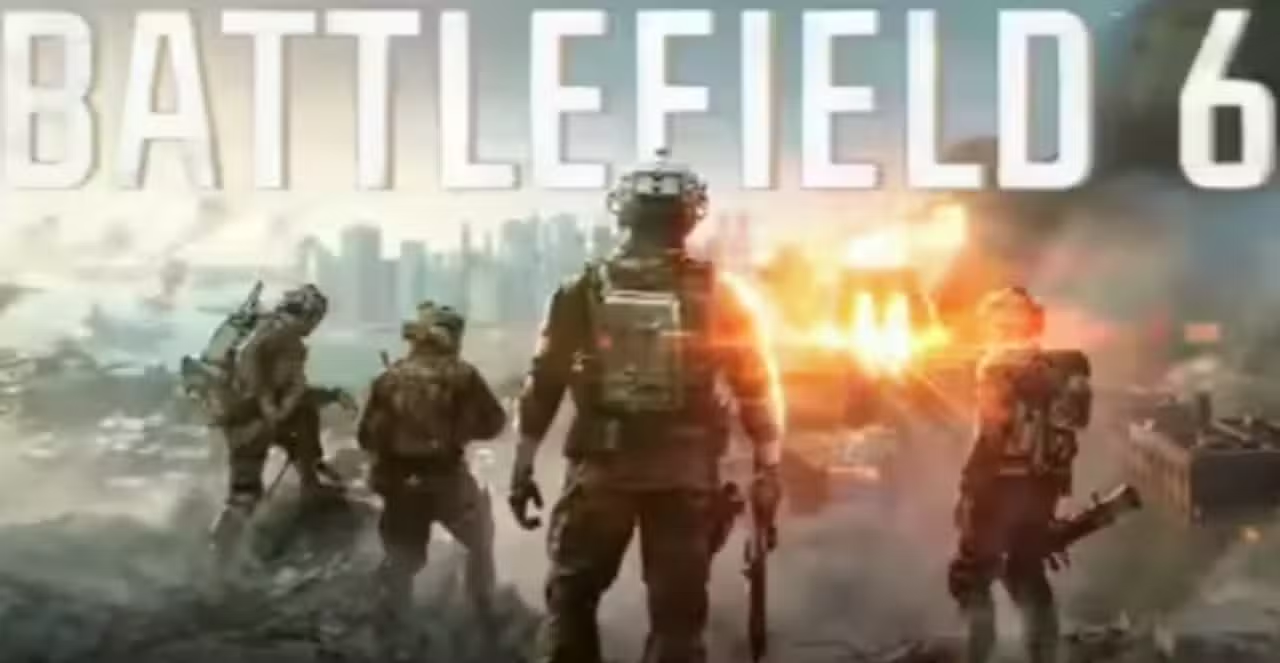
Electronic Arts has initiated a layoff process that affects multiple studios responsible for the development of Battlefield 6. The measure directly affects renowned teams in the electronic games industry, including DICE, Criterion, Ripple Effect and Motive. The corporate move comes months after the launch of the title, which reached the top of the sales charts in the Estados Unidos and generated great expectations in the global financial market.
The publisher describes the action internally as a strategic realignment of its global operations. The declared objective is to optimize resources in the midst of an extremely difficult scenario to maintain continuous user engagement. The decision reflects a change in the company’s focus to sustain the game-as-a-service model in the long term, adapting the workforce to the current reality of product consumption.
The changes in the workforce coincide with a period of profound structural transformations in the company. Electronic Arts is going through a transition phase that involves large-scale market negotiations and forced changes in its top management, factors that add complexity to the management of its main intellectual properties and directly affect the long-term planning of programming teams.
Sales dynamics and player base fluctuation
The initial commercial performance of Battlefield 6 recorded impressive numbers for the franchise, surpassing the mark of seven million copies sold in just three days after its arrival in virtual and physical stores. Esse sales volume put the game ahead of direct competitors in the first-person shooter segment, generating robust revenue that contributed to the company’s $1.9 billion in revenue in the third quarter of the fiscal year. However, initial traction did not translate into a stable user base, highlighting a mismatch between purchasing interest generated by marketing campaigns and daily retention in the multiplayer environment, which forced management to review its recurring profit projections.
Data from digital distribution platforms illustrates the volatility of audience engagement with the new military combat title. On the Steam platform, the game recorded a concurrent peak of 747,440 players during the launch window, but that number has seen a severe retraction, recently stabilizing at a ceiling of 67,080 active users. Essa sharp drop demonstrates the publisher’s difficulty in providing content updates that justify consumers’ daily stay on the servers.
To try to reverse the evasion situation and stabilize the infrastructure, the company mapped critical areas that require immediate intervention from the remaining development teams. The studios affected by the realignment have specific responsibilities for maintaining the game ecosystem:
- DICE: Foco in core engineering, server stability and shooting mechanics.
- Criterion: Otimização vehicles, destruction physics, and expansive map design.
- Ripple Effect: Criação of experimental game modes and temporary seasonal events.
- Motive: Desenvolvimento of narrative campaigns and integration of story elements.
Corporate transition and market negotiations
The restructuring of the studios takes place in parallel with one of the biggest recent financial movements in the digital entertainment sector. Electronic Arts is in an advanced stage of an acquisition process by an international consortium of investors focused on technology.
The purchase agreement is valued at approximately US$55 billion and involves large entities in the global financial market. The group of buyers includes Fundo of Investimento Público of Arábia Saudita, as well as private equity firms Silver Lake and Partners.
The official forecast establishes that the billion-dollar transaction will be completed at the beginning of 2027, depending on regulatory approvals. Até the completion of the process, the current board needs to demonstrate operational efficiency and strict control of expenses for the company’s future owners.
Headcount reduction movements are standard procedures in publicly traded companies preparing for mergers or acquisitions of this magnitude. The elimination of redundancies between the studios aims to present a leaner and more attractive financial balance for the investing consortium that will take control.
Vacuum in franchise creative leadership
In addition to commercial challenges and the ownership transition, the division responsible for Battlefield faces a leadership crisis following the loss of its key creative figure. Vince Zampella, industry veteran and franchise boss, passed away in a car accident in December last year. Sua’s sudden absence left a vacuum in the game’s strategic direction, requiring Electronic Arts to reorganize the decision-making hierarchy on an emergency basis to avoid halting ongoing projects.
Zampella had a recognized track record in coordinating large shooting game development teams and was the central piece in the attempt to revitalize the brand in the community. The search for a replacement capable of unifying the vision of the four studios involved in the project has become an absolute internal priority. The new leadership will be responsible for aligning the players’ technical expectations with the profitability goals required by the current operations management.
Performance of side projects and expansions
The franchise’s universe expansion strategy also suffered recent setbacks with the launch of derivative projects that did not meet the stipulated metrics. The title Redsec, a free spin-off focused on the battle royale genre, did not receive the reception expected by the publisher in its first months of operation.
The side game has accumulated mostly negative reviews on the Steam platform since its public availability. The failure to diversify the target audience increased pressure on the main game to sustain the financial goals of the company’s shooter division on its own.
Scheduled updates and infrastructure testing
The next acid test for the remaining studios’ infrastructure will occur with the release of a new content pack scheduled for the next few days. The introduction of a new map, scheduled for March 17th, will serve as a technical barometer to measure the reduced team’s ability to deliver complex updates without supervision from previous leadership and under the new cost structure.
Operational pressure in high-budget development
The dynamics of producing triple-A games require massive investments in proprietary technology and specialized human resources, creating a zero-tolerance environment for audience retention failures. The game-as-a-service model, adopted by Electronic Arts for the franchise, fundamentally depends on the continuous sale of battle passes and virtual cosmetic items to justify the high costs of maintaining global servers and paying support teams. Quando player base shrinks drastically shortly after launch, recurring revenue projection plummets, forcing executive management to cut operating expenses immediately to balance cash flow. The dismissal of highly qualified professionals in historic studios such as DICE and Criterion reflects the harsh reality of a market where the initial success of software sales does not guarantee job stability if the final product is unable to monopolize consumers’ free time compared to free alternatives that are updated more frequently by direct competitors.
Competition in the first-person shooter segment
The first-person shooter market has a level of saturation that makes it difficult for titles that lose their initial user base to quickly recover. Franquias Established competitors, such as Call of Duty, maintain robust upgrade ecosystems that immediately appeal to gamers dissatisfied with other options available in digital stores.
Electronic Arts needs to compete for public attention not only with traditional big-budget rivals, but also with new independent releases that require less initial investment from the consumer. Emerging Títulos, like Arc Raiders, are able to capture specific market shares by offering different gameplay proposals and more stable servers.
The need to provide a constant stream of new products forces technology companies to maintain extremely aggressive production schedules. Qualquer delay in correcting critical technical flaws or delivering new maps results in the immediate migration of players to competing platforms, emptying servers and making the monetization model planned by investors unfeasible.