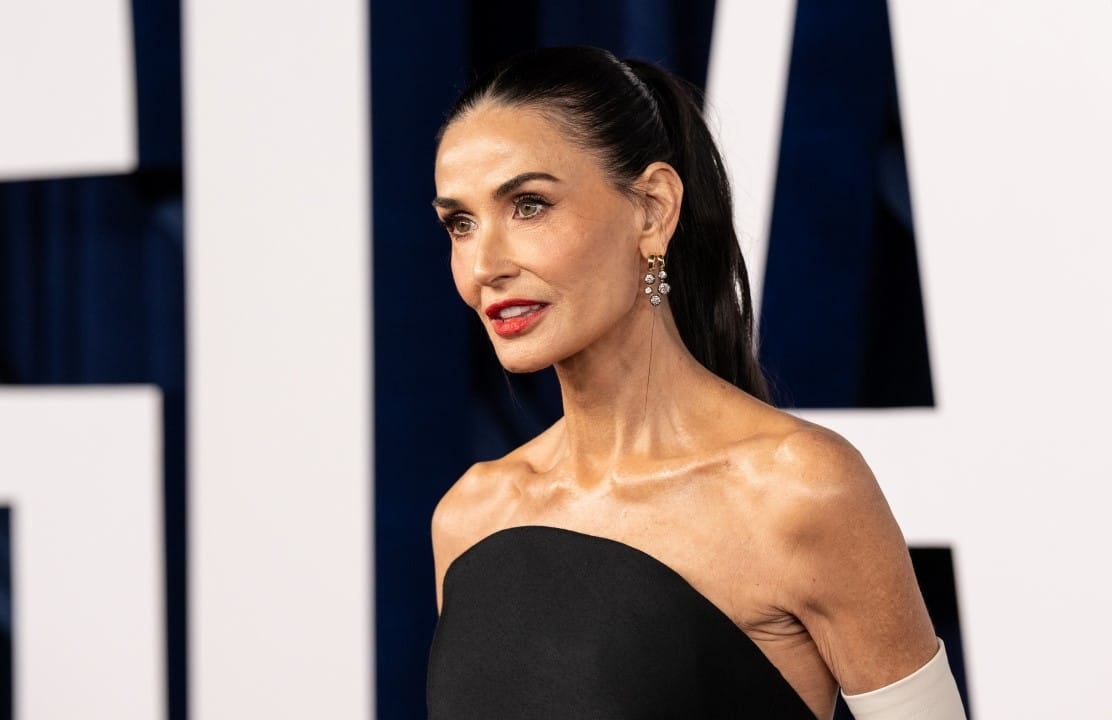
Actress Demi Moore revealed unprecedented details about the first steps of her career in the audiovisual industry during a recent panel. The artist highlighted a specific interaction that took place behind the scenes of a recording, when she was just 14 years old and was trying to understand how the entertainment market works.
The meeting with the renowned producer and director Garry Marshall served as a turning point for the young woman, who until then had only acted as an extra. The quick conversation in the recording studios changed the teenager’s perception of her own professional future and established new goals for her performance.
Marshall, known for creating highly successful series on American television, noticed the young woman’s presence on set and offered direct guidance. Essa specific intervention prevented her from remaining anonymous in productions and encouraged her to seek prominent roles with speaking roles and more screen time.
Meeting behind the scenes of television production
The contact between the future movie star and the television veteran took place on the set of the popular series Happy Days. The production was one of the biggest successes of the time and had a dynamic and highly competitive work environment, demanding constant attention from everyone involved.
During the recordings, Garry Marshall observed the extra’s behavior and decided to intervene with practical advice focused on skill development. The director identified a unique energy in the teenager and stated that she should focus on bigger goals within her acting. The guidance included the need to study the craft, audition for speaking roles, and understand the mechanics of how large recording studios work.
The producer’s attitude demonstrated a rare ability to identify talent among dozens of professionals who circulated daily through the complex scenarios of television networks. Marshall already had an established reputation for launching new names in the entertainment market, and his direct approach provided Demi Moore with the validation needed to take the profession seriously and create a plan of action. From that moment on, the young woman stopped seeing acting as a temporary job and started investing in building a solid foundation for her artistic career, seeking professional agency, acting classes and real opportunities to demonstrate her dramatic ability in front of the cameras.
First steps in professional activity
The transition from acting to credited roles occurred gradually in the early 1980s, requiring persistence and adaptation. The actress made her official film debut in the film Choices, released in 1981, marking her first concrete victory in the hotly contested film industry.
Soon after, she gained an important space on television when she joined the cast of the soap opera General Hospital. Playing the character Jackie Templeton required daily dedication and provided intensive training in memorizing texts and technical positioning in front of the cameras.
Rise to global stardom
The big leap in the artist’s career happened in 1990, with the release of the feature film Ghost. The production became a worldwide box office phenomenon and consolidated the actress’s name in the top ranks of Hollywood, guaranteeing immediate international visibility.
Her performance in the supernatural drama earned recognition from critics and the public, raising the professional’s status to the level of absolute protagonist. The film’s commercial success proved the actress’ ability to attract large audiences to movie theaters in different countries.
In the following years, she continued her upward trajectory with appearances in big-budget projects and massive marketing campaigns. Filmes like Proposta Indecente, from 1993, and Assédio, from 1994, reaffirmed his position as one of the most profitable and sought-after figures of the decade.
Breaking salary records in the industry
The actress’s financial and contractual peak was reached in 1996, during negotiations for the film Striptease. Ela signed a $12.5 million contract, setting a new standard for pay for women in commercial film.
This amount broke historical records and placed the artist in a salary range previously dominated exclusively by male actors in action films. The contractual requirement represented a milestone in discussions about equalization of earnings in the North American entertainment industry.
The following year, in 1997, the actress’s physical and mental dedication was tested to the extreme in the feature film Até o Limite da Honra. Preparing for the role of a soldier required rigorous training and the decision to shave her hair, drastically altering her public image to meet the needs of the script.
Delivery to the project demonstrated the professional’s commitment to the art of acting and willingness to take calculated risks. The performance reinforced the artist’s versatility, who moved easily between romantic dramas, psychological thrillers and intense action films.
Director’s legacy on television and cinema
Garry Marshall built a television empire during the 1970s, creating formats that defined the comedy genre and influenced generations of screenwriters. Produções as well as Mork & Mindy and Laverne & The producer had a strategic vision that combined accessible humor with familiar narratives, attracting millions of viewers weekly in front of their televisions.
In addition to his success on television, Marshall migrated to cinema with the same ability to communicate with the general public and generate significant profits for the studios. Ele was responsible for directing smash hits such as Uma Linda Mulher, in 1990, and Diário by
Importance of mentoring in professional development
The revelation about the advice received behind the scenes sheds light on the relevance of informal mentoring within highly competitive and structured corporate environments. A veteran professional’s ability to identify potential in newcomers and offer clear direction can completely alter the course of a career that would otherwise stagnate in basic operational roles. In the case of the audiovisual industry, where the rejection rate is high and opportunities for advancement are scarce, a word of encouragement from an authority figure serves as a catalyst for confidence and action. Marshall’s attitude exemplifies how effective leadership is not just restricted to directing key actors or managing budgets, but encompasses close observation of the entire team involved in a daily production. The transmission of practical knowledge between generations guarantees the renewal of talent, the maintenance of the technical quality of the sector and the creation of a sustainable cycle of training new qualified professionals to assume prominent positions.
Recent projects and continuity in the sector
Currently, Demi Moore continues to be active in the audiovisual market, participating in acclaimed productions and exploring new performance formats on different platforms. The artist maintains a regular work schedule, proving the longevity of a career that began with a simple figuration and was shaped by precise advice from veterans in the field.
Adaptation to new distribution formats
The evolution of the entertainment market required established professionals to adapt their operating strategies to maintain commercial relevance. The transition from traditional cinema to streaming platforms opened up a new range of possibilities for serialized narratives and direct-to-digital films, changing the way the public consumes them.
The actress followed these structural changes in the industry, engaging in projects developed specifically for on-demand consumption in global catalogs. Essa flexibility demonstrates the capacity for reinvention necessary to operate in a constantly changing technological landscape and with new success metrics.
