

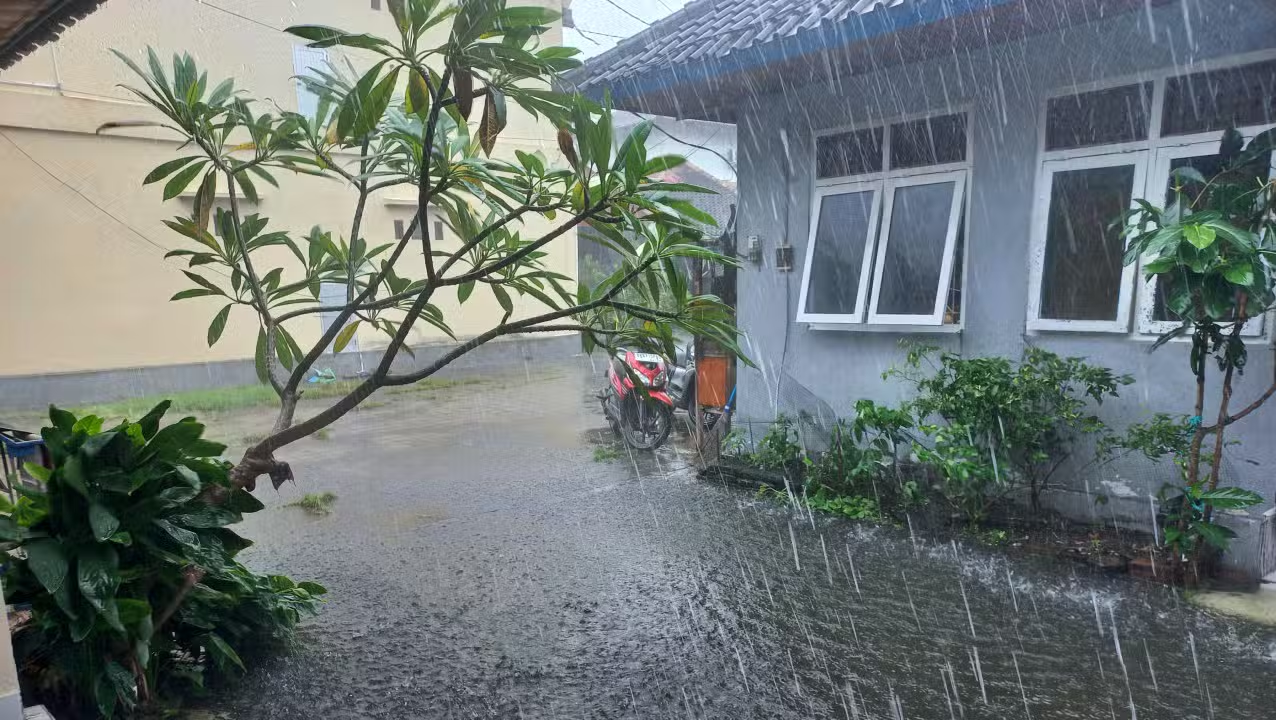
Serviço Nacional of Meteorologia has issued an emergency warning for Condado of Clinton, located in the state of The preventive measure remains in force until Tuesday night, requiring increased attention from local residents. The phenomenon occurs in response to the significant volumes of rain recorded in the last twenty-four hours.
The waters of the Rio Maple have already begun to invade the banks, resulting in minor flooding, especially in the vicinity of the Maple Rapids region. Local authorities confirm that the current scenario requires caution, as soil saturation prevents the rapid absorption of excess moisture.
Emergency teams are on standby to act in possible rescues or road blockages. The main recommendation is that the population avoids traveling through areas known for their history of water accumulation, ensuring individual safety and facilitating the work of public agents.
Monitoring details and affected areas
Constant monitoring of river levels reveals that the water has reached the nine-foot mark, a level that triggers immediate overflow into the adjacent plains. Este water volume directly affects road infrastructure, with emphasis on secondary roads such as County Line Road, which already has submerged sections that are impassable for passenger vehicles. The strength of the current at these points represents an imminent risk of accidents, requiring the installation of temporary signage to divert the flow of cars.
Hydrology experts explain that the region’s topography favors the rapid accumulation of water when the Rio Maple exceeds its channel limit. The invasion of water is not restricted to asphalt, it also reaches rural properties and lower lands located on the banks of the river. Relatos Preliminaries from field teams confirm that at least one isolated residence is already suffering direct impacts from advancing waters, requiring logistical support.
The extension of the meteorological warning covers the entirety of Condado and Clinton, reflecting the severity of the climate situation affecting the central region of the state. Rainfall measurements continue to be updated every hour, providing essential data so that crisis managers can anticipate upcoming scenarios and direct resources efficiently.
Direct impacts on local mobility
The advance of water over rural roads drastically changes the travel routine of residents of Condado and Clinton. The presence of sheets of water on the roads hides holes and debris, increasing the likelihood of mechanical damage to vehicles and the risk of drivers losing directional control.
Road maintenance professionals work around the clock to assess the integrity of asphalt and smaller bridges. The preventive blocking of certain routes forces drivers to look for alternative routes, which causes delays and requires advance planning for essential trips within the county.
Security measures recommended by authorities
The main safety guideline issued by civil defense agencies advises citizens to seek high ground at the first sign of approaching water. Pessoas who reside in valley areas or who use camps close to riverbanks must initiate preventive evacuation before escape routes are completely blocked.
Immediate compliance with evacuation orders is essential to preserve lives and avoid high-risk rescue operations. Antes Before leaving their homes, owners are instructed to lock doors and windows, in addition to turning off the electricity grid and gas supply to prevent fires and short circuits.
Circulation in flooded indoor environments requires extreme caution, and access to basements where the water has reached the level of the sockets is strictly prohibited. Water acts as an excellent conductor of electricity, transforming domestic environments into lethal traps if equipment is connected to the network.
Walking along the banks of the river or trying to cross flooded areas on foot are practices discouraged by rescue teams. The force of the current, even in shallow water, is enough to knock over an adult, while the turbidity hides deep holes and sharp objects swept away by the flood.
Rainfall history in the central region
The current flood scenario is the direct result of a meteorological system that dumped significant volumes of rain over the central portion of Michigan over the last forty-eight hours. Condados neighbors, including Gratiot, Ionia and Montcalm, are also facing severe weather conditions, with active warnings for flash floods remaining in effect until early morning. Previous saturation of the soil, resulting from previous rainfall, prevented the natural infiltration of water, accelerating surface runoff towards the river basins.
Climate models analyzed by meteorologists indicate that some specific areas recorded accumulations of more than two inches in a short space of time. Este rainfall quickly overloads natural and artificial drainage systems, increasing the risk of overflows at critical points in the river network. The region’s climate history demonstrates that events of this magnitude tend to occur during seasonal transitions, requiring resilient infrastructure to support the water load.
Weather forecasts for the next few days
Projections provided by climate monitoring centers indicate the continuation of moderate rains until the middle of the week, a factor that should prolong the state of alert and the persistence of floods throughout the Rio Maple. The expectation is that river levels will remain above the overflow level for an additional period of at least forty-eight hours, delaying the runoff process and the recovery of the affected areas. Diante of this forecast, hydrological stations operate at maximum data transmission capacity, sending real-time updates that allow fine-tuning of forecast models. Impacted communities, in conjunction with emergency management agencies, use this information to refine their contingency plans, ensuring that temporary shelters and basic assistance resources remain stocked and ready to receive the homeless if the situation suddenly worsens.
Differences between emergency classifications
Meteorological risk communication uses specific terminologies that determine the level of urgency of response actions. Flash flood warnings, for example, require immediate mobilization, as they describe events that occur in a matter of minutes or a few hours, generally in urbanized areas or with highly saturated soil.
On the other hand, flood warnings, such as the one currently in force for Condado of Clinton, indicate imminent or ongoing events, focused on the gradual increase in the volume of rivers and streams. Esta classification allows more time for community preparation and protection of material assets.
There are also flood watches, which function as a preliminary warning about atmospheric conditions favorable to the occurrence of flooding, without guaranteeing that the event will actually happen. Compreender these differences are essential for the population to adopt the correct attitude towards each official announcement.
Mobilization of rescue teams and volunteers
Responding to the climate emergency involves a coordinated network of government agencies and civil society organizations. Equipes specialized in water rescue, equipped with flat-bottom boats and four-wheel drive vehicles, are positioned at strategic points in the county to guarantee minimum response times in the event of distress calls.
At the same time, groups of volunteers organize the logistics of distributing essential supplies to families isolated by water. The initial focus of these community support operations is to ensure that the elderly, people with reduced mobility and children receive food, clean water and basic medical assistance during the period of isolation.
Mitigation and infrastructure strategies
Reducing the impacts caused by extreme weather events depends on continued investments in resilient infrastructure and environmental management practices. Projetos of engineering aimed at strengthening dikes, expanding urban drainage systems and preserving natural wetlands are essential to absorb excess precipitation and stabilize river banks, reducing the speed of surface runoff and protecting inhabited areas.
Prolonged risks to health and economy
The consequences of a flood extend far beyond the receding waters, presenting significant challenges for local public health. Contamination of artesian wells and drinking water sources by debris and chemicals requires rigorous quality testing before consumption is allowed again.
Contact with flood water also increases the risk of transmitting infectious diseases and skin infections. Health authorities recommend rigorous cleaning of any object or surface that has been submerged, in addition to discarding food that has come into contact with the flood.
In the economic sphere, structural damage to properties, erosion of arable soil and the interruption of logistics routes generate losses that require months of recovery. The temporary halt to commercial activities in the most affected areas requires the development of financial aid programs to sustain the regional economy.
Collaboration between government agencies
Efficiency in the management of natural disasters depends on fluid integration between the municipal, state and federal spheres. Sharing resources, such as heavy equipment and meteorological intelligence, allows for a unified approach that optimizes service to the population of Condado of Clinton and neighboring regions.
Tactical alignment meetings occur periodically at command centers, where joint action protocols are reviewed based on the most recent data. Esta interinstitutional collaboration ensures that no community is left destitute and that the transition from the response phase to the reconstruction phase occurs in a structured manner.