

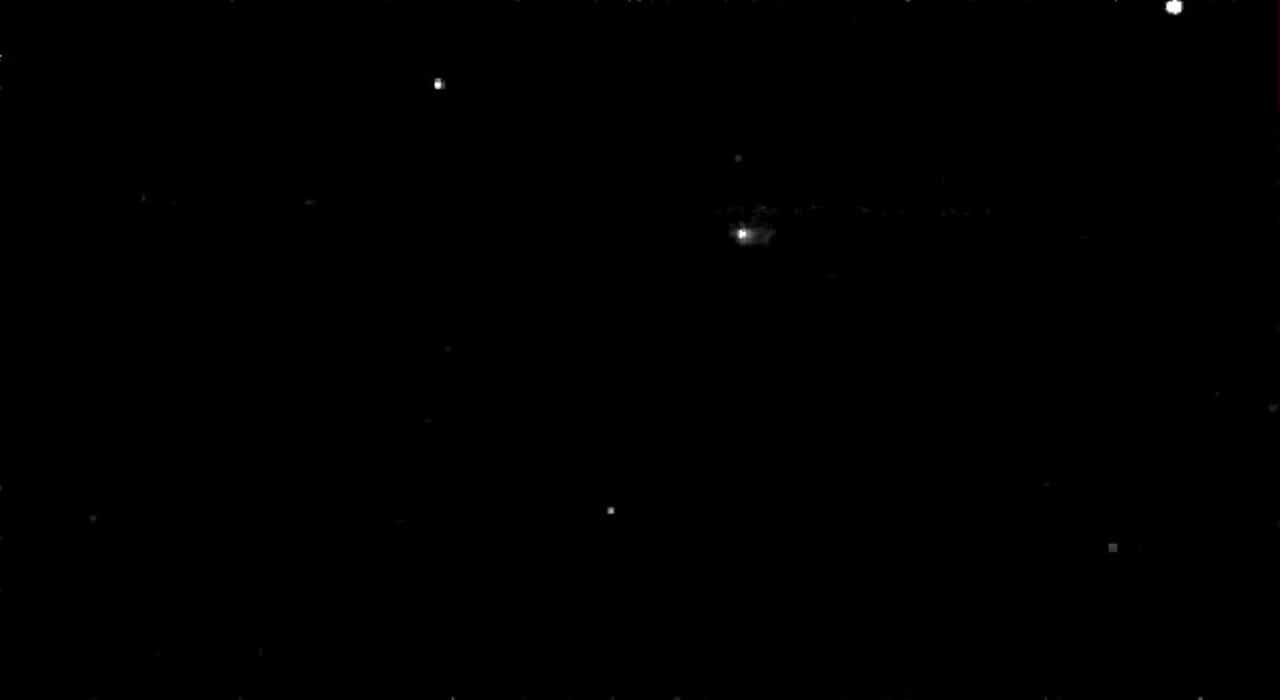
Researchers have identified an unusual chemical signature in the interstellar comet 3I/ATLAS as it passed through the inner regions of our planetary system. The celestial body has an extraordinary amount of methanol, a type of simple alcohol, in proportions much higher than those observed in objects formed in the vicinity of Sol.
The analyzes were conducted with the aid of the Atacama Large Millimeter/submillimeter Array, a radio telescope complex located in the Atacama desert, in the Chile. The instruments captured gas emissions as the object approached the central star, revealing unprecedented details about its internal structure.
The detection of this organic substance in abundance provides direct clues about the chemical building blocks present in other corners of the galaxy. The cosmic visitor functions as a time capsule preserved in the extreme cold of deep space.
Cosmic visitor trajectory and approach dynamics
The celestial body was initially detected by the asteroid warning system at Chile, when its hyperbolic orbit confirmed its origin external to our planetary system. Diferente of local comets, which orbit Sol in closed elliptical trajectories, this object has been traveling through interstellar space for billions of years and makes only a quick pass through our neighborhood before returning to the galactic darkness. The extreme speed and angle of entry into the planets’ orbital plane ruled out any possibility of gravitational capture, making the observation period a unique and restricted window for the global scientific community.
During perihelion, the point of greatest proximity to the star, intense thermal radiation caused the accelerated sublimation of primordial ices embedded in the comet’s nucleus. Esse physical process transforms solid state elements directly into gas, creating a vast cloud around the main body, known as a coma. It is exactly in this temporary atmosphere that radio telescopes are able to read the spectral signatures of molecules, decoding the exact composition of the material that has remained frozen and unchanged since the object’s formation in its stellar system of origin.
Observation technology in the Chilean desert
O complexo astronômico utilizado na pesquisa opera em comprimentos de onda milimétricos e submilimétricos, ideais para detectar o brilho fraco de moléculas frias no espaço. The high altitude and dry atmosphere of the desert ensure that cosmic signals reach the antennas without interference from terrestrial humidity.
The dozens of parabolic antennas work synchronously, creating a virtual telescope with very high resolution. Essa technical capability allowed it to map the exact distribution of gases around the comet nucleus with unprecedented precision.
Chemical proportions and abundance of methanol
The data collected revealed that methanol appears in quantities 70 to 120 times greater than hydrogen cyanide. Essa proportion is considered extreme when compared to standards established by modern astronomy.
Hydrogen cyanide is a molecule often used as a basis of comparison to measure chemical activity in comets. The disparity found in 3I/ATLAS places it at the top of the list of celestial bodies richest in alcohol ever documented.
The massive presence of this organic substance indicates that the object formed in an extremely cold molecular cloud. In Nesses environments, carbon monoxide freezes on dust grains and reacts with hydrogen atoms to form methanol.
These specific conditions suggest that the stellar system where the comet was born had different temperature and density dynamics than the primordial solar nebula. The observed chemistry challenges traditional models of planetary formation.
Distinct patterns in gas release
Spectral measurements showed that the molecules are not ejected from the comet in the same way. Hydrogen cyanide flows directly from the celestial body’s dark, solid core, following a linear pattern of sublimation.
Methanol, in turn, has a double and more complex origin during the solar approach. Além exiting the core, the substance is also released from small grains of ice that float in the surrounding coma.
These grains act as secondary reservoirs of organic material. Quando solar radiation reaches the dust cloud, heating these isolated particles, generating an additional emission of alcohol that amplifies the signature detected by the telescopes.
Comparisons with celestial bodies in the solar system
The chemical architecture of 3I/ATLAS contrasts sharply with the family of comets that inhabit Nuvem of Oort and Cinturão of Kuiper, the two main reserves of icy bodies in our system. Nos local comets, the ratio of methanol to hydrogen cyanide is often significantly lower, reflecting a formation environment where radiation from the young solar star altered the chemistry of the planet-building blocks. Complementary infrared Observações data, including data captured by Telescópio Espacial James Webb, had previously demonstrated that the distant coma of this interstellar visitor was dominated by carbon dioxide, another indicator of extremely low formation temperatures. The combination of high carbon dioxide and methanol builds a unique chemical profile, proving that the diversity of planetary systems in Via Láctea is vast and that the basic ingredients for complex organic chemistry are heterogeneously distributed throughout the galaxy.
Visitor history from other stars
3I/ATLAS is the third interstellar body confirmed to cross our cosmic neighborhood. The first was the asteroid ‘Oumuamua, which intrigued science with its elongated shape and anomalous acceleration, followed by comet Borisov, which presented characteristics more familiar to astronomers.
The ongoing identification of these objects demonstrates that the space between stars is filled with trillions of fragments ejected from their original systems. Cada new visitor offers a rare opportunity for direct sampling of galactic matter.
Estimated age and material preservation
Calculations based on speed and trajectory indicate that the comet may have formed billions of years ago, potentially being up to three billion years older than Sol itself. Esse time of isolation in the interstellar vacuum ensured that its internal structure remained frozen and intact, free from degradation caused by stellar winds or intense radiation, until the moment of its recent thermal approach.
Investigation into the origin of planets
The analysis of organic molecules in such ancient bodies is fundamental to understanding how planetary systems develop. Methanol is considered an essential chemical precursor, capable of reacting and forming more complex compounds, such as amino acids, which are the bases of biology.
Finding these substances in abundance in an object from another star reinforces the theory that the ingredients needed for prebiotic chemistry are common in the universe. The dust and gas mapped by radio telescopes represent the raw materials of stellar creation.
Thermal variations during perihelion
The point of closest approach occurred at a distance of approximately 1.4 astronomical units from Sol. Nessa region, equivalent to the orbit of the planet Marte, the increase in temperature was enough to intensely activate the comet’s surface.
The instruments recorded clear fluctuations in the rate of gas production over weeks. Conforme the object crossed the water sublimation line, the release of methanol suffered significant peaks in intensity.
These dynamic variations help scientists map the thermal structure of the core. The way heat penetrates ice sheets reveals the porosity and density of the underlying rock material.
Spatial mapping and emission scales
The precision of the antenna complex on Chile allowed the creation of detailed spatial maps of the comet’s coma. As análises estatísticas confirmaram que a produção secundária de metanol ocorre em escalas superiores a 258 quilômetros de distância do núcleo central.
Although detection on smaller scales still presents technical limitations due to the resolution of the equipment, the current results already establish a new paradigm. The clear distinction between sources of molecular emission marks a technical and scientific advance in the observation of celestial bodies of external origin.



