

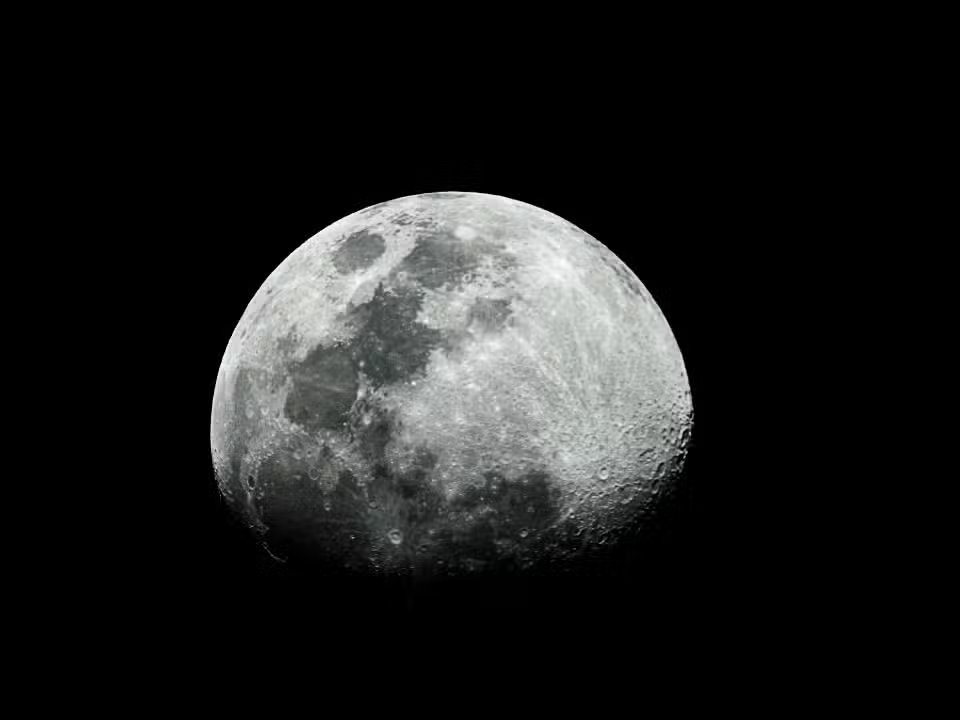
The natural satellite of Terra reaches a specific mark in its orbital cycle, presenting exactly sixty percent of its visible surface illuminated by sunlight. The astronomical event reflects the continuous advancement of the celestial body in its trajectory around the planet, characterizing the phase classified by researchers as waning gibbous. Durante this transition stage, the bright portion of the lunar sphere gradually decreases each night, changing the configuration of the nighttime landscape.
The current geometric configuration established between Sol, Terra and Lua results in the progressive darkening of the lunar disk, a physical process that extends until the complete renewal of the synodic cycle. Observatórios terrestrials record that the terminator line, which represents the visual boundary between day and night on the satellite’s surface, advances steadily over the craters and the vast basalt plains known as lunar seas.
Astronomy experts point out that the reduction in natural luminosity at night directly changes the visibility conditions for identifying other objects in deep space. The temporal distancing of the full phase allows the blinding brightness to be replaced by a scenario more conducive to collecting scientific data and tracking asteroids close to Earth’s orbit.
Technical conditions for celestial monitoring
At this specific moment in the astronomical calendar, the sixty percent lighting index indicates the imminent proximity to the last quarter phase, changing the routine of research centers. Orbital movement causes Lua to rise later and later at night, frequently becoming visible during the early morning hours in the western sky, which requires rigorous planning from observation teams.
The inclination of the Earth’s axis and the position of the satellite in its elliptical orbit determine the apparent height of the star on the horizon during the early hours of the morning, accelerating the rate of decrease in the illuminated area as the celestial body approaches perpendicular alignment with Sol.
To optimize data collection during the waning gibbous phase, research centers adopt specific technical protocols that guarantee the integrity of the images captured by optical instruments. The dissemination of this precise data facilitates the organization of observation campaigns and the scheduling of research at universities and space agencies, following strict instrumental operation guidelines:
– Calibração of image sensors to deal with the extreme contrast between the illuminated area and the shadow of the lunar terminator.
– Ajuste of neutral density filters in refracting telescopes to avoid pixel saturation in astrophotography cameras.
– Sincronização of equatorial tracking engines with apparent displacement speed of Lua.
– Mapeamento preview of the craters that will be positioned exactly on the dividing line of light for topographic studies.
Orbital dynamics and the synodic cycle
The lunar synodic cycle has an average duration of twenty-nine and a half days, a period in which the satellite completes all its visible phases from the perspective of observers located on the Earth’s surface. The change occurs in a predictable manner, obeying the laws of celestial mechanics, which provides accurate data for institutes that monitor the sky daily.
The waning gibbous phase represents the specific stretch of this journey in which the illumination rate drops from totality to the fifty percent mark. Daily monitoring reveals that the dark portion advances continuously, setting the stage for the total darkness of the new phase.
Topographic relief mapping
The advancement of the dividing line between light and shadow reveals unique topographic textures due to the grazing angle of sunlight that hits the satellite’s surface. The shadows cast by the lunar mountains become longer and more defined as the days go by, creating a map of natural high relief.
This shadowing phenomenon offers a detailed field of study for optical magnification equipment and radio telescopes operated by space agencies. Meticulous analysis of these shadows allows scientists to calculate the depth of craters with extreme precision.
The height of the rock formations and the extent of the winding valleys are measured using photogrammetry techniques applied to images captured during this observation window. The extreme contrast generated by this division highlights the mountain ranges that make up the star’s rugged relief.
Adjustments to precision astrophotography
The presence of a moon with sixty percent illumination creates mixed technical conditions for the practice of astrophotography and advanced observation in terrestrial observatories. The afterglow is still intense enough to obscure the capture of distant galaxies during the hours the satellite is positioned above the horizon.
The terminator line on the lunar surface itself becomes the main target for high-resolution telescopic lenses, temporarily shifting focus away from deep space. Profissionais who monitor the cosmos often plan their image-gathering sessions for the moments just before the gibbous moon rises.
Another common strategy adopted by research teams involves waiting for subsequent nights, when the percentage of luminosity drops drastically. The daily reduction of natural light interference progressively clears the atmospheric field of vision.
This rigorous planning, based on ephemeris tables, ensures that equipment operates at maximum efficiency during observation windows. Telescópios terrestrials can capture photons from remote stellar sources with greater clarity only when the lunar brightness decreases significantly.
Spatial geometry and rotation synchrony
The phenomenon of lunar phases results exclusively from the three-dimensional geometric relationship between the solar system’s light source, the planet Terra and its natural satellite. Lua has a synchronized rotation, which means that it rotates around its own axis at the same rate as it orbits Terra, permanently maintaining the same face facing terrestrial observers. As the satellite advances in its orbit at an average speed of three thousand six hundred kilometers per hour, the angle at which sunlight strikes this visible face changes continuously, generating the phases that we observe from the ground and influencing the amount of light reflected into the Earth’s atmosphere.
When the celestial body is in the waning gibbous phase, it has already surpassed the position of opposition to Sol and is heading back towards the spatial region located between the star and the planet. Sunlight hits the lunar sphere obliquely from Earth’s perspective, illuminating more than half of the disk, but with an area of shadow that grows progressively with each planetary rotation. The mathematical precision of this orbital mechanics allows space agencies to calculate exact lighting for any future date with virtually zero margins of error, making it easier to schedule rocket launches and artificial satellite maneuvers that depend on specific lighting conditions.
Data processing and automation
The advancement of digital technology has transformed the way astronomical data is processed and distributed to the public and the international scientific community, requiring increasingly robust infrastructures. Softwares spatial modeling systems use complex algorithms to determine the exact position of celestial bodies, providing real-time updates on the percentage of illumination and transit times on the local meridian. Modern Observatórios integrate this modeling information into their automated tracking systems, allowing protective domes and large-diameter primary mirrors to automatically adjust to compensate for the Terra’s rotation. Essa mechanical and digital synchronization eliminates human errors in tracking fast-moving stars, ensuring that long-term photographic exposures are undistorted, resulting in highly accurate star catalogs and the continued discovery of exoplanets and brown dwarfs located in the confines of Via Láctea.
Gravitational stability of the system
The regularity of the lunar movement demonstrates the gravitational forces that govern the solar system in its entirety, keeping celestial bodies on predictable trajectories. The continuous transition from the gibbous phase to the gibbous phase highlights the orbital stability that directly influences the measurement of time and the creation of astronomical calendars used by several scientific institutions around the globe.
Aerospace navigation safety
In addition to dictating the rhythm of ocean tides due to the gravitational attraction exerted on the water masses of the Terra, the uninterrupted cycle of the natural satellite remains a fundamental factor for modern space navigation. Exact knowledge of the lunar position prevents collisions and optimizes fuel consumption in missions outside the atmosphere.
Continuous monitoring of these phases guarantees the safety and accuracy of trajectories calculated for probes and artificial satellites. Equipamentos that operate in low Earth orbit and on long-duration interplanetary missions depend directly on the gravity and lighting maps generated from the daily observation of our natural satellite.