

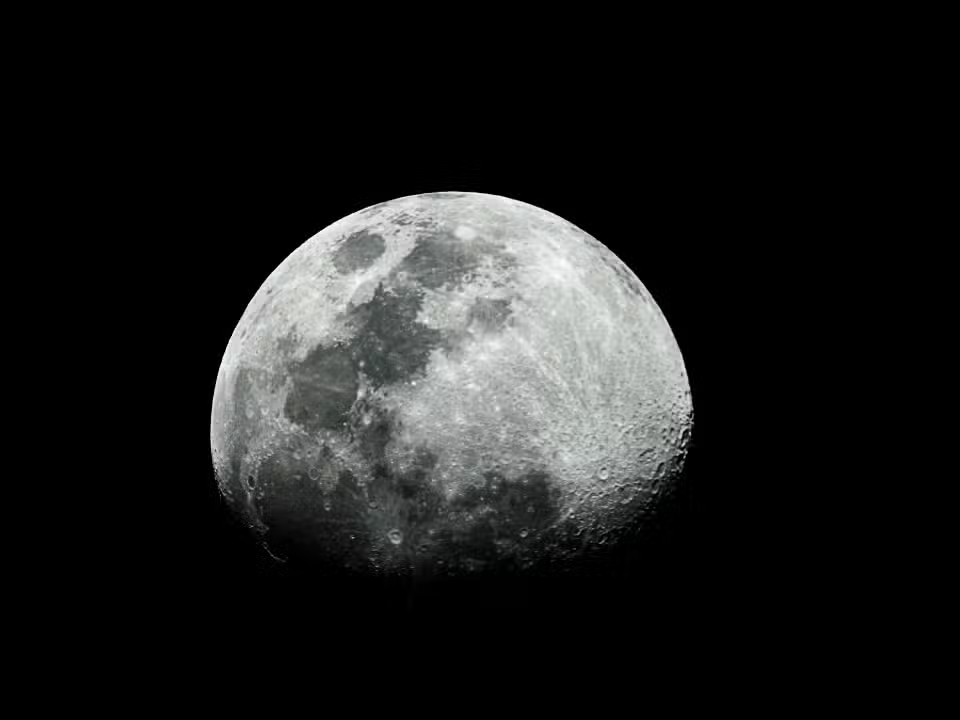
The natural satellite of Terra reaches a specific mark in its orbital trajectory this Tuesday, March 10th. The visible surface of the star presents exactly sixty percent of illumination generated by the incidence of direct sunlight in space.
This astronomical event marks the advancement of the celestial body around the planet, configuring the phase technically classified by researchers as waning gibbous. The bright portion of the sphere gradually dims each night during this geometric transition stage.
The change in the night landscape modifies the visibility conditions for identifying other objects in deep space. The change obeys the laws of celestial mechanics and provides accurate data for research institutes that monitor the sky daily.
Shading dynamics and topographic mapping
The geometric configuration established between Sol, Terra and Lua results in the progressive darkening of the lunar disk. Este physical process extends until the complete renewal of the synodic cycle, allowing terrestrial observatories to record the constant advancement of the terminator line. Essa fronteira visual entre o dia e a noite na superfície do satélite avança sobre as crateras e as vastas planícies de basalto, conhecidas cientificamente como mares lunares, alterando o contraste visual de forma previsível e contínua.
Astronomy experts point out that the reduction in natural luminosity at night favors the identification of constellations and celestial bodies of smaller magnitude. The temporal distancing of the full phase allows the blinding brightness to be replaced by a suitable setting for collecting scientific data and tracking asteroids close to Earth’s orbit. Daily monitoring reveals that the dark portion advances continuously, revealing unique topographic textures due to the grazing angle of sunlight, which makes the shadows cast by the lunar mountains longer and more defined throughout the days, making it easier to calculate the depth of rock formations.
To optimize data collection during this specific phase, research centers adopt strict technical protocols:
– Calibração of image sensors to handle extreme dividing line contrast.
– Ajuste of neutral density filters in high-power refracting telescopes.
– Sincronização of equatorial tracking engines with lunar displacement speed.
– Previous Mapeamento of craters positioned at the light boundary for high-resolution studies.
Synodic cycle and apparent motion
The lunar synodic cycle has an average duration of twenty-nine and a half days. Durante this period, the satellite completes all its visible phases from the perspective of observers located on the Earth’s surface.
The waning gibbous phase represents the stretch of this journey in which the illumination rate drops from totality to the fifty percent mark. Orbital movement causes the star to rise later and later in the night, becoming visible in the early hours of the morning.
Spatial geometry and light reflection
The phenomenon of phases results exclusively from the three-dimensional geometric relationship between the solar system’s primary light source, the planet and its natural satellite. The Lua has a perfectly synchronized rotation, rotating around its own axis at the exact same rate as it completes its translation around the Terra.
This mechanical feature, known as tidal coupling, permanently keeps the same face facing terrestrial observers, hiding the reverse side from direct view. The satellite advances in its elliptical orbit at an average speed of three thousand and six hundred kilometers per hour, constantly changing the angle of incidence of sunlight on the rocky surface.
When the celestial body is in the waning gibbous phase, it has already surpassed the position of opposition to Sol and is heading back towards the internal spatial region. The light hits the sphere obliquely, illuminating sixty percent of the disk, but with a continually growing shadow area with each planetary rotation.
Technical conditions for image capture
The presence of a moon with sixty percent illumination creates mixed conditions for the practice of professional and amateur astrophotography. The afterglow is still intense enough to obscure the capture of distant galaxies and dim nebulae during the early hours of the morning.
The dividing line between light and shadow on the lunar surface becomes the main target for high-resolution telescopic lenses. The extreme contrast generated by this division highlights the depth of the craters and the winding valleys of the star’s rugged relief.
Professionals who monitor deep space plan their image collection sessions for the moments immediately before the celestial body rises. Outra common strategy involves waiting for subsequent nights, when the percentage of luminosity drops drastically.
The daily reduction of natural light interference progressively clears the atmospheric field of vision. Isso allows ground-based telescopes to capture photons from remote stellar sources with greater clarity, following rigorous planning based on astronomical ephemeris tables.
Mathematical precision and mission scheduling
The mathematical precision of orbital mechanics allows space agencies to calculate exact illumination for any future date with virtually zero margins of error. The advancement of digital technology has transformed the way astronomical data is processed and distributed to the international scientific community, using spatial modeling software with complex algorithms to determine the exact position of celestial bodies and provide real-time updates on local meridian transit times.
Modern observatories integrate this modeling information into their high-precision automated tracking systems. Isso allows the domes and primary mirrors to automatically adjust to compensate for the rotation of the Terra, making it easier to organize observation campaigns, schedule research at universities, and schedule artificial satellite maneuvers that depend on specific lighting conditions in Earth orbit.
Transition to total darkness
Astronomical records indicate that the month began with the approach of the full phase, reaching its peak of illumination in the first week, and since then the trajectory has determined the constant decline of the light reflected towards the planet. The waning quarter phase will officially occur on March eleventh, at six hours and forty-one minutes, the exact moment when the disk will display a perfect division with half of its visible face immersed in darkness. The progression will continue uninterruptedly until March eighteenth, when the satellite will enter the new phase at ten hours and twenty-six minutes. Durante this specific stage, the side facing the planet does not receive direct sunlight, making the celestial body invisible to the naked eye and completely darkening the night sky, which marks the beginning of a new synodic cycle and offers the ideal monthly observation window to map low-luminosity objects located in the confines of Via Láctea and in neighboring galaxies.
Gravitational forces and time measurement
The regularity of the lunar movement demonstrates the gravitational forces that govern the solar system in its entirety. The continuous transition between phases highlights the orbital stability that influences the creation of astronomical calendars used by several scientific institutions around the world to mark time.
Safety in interplanetary navigation
The uninterrupted cycle of the natural satellite remains a fundamental factor in modern space navigation and understanding celestial mechanics. Continuous monitoring of these phases ensures the safety and accuracy of calculated trajectories for probes and artificial satellites operating in low Earth orbit.
The inclination of the Earth’s axis and the position of the star in its elliptical orbit determine the apparent height on the horizon during the early hours of the morning. Instrumentos measurements confirm that the rate of decrease in the illuminated area accelerates as the celestial body approaches perpendicular alignment with the Sol, setting the stage for the beginning of a new cycle of observations.