

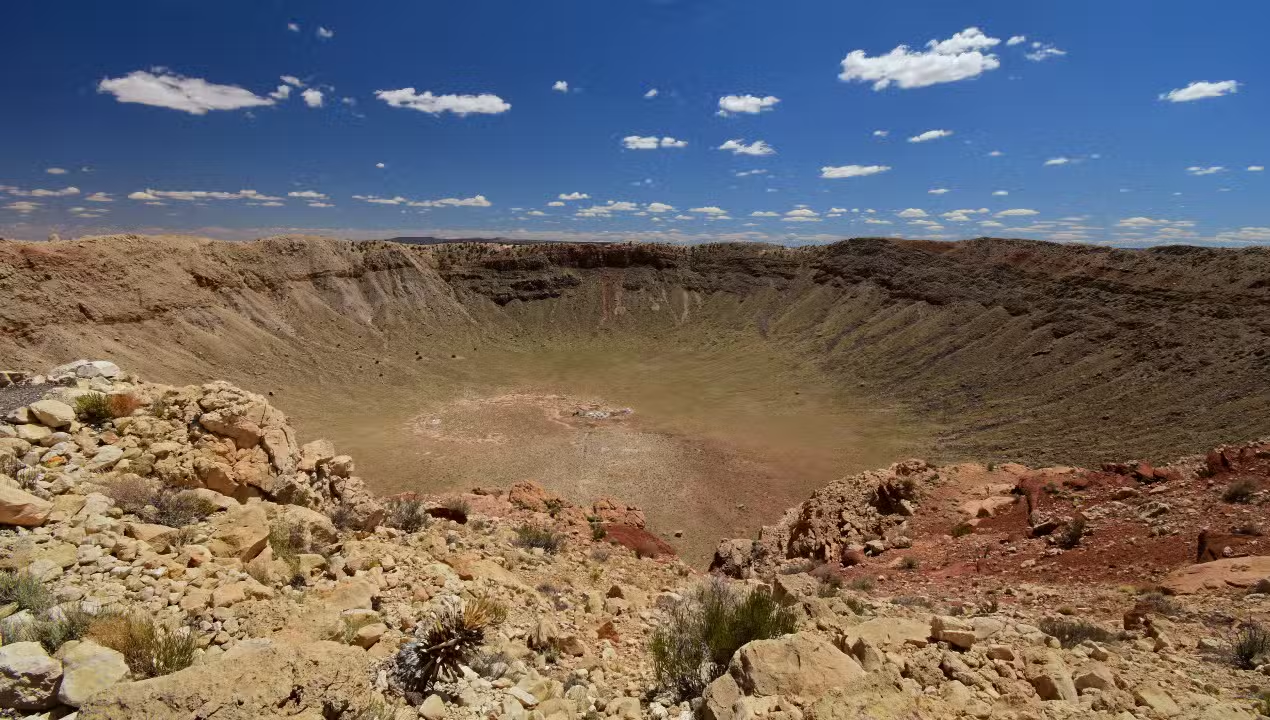
Around 50,000 years ago, a cosmic event of colossal magnitude left an indelible scar on the arid landscape of Arizona, in the Estados Unidos, resulting in the formation of Cratera of Meteorito, one of the best preserved impact sites in the world. Esta’s impressive geological structure, which stretches over 1,200 meters in diameter and reaches a depth of 210 meters, continues to be an inexhaustible source of knowledge for the global scientific community, unlocking secrets about the cataclysmic events that shaped Terra over millions of years. Pesquisadores of Sua’s remarkable preservation allows each new discovery to reinforce understanding of Terra and its interaction with the space environment.
The magnitude of this impact is difficult to conceive, but the crater’s dimensions serve as a vivid reminder of the catastrophic power involved, a force that can be compared to that of nuclear explosions, but originating in deep space. Esta characteristic elevates it to a unique level among the geological formations on our planet.
Ongoing research at the site focuses on several fronts crucial to geoscience and astrobiology:
- Analysis of the effects of shock metamorphism on minerals and rocks.
- Assessment of the impact of cosmic events on the evolution of the terrestrial biosphere.
- Obtaining comparative data for studies of craters on other planets.
Meteorito crater: a 50,000-year-old natural laboratory
Cratera of Meteoro, also known as Cratera Barringer, serves as an invaluable model for studying planetary impacts. The event that created it involved a nickel-iron meteorite, probably about 50 meters in diameter, which hit Terra at an estimated speed of 12 to 20 kilometers per second. The energy released was equivalent to several megatons of TNT, instantly vaporizing the celestial body and much of the rock at the point of impact, generating a shock wave that carved the circular depression we see today.
The crater’s uniqueness lies in its almost pristine preservation, in contrast to many other formations that have been eroded or altered by tectonic activity. The arid climate of Arizona and the absence of large bodies of water in the region have helped maintain its original characteristics over millennia, allowing scientists to precisely study the exposed rock layers and minerals altered by the shock, providing an exceptional geological record.
The legacy of scientific identification
Apesar of its grandeur, the true origin of Cratera of Meteoro was the subject of intense debate for decades at the beginning of the 20th century. Inicialmente, many geologists attributed the formation to volcanic processes, a common theory for large circular depressions in the landscape. Foi the persistent work of Daniel Barringer, a mining engineer, who challenged this prevailing view. Ele invested much of his fortune and life in the search for evidence, such as meteorite fragments and shock minerals, that proved the impact theory. Sua’s insistence on drilling into the ground in search of the main meteoric body, which he mistakenly believed to be buried intact, paved the way for scientific recognition of the site as a genuine impact crater. Essa confirmation was a milestone, reshaping global understanding of the dynamics of impact events at Terra and serving as a catalyst for the identification of other similar craters around the world, previously ignored or misinterpreted.
Mineral evidence and record of the shock
Geological studies in the crater reveal the presence of shock minerals such as coesite and stishovite, forms of silica that only crystallize under the extreme pressures and temperatures generated by high-speed impacts. Essas discoveries were crucial in validating the meteoric origin of the structure, distinguishing it from volcanic formations and confirming the nature of the event.
Detailed analysis of the rocks exposed on the crater walls allows scientists to reconstruct the impact’s sequence of events, from the ejection of material to the formation of the complex breccia structures. Cada collected sample is a fragment of time, containing information about the exact conditions at the time of the cosmic collision.
The crater’s internal topography, with its almost perfectly circular shape and the ring of ejected rocks around the rim, offers a classic model for understanding the morphology of simple impact craters. Essa characteristic is widely used in computational models and comparative studies for various planetary structures.
Ongoing research includes advanced geophysical imaging and mapping techniques, which allow researchers to visualize underground structures and the distribution of impacted materials, providing a three-dimensional understanding of the complexity of the crater’s subsurface and surrounding area.
Cosmic impacts and the evolution of life
Christian Koeberl, professor at Universidade of Esses events have shaped not only the Earth’s crust but also the atmosphere and ecosystems, driving drastic climate change and, in some cases, triggering mass extinctions that have fundamentally altered the course of life on the planet, as evidenced by paleoclimatic and paleontological studies.
One of the most dramatic examples of the consequences of a cosmic impact is the event that occurred about 66 million years ago, in the transition between periods Cretáceo and Paleogeno (K-Pg). Acredita an asteroid approximately 10 to 15 kilometers in diameter is believed to have struck Península of Yucatán, on México, creating Cratera of dinosaurs.
Cratera of Meteoro, although on a much smaller scale, serves as a microcosm illustrating the physical mechanisms behind such events. Shock waves, giant tsunamis, the cloud of dust and debris that obscured the sun for years, and the subsequent drastic climate changes, are phenomena that can be modeled and understood from data obtained in places like Arizona, albeit in a reduced proportion, providing essential information for geoscience.
Implications for planetary defense
The information extracted from Cratera from Meteoro transcends the study of terrestrial geology, being applicable to understanding impacts on other celestial bodies in our solar system. The moon, Marte and Este site offers a crucial terrestrial analogue for space missions and for the development of models that predict the behavior of materials under extreme impact conditions, advancing knowledge about the formation and dynamics of planets.
In response to the latent threat of future impacts, space agencies and scientific organizations around the world have intensified their efforts in monitoring programs for objects near Terra (NEOs). Telescópios terrestrial and space scientists track thousands of asteroids and comets, calculating their trajectories and assessing the risk of future collisions with our planet. Current technology makes it possible to identify and catalog celestial bodies that represent potential dangers with increasing precision, with international collaboration being a fundamental pillar in this surveillance and protection process.
Innovation and improvement in research
Technological advances such as mass spectroscopy and X-ray microanalysis have allowed unprecedented understanding of the materials and processes that occur during an impact. Essas tools allow scientists to identify unique chemical and structural signatures in rock fragments, revealing the composition of the original impactor and the pressure and temperature conditions to which the soil was subjected. The ability to analyze nanometer-scale samples offers a window into the fundamental physics of these violent events.
Além Additionally, Cratera of Meteoro has served as a training site for NASA astronauts, preparing them to recognize and analyze geological features in extraterrestrial environments, such as Lua and Marte. The similarities in the morphology of craters on different celestial bodies make Arizona an ideal proving ground for developing exploration and sample collection techniques on future missions, underlining the intrinsic connection between the study of our planet and the exploration of the universe and improving the skills of future space explorers.
The imperative of continued research
In short, Cratera of Meteorito in Arizona is not just a tourist attraction or a geological curiosity; it is a living scientific monument that continues to challenge and inform our understanding of space and time. Sua existence reminds us of the constant dynamics of the cosmos and our responsibility to decipher its messages to ensure a safer future for humanity. Continuing studies there is really important, as highlighted by scientist Dan Durda, so that the flow of new information never stops, enriching the global scientific heritage and strengthening planetary defense strategies.