

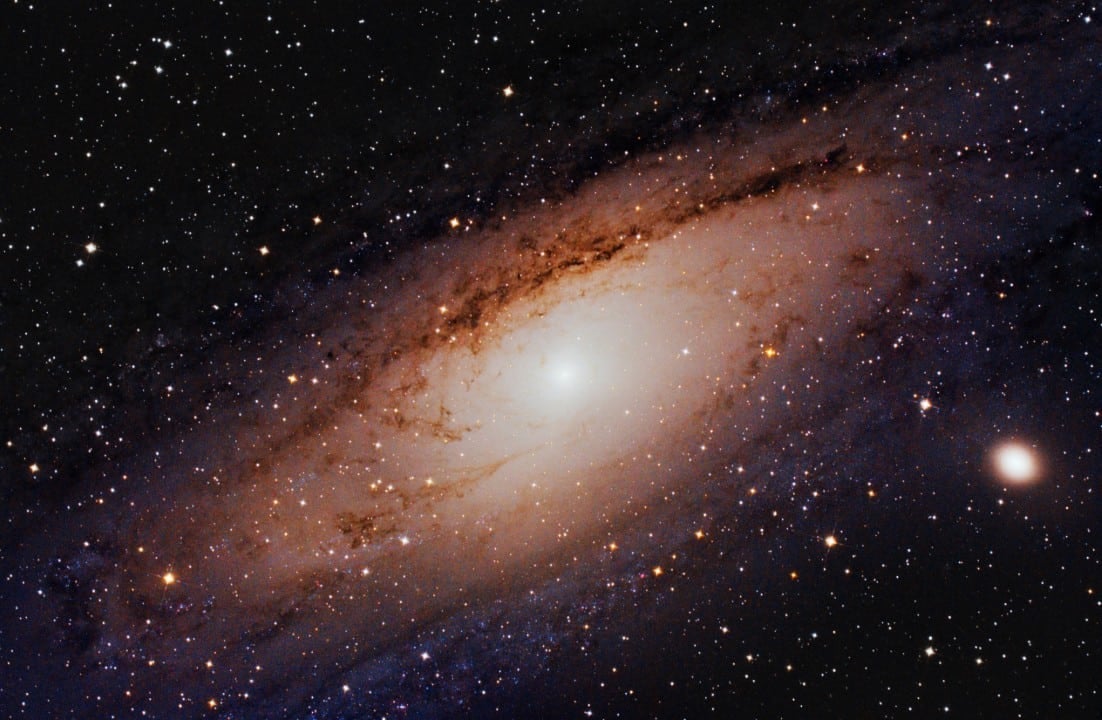
The arrival of spring marks the beginning of an unmissable space observation season for amateur astronomers in the Northern Hemisphere. Durante this period, the night sky moves away from the dusty density of Via Láctea, offering a privileged view of some of the most stunning galactic formations.
This cosmic alignment allows constellations filled with majestic galaxies to become more accessible, turning spring into a unique window of opportunity to explore deep space. Observadores with amateur telescopes can marvel at the ancient light of billions of stars in distant systems.
The search for these celestial wonders, although challenging due to their distance and faint glow, is rewarding. With ideal conditions and the right equipment, the spectacle of galaxies like Trio of Leão or Galáxia of Sombrero can be captured and enjoyed in their silent grandeur.
Essential conditions for observing galaxies
Nossa’s perception of the night sky is constantly changing, driven by Terra’s annual journey around Sol. In spring, the northern hemisphere moves to a position that provides a clearer view outside the galactic plane of Via Láctea, where the concentration of dust and stars can obscure more distant objects. Este positioning minimizes interference from light and material present in our own galaxy, allowing a clearer view of extragalactic systems.
Constellations like Leão and Virgem, which are home to some of the closest galaxy clusters to us, reach their highest point in the sky at midnight during spring. Este is the darkest moment of the day, crucial for observing galaxies that are, by nature, very faint and distant objects. Finn Burridge, scientific communicator of Observatório Real of
Tools and techniques for cosmic exploration
Observing galaxies requires both appropriate equipment and specific techniques. Para astronomy enthusiasts, having the right equipment and knowing how to use it can turn an ordinary night into a cosmic adventure. Muitos Modern amateur telescopes come equipped with GoTo mounts, which simplify locating thousands of pre-programmed targets, optimizing observation time and enhancing the experience. Aplicativos astronomy tools for smartphones also prove to be valuable tools, providing interactive star maps and detailed information about celestial bodies.
Despite technological assistance, the visual experience through a telescope’s eyepiece differs from the spectacular images captured by astrophotography, which are the results of long exposures and digital processing. However, connecting directly with the ancient light of galaxies remains a deeply rewarding experience. Para extremely faint galaxies, the deviated eye method is an effective technique. By positioning the object at the periphery of the field of vision, where the retinal rods (more sensitive to low light) are more numerous, the observer can capture more light, although without perceiving the colors.
For efficient observation of galaxies, some tips are crucial:
The Trio of Leão: a dynamic grouping
The famous Trio of Leão is an unmissable celestial spectacle for astronomy enthusiasts, located below the star Chertan, in the constellation of Leão. Este cluster of three spiral galaxies offers a unique view of interacting galactic systems, each with a different orientation and located approximately 30 million light-years from Terra. The gravitational interaction between them is a fascinating topic of study for astrophysicists.
The galaxies Messier 65 (M65), Messier 66 (M66) and NGC 3628 make up the Trio of Leão. Elas are less than 1 degree apart in the night sky, allowing them all to fit within the field of view of a low-magnification amateur telescope. Esta proximity offers observers a rare opportunity to witness the dynamics of a small galactic cluster in action, revealing the complexity of the universal structure.
Finding Trio of Leão in the sky
Para locate the Trio of Leão, begin by identifying the constellation of Leão, which shines in the southeastern sky in the hours after sunset in early spring. Then focus on the stars Chertan and Iota Leonis A, which form part of the celestial lion’s hind paw. Trio of Leão is located in the region of the sky precisely between these two stars.
Observers with a 15 cm telescope in dark skies will see the bright core of M66 and the fainter core of M65. NGC 3628, known as the “Hambúrguer Galaxy” for its dust band and profile view, requires larger apertures and clearer skies to be fully appreciated, offering a rewarding challenge to observers.
M81 and M82: giants in the Ursa Maior
Nossos next targets are Galáxia of Bode (M81) and Galáxia of Charuto (M82), both located in the constellation of M81 is a vast spiral monster that, with its apparent magnitude of 6.9, is one of the brightest galaxies visible in the Northern Hemisphere. The astronomical magnitude scale classifies objects: the lower the number, the brighter the celestial body.
In very dark sky conditions, the human eye can discern objects with magnitude as low as +6.5. Telescópios and binoculars, in turn, considerably expand this capacity, allowing the observation of much fainter objects such as galaxies and nebulae that would otherwise remain invisible.
The majestic Galáxia of Bode is accompanied by Messier 82, the “Charuto Galaxy”, so nicknamed for its elongated shape. M82 is in an intense burst of star formation, a phenomenon attributed to the significant gravitational influence of its galactic neighbor, M81, which deforms its structures and accelerates the process of creating new stars.
To locate Galáxia from Bode, find the asterism of Ursa Maior in the northeastern sky in spring. Identifique the stars Phecda and Dubhe. Traçando an imaginary line between them and extending it a similar distance, you will find the M81 region, which will appear as a fuzzy oval with a bright core, with the Galáxia of Charuto less than 1 degree away.
The Galáxia of the Sombrero and its dust lane
M104, known as Galáxia from Sua’s silhouette notably resembles a wide-brimmed hat, which earned it its distinctive nickname.
Captured with magnificent effect by Telescópio Espacial Hubble, Galáxia of Sombrero reveals its vast disc-shaped structure and pronounced dust lanes. The luminous galactic nucleus can be observed with a 15 cm telescope pointed between the constellations of Virgem and Corvo. With apertures of 20 cm or more on clear nights, the subtle streak of dust can be detected, appearing as a small oval speck of light in the eyepiece.
The Galáxia of the Redemoinho and gravitational interactions
Galáxia of Redemoinho (M51a), a spectacle of “grand design” spiral arms, shines head-on to Terra in the constellation Sua intense star formation is partly triggered by the gravitational influence of the neighboring galaxy NGC 5195, whose bright core is visible at one end of the spiral structure. Para locate it, find the star Alkaid in the
The Corrente of Markarian: a peculiar alignment
Finalmente, the Corrente of Markarian is a magnificent sequence of galaxies that spans the constellations of Leão, Virgem and Nomeada named after astrophysicist Benjamin Egishevich Markarian, who discovered their shared motions and distances, indicating their membership in the same cluster. Galáxias like M84 and M86 are galactic giants that are home to billions of stars. In the middle of the chain, the pair “Os Olhos” shines 50 million light years away, deformed by interactions. Para find it, locate Denebola in Leão and Vindemiatrix in Virgem; the current is between them. Para those looking to improve observing equipment, the best telescopes available in 2026 offer significant advances, and the list of best smart telescopes stands out in deep space astrophotography.



