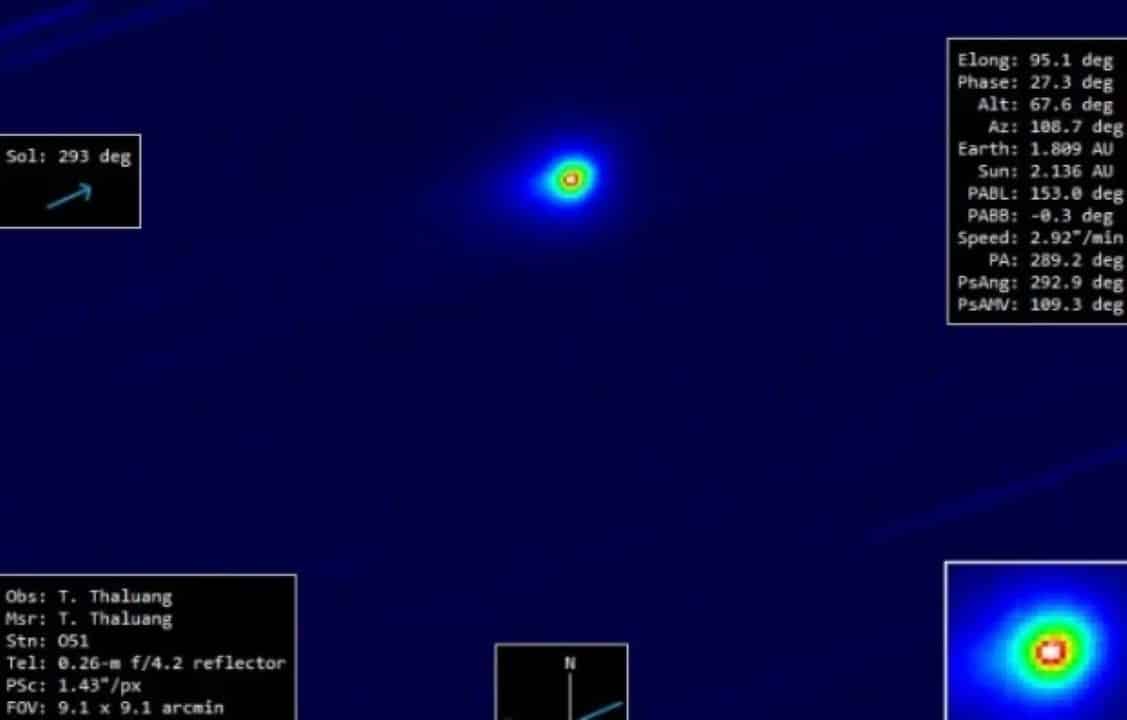
A recently observed celestial body crossing the boundaries of our planetary system has characteristics that place it among the oldest objects ever recorded by modern science. Análises Detailed chemistries and orbitals indicate that the interstellar comet 3I/ATLAS is estimated to be between ten and twelve billion years old. Essa time stamp places it in a category of formation that dates back to the initial stages of organization of Via Láctea, shortly after the events that gave rise to the universe itself.
The magnitude of this discovery takes on greater proportions when compared to the chronology of our own space environment. Terra and the entire solar system have approximately 4.6 billion years of documented existence. The formation of our local planets occurred at a time when the galaxy already had a well-defined structure and a chemistry enriched by previous generations of stars.
The interstellar visitor is more than twice that age, functioning as an intact time capsule that traveled across vast expanses of the galaxy long before our planet even appeared on the cosmic scene. The preservation of its original elements offers a direct observation window into the physical conditions that prevailed in deep space during our galaxy’s youth.
Space visitor trajectory and speed
The initial identification of 3I/ATLAS occurred when monitoring systems recorded an object moving at a speed of 221 thousand kilometers per hour. Esta displacement rate is considered incompatible with the celestial bodies orbiting the Sol, indicating an external origin. The kinetic energy accumulated by the object prevents it from being captured by our star’s gravity, ensuring that its passage is just a rapid transit event.
In addition to the extreme speed, the angle of entry into the planetary system presented a sharp separation in relation to the orbital plane where the local planets and comets are located. The Essa combination of physical factors provided definitive evidence that the space rock did not form in the Nuvem of Oort or the Cinturão of High-precision Equipamentos, like the Telescópio Espacial Hubble, were targeted to track object movement quickly. Optical measurements revealed that the comet’s nucleus has a diameter that varies between 440 meters and 5.6 kilometers.
After bypassing Sol in a gravitational assistance maneuver, the celestial body resumed its outward route, gradually moving away from the field of view of terrestrial observatories. Key orbital data recorded by research centers include:
– Rota input perpendicular to the main plane of the solar system
– Velocidade escape vastly superior to the gravitational pull of Sol
– Ausência total previous orbital interactions with local gas planets
Data capture and chemical signature analysis
Determining the comet’s advanced age only became viable thanks to the intervention of Telescópio Espacial James Webb. The observation equipment was activated at the exact moment the object reached its closest approach to Terra, passing at a safe distance of 270 million kilometers. The observatory’s infrared sensors were able to capture the invisible chemical emissions coming from the comet’s coma.
This cloud of gas and dust forms when solar radiation heats the object’s frozen surface, causing the sublimation of volatile materials that have remained frozen for millennia in the vacuum of space. The material ejected by the cometary nucleus carries the exact composition of the environment where the rock was formed. By analyzing the spectrum of light that passes through these gases, scientific instruments are able to identify the chemical elements present and their respective concentrations, creating a detailed history of the celestial body.
Telltale isotopes and formation at extreme temperatures
The main focus of the investigation was on isotopes, which are variations of the same chemical element with slightly different atomic masses. The exact proportion between different isotopes works like a cosmic fingerprint, revealing the temperature and radiation conditions of the source environment.
The results demonstrated an atypical concentration of deuterium in the water sublimated by 3I/ATLAS. Deuterium is a heavy isotope of hydrogen, and its abundance in this comet is significantly greater than that found in the water in the oceans of Terra or in comets originating in our system. The analysis also detected an important anomaly in the proportion of carbon isotopes.
This chemical divergence in relation to local patterns consolidates the explanation that the object condensed in a region of the galaxy with physical and chemical properties completely different from those that formed Sol and its planets. Deuterium and carbon levels measured by the space observatory indicate that 3I/ATLAS solidified in an extremely cold environment.
Thermodynamic calculations indicate that the region of origin had temperatures in the range of 30 kelvins, equivalent to minus 243 degrees Celsius. Esse level of freezing is strictly necessary to trap the observed isotopic ratios in the comet’s ice structure before stellar radiation could alter the local chemistry irreversibly.
Complex molecules in the structure of the early universe
The detection of advanced molecular compounds in the comet’s ejected material raises fundamental questions about the distribution of essential elements throughout the galaxy. The presence of these molecules indicates that complex chemical reactions, often associated with the building blocks necessary for the emergence of life, were already occurring in the early days of Via Láctea. The fact that an object over ten billion years old carries this chemical complexity demonstrates that the precursors of biology are not exclusive to younger stellar systems, like ours. Pelo On the contrary, these materials may have been synthesized and spread throughout the interstellar medium long before the formation of Terra, traveling frozen within the billions of wandering celestial bodies that cross the empty space between the stars. Astronomers estimate that this object’s space nursery was a dense protoplanetary disk, a structure of gas and dust that orbits a newborn star. The intact preservation of this ancient chemistry turns the comet into a galactic fossil, providing direct evidence about the composition of the molecular clouds that existed in the first billion years after the formation of the universe.
Gravitational dynamics and the impossibility of tracking
Despite the wealth of chemical data collected, tracking the exact star that served as the cradle for 3I/ATLAS is considered an unfeasible procedure. The immensity of the time that has elapsed since its initial ejection guarantees that the object has suffered numerous route deviations throughout its existence. Durante its 12 billion year journey, the comet crossed different spiral arms of the galaxy. Cada passage close to massive stars, black holes or dense molecular clouds exerted a gravitational force that changed their direction and speed. Esta complex network of interactions acts like a game of cosmic billiards on a colossal scale. Every millennium, the original trajectory was erased by a succession of kinetic perturbations imposed by a galactic environment in constant motion.
Technological advances in astronomical observation
The documented passage of this interstellar artifact validates recent investments in fast-response telescopes and deep-space infrared observatories. The ability to detect and analyze high-speed objects before they leave the solar system represents a fundamental technological leap for modern science.
Research centers now maintain continuous monitoring of the night sky, operating algorithms developed specifically to identify orbital anomalies. The expectation is that new visitors from outside the solar system will be cataloged in the coming years, increasing the volume of data available on the formation of other systems.
Accumulating data on the galaxy’s primordial chemistry will allow us to refine models of star and planetary formation. The continuous study of wandering celestial bodies consolidates a new frontier in space exploration, based on the interception and analysis of physical fragments from other regions of the Via Láctea that cross our path naturally.
