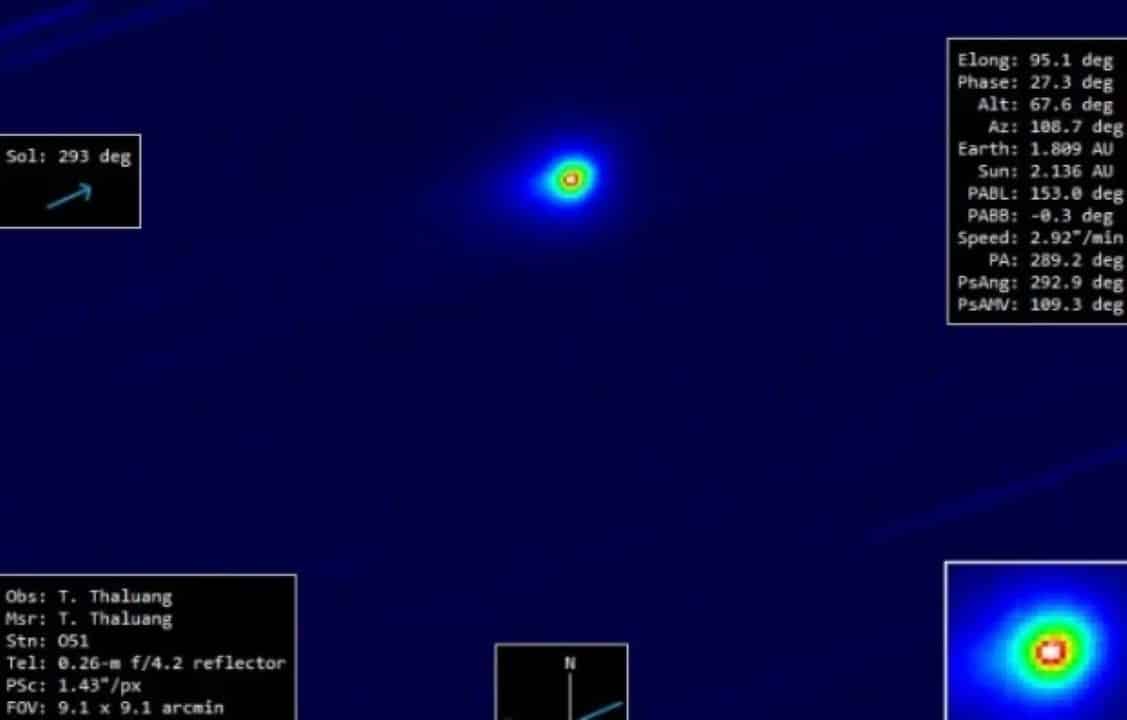
A newly discovered celestial body has crossed the boundaries of Sistema Solar and redefined scientific understanding of galaxy formation. Pesquisas recent studies indicate that the interstellar comet 3I/ATLAS has an estimated age of between 10 and 12 billion years. Essa timestamp classifies it as one of the oldest objects ever detected in the vicinity of Earth’s orbit. The period dates back to a phase in which Via Láctea took its first structural steps, shortly after the emergence of the universe, calculated at 13.8 billion years.
To establish a comparison parameter, Terra is approximately 4.5 billion years old. Sistema Solar, in turn, was consolidated around 4.6 billion years ago. Caso astronomical measurements are confirmed, the space visitor is more than twice the age of our planet, functioning as an intact time capsule that traveled through cosmic darkness until it was intercepted by human observation instruments.
Detailed data on the composition and chronology of the object are contained in a survey published on the scientific platform Research Square. The repository houses preliminary studies before formal peer review, allowing the global community of astrophysicists to access and validate the information collected in an accelerated manner, given the unique importance of the finding for space science.
The analysis of the celestial body raises fundamental points for modern astrophysics, standing out on three main fronts of investigation:
– The identification of primordial materials that resisted stellar degradation.
– The measurement of rare isotopes in their gaseous structure during evaporation.
– The absolute confirmation of its origin external to our planetary system.
Anomalous trajectory and high travel speed
The initial recognition of 3I/ATLAS occurred in 2025, marking a singular moment for contemporary astronomical observation. Sky scanning equipment recorded a body crossing local space with extreme speed and a route completely divergent from the orbital pattern known for comets that inhabit Nuvem of Oort or Cinturão of Kuiper.
The combination of speed and atypical trajectory provided definitive proof that the object was not born under the gravitational influence of Sol. Essa finding immediately classified the body as an interstellar traveler, a very rare observation category in current science, offering a unique opportunity to study matter forged in alien star systems.
Initial observations and dismissal of alternative theories
Visitor detection generated intense debate in the early days of continuous monitoring. Algumas Unsubstantiated speculation quickly circulated, suggesting artificial origins for the luminous object that cut across the night sky.
The astronomical community acted quickly to present the technical data and rule out any unscientific hypotheses. Spectrographic evidence confirmed the rocky and frozen nature of the celestial body, aligning it perfectly with the expected morphology of a comet ejected from its parent system.
The focus of the investigation immediately returned to collecting data on chemical composition. The rapid passage required an immediate mobilization of the world’s largest observatories before the object disappeared into the darkness of deep space, far from the reach of Earth’s lenses.
Precise measurements with cutting-edge technology in space
Telescópio Espacial Hubble assumed a central role in the first phase of the visitor’s physical characterization. The orbital equipment, free from the distortions of the Earth’s atmosphere, was able to measure the size of the rocky core with high photometric precision.
Estimates indicated a diameter ranging between 440 meters and 5.6 kilometers. Essa considerable mass traveled at an impressive speed of 221 thousand kilometers per hour during its closest approach to the center of our system.
The path included a transient orbital maneuver around Sol, using stellar gravity as a natural acceleration mechanism. Após this contour, the body resumed its journey towards deep space, following a hyperbolic trajectory of no return.
The visual observation window was short, but sufficient to map the flight dynamics accurately. The progressive distancing transferred the responsibility for research to instruments focused on infrared radiation, capable of seeing beyond the visible spectrum.
Capturing chemical signatures by infrared radiation
The most complex stage of the research occurred under the lens of Telescópio Espacial James Webb. The observatory aimed its hexagonal mirrors at the target in late December 2025, taking advantage of Terra’s distance of 270 million kilometers. The equipment’s infrared sensitivity allowed the reading of the most subtle chemical signals emitted by the evaporation of surface ice, a process triggered by residual heat from the passage close to Sol.
The heating caused the release of gases that formed the comet’s vast tail. Scientists focused on analyzing this cloud of volatile material to find specific isotopes. Essas atomic variations serve as an unalterable fossil record, indicating the exact temperature and pressure conditions of the environment where rock and ice fused billions of years ago, long before Terra existed.
Isotopic anomalies and the extreme cold environment
The chemical mapping results yielded surprising proportions of deuterium, a heavy isotope of hydrogen, in concentrations much higher than those found in the water of local comets. Somado to this, the carbon signature completely diverged from the patterns of Sistema Solar. Essa anomalous combination provides material proof that 3I/ATLAS condensed in an environment of absolute cold, with temperatures estimated at 30 kelvins, the equivalent of minus 243 degrees Celsius. Tais extreme thermal conditions indicate that the birthplace of this celestial body operated under very different physical and chemical rules than those that forged its terrestrial neighborhood, pointing to a primordial molecular cloud that preserves the exact chemistry of the universe in its youth.
Formation in ancient protoplanetary disks
The chemical structure suggests that the birth occurred inside a very old protoplanetary disk. Essas vast clouds of gas and dust orbited young stars in the early days of Via Láctea, serving as raw material for the first planetary systems, housing complex molecules that predate the formation of our own Sol.
The permanent enigma of the exact origin
Identifying the star system that ejected the comet remains an insurmountable obstacle for modern astrophysics. The journey of more than 10 billion years involved complex gravitational interactions with countless stars, nebulae and other massive bodies.
Each cosmic encounter subtly altered the original route, definitively erasing the object’s directional trail. 3I/ATLAS now continues its path into the unknown, leaving behind an invaluable amount of data on the primordial chemistry and dynamics of the ancient universe.
