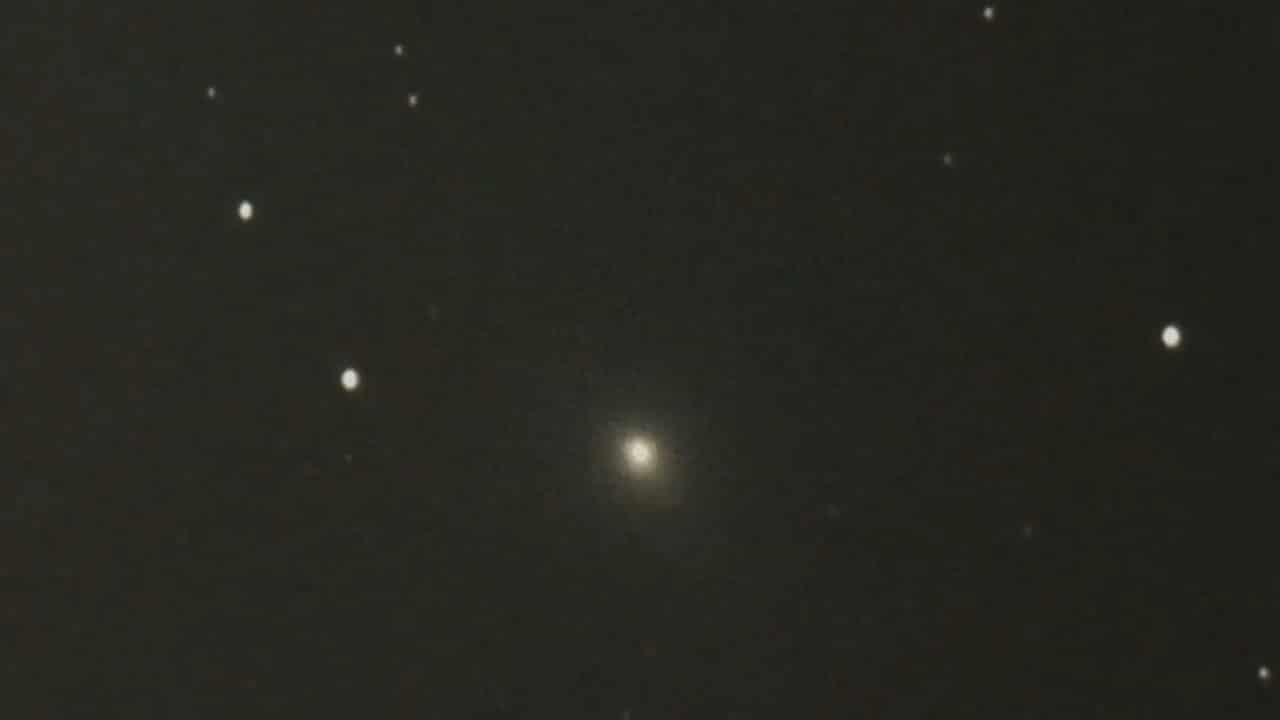
An intriguing cosmic object, called 3I/ATLAS, is challenging conceptions about planetary formation and the history of Via Láctea. Não is not an ordinary comet, but rather an interstellar visitor that appears to be a relic from ages long before the existence of our own solar system. Current observations suggest this cosmic traveler may be impressively old, surpassing most known celestial bodies.
Recent data indicate that 3I/ATLAS may be between 10 and 12 billion years old, placing it in a unique category of objects that witnessed the beginnings of our galaxy. Este colossal time positions it as a material fragment that existed when Via Láctea was just beginning to structure itself, long before Terra was even a remote possibility in the universe. Sua passage through the solar system offers a rare opportunity to study the distant past.
Scientists are analyzing the composition and characteristics of this comet to unravel mysteries about the conditions of the universe in its early stages. Its uniqueness goes beyond a simple passage, representing a direct link with an ancient chapter of cosmic history. The ability to study such a primordial object, originating in a distinct star-forming environment, opens up new perspectives for astrophysics.
A cosmic fossil older than the solar system
The most notable part of the new discoveries concerns the exceptional age of the object. Preliminary Resultados, based on detailed observations from Telescópio Espacial James Webb (JWST), point to an isotopic composition of 3I/ATLAS that differs markedly from that found in comets that formed within our solar system. Essas Chemical “fingerprints” are crucial in determining the object’s origin and timeline.
Such chemical ratios strongly suggest that 3I/ATLAS may have formed an astonishing 10 to 12 billion years ago. Essa’s age makes it more than twice the age of Terra and all of Sistema Solar, which formed approximately 4.6 billion years ago. Este comet is not just a “fossil” in the literal sense, but a frozen time capsule from a period when Via Láctea was a very different place, with fewer heavy elements and intense star formation.
Chemical composition challenges conventional models
Age is an important factor, but the composition of comet 3I/ATLAS is equally intriguing to the scientific community. Observações carried out by James Webb and other space instruments had previously indicated that the comet was exceptionally rich in carbon dioxide. The most recent isotopic analyses, in turn, only corroborate the perception that it is something chemically distinct from the comets that originated in our own solar system.
This chemical singularity suggests that 3I/ATLAS may have formed under astrophysical conditions that are no longer common in today’s Via Láctea, or that are rare even in the outermost, coldest parts of protoplanetary nebulae. The presence of such a peculiar isotopic signature offers researchers valuable clues about the stellar and galactic environment that gave rise to this object.
The Agência Espacial Europeia (ESA) materials also include detections of other volatile components in the comet, such as water, carbon monoxide, carbonyl sulfide, and water ice. Observing these compounds in a tenuous layer of gas and dust, known as a coma, that surrounds the comet’s nucleus, allows scientists to infer the conditions of its formation and what it preserved throughout its vast cosmic journey.
The millennial journey of 3I/ATLAS through the milky way
3I/ATLAS, like other interstellar objects, is believed to have been ejected from its original star system, probably during violent gravitational interactions at an early stage in the galaxy’s life. Este process, which can occur when newly formed giant planets interact with smaller bodies, launched the comet on a trajectory that caused it to wander through interstellar space for billions of years, until its recent detection in our system.
The rarity of observing such an ancient object with an extragalactic origin highlights the importance of 3I/ATLAS. Most of the comets studied are considered “time capsules” of our solar system’s youth. However, 3I/ATLAS elevates this analogy to a cosmically larger scale, being a fragment of the building blocks of an era when the galaxy was in its infancy, just beginning to take shape.
Studying its trajectory and its interactions with the interstellar medium can reveal details about the distribution of matter and gravitational fields in regions distant from Via Láctea. With each encounter with star systems, its orbit may have been subtly altered, adding more layers to its already complex travel story.
Its passage is an event that occurs on an astronomical timescale, allowing modern instruments to capture unprecedented data. Understanding how and why it was ejected is fundamental to deepening knowledge about the dynamics of planetary systems in other parts of the galaxy.
James Webb: unlocking secrets from the distant past
Telescópio Espacial James Webb played a pivotal role in these discoveries. Suas Advanced infrared spectroscopy capabilities have allowed astronomers to analyze the light emitted and absorbed by the comet’s materials with unprecedented precision. Essa analysis is what revealed the distinctly different isotopic composition of 3I/ATLAS.
JWST’s sensitivity and resolution are essential for studying such faint and distant objects, enabling the detection of chemical elements and their proportions in a coma of gas and dust that would otherwise be impossible to characterize with previous equipment. Através Of its multiple instruments, Webb functions as an orbiting laboratory, providing crucial data for reconstructing the comet’s history.
The ability to observe at infrared wavelengths is also critical because it allows it to penetrate dust and gas that can obscure visible light, revealing deeper features of celestial objects. Esta is one of the reasons why Webb is so effective at unlocking the secrets of bodies like 3I/ATLAS, which formed in possibly colder, denser environments.
Windows into primordial star formation
The characteristics of 3I/ATLAS suggest that it formed in an environment poorer in heavy elements than that which gave rise to our own solar system. Isso refers to an early period of Via Láctea, when the first generation stars, which produced these heavy elements, had not yet enriched the interstellar medium. Este comet, therefore, is a remnant of the conditions of primordial star formation.
Comparing an ordinary comet to this ancient object is like juxtaposing a family album with a clay tablet recovered from an archaeological dig. Ambos preserve the past, but the time scale is radically different. 3I/ATLAS may be one of the oldest fragments of planetary material ever directly observed passing through our solar system. Ele makes us look not just at a spectacular object, but at a very ancient document of the natural history of the galaxy.
Understanding Vast Galactic History
The discovery and in-depth study of comet 3I/ATLAS represents a significant milestone in astronomy and astrophysics. By providing a window into the conditions of the early universe, it helps us better understand the evolution of stars, planetary systems, and Via Láctea itself. Cada new information collected about this object is an additional piece in the puzzle of our cosmic origin. Scientists hope that continued monitoring of 3I/ATLAS with advanced technologies will continue to reveal details about the formation of objects in other galactic regions and epochs.
