

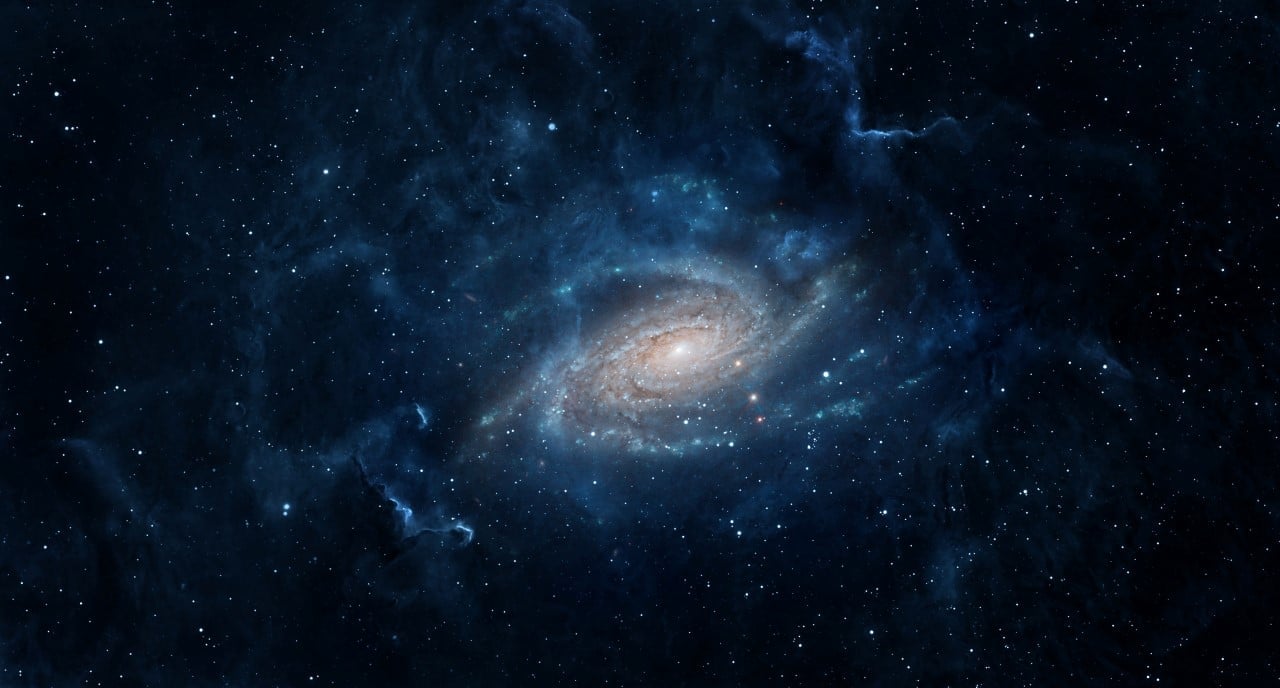
An instigating discussion has shaken the world of science, calling into question one of its most deeply held pillars: the universality of the laws of physics. Physicist Yoshihiro Taguchi, with a provocative perspective, suggests that our understanding of physics, including fundamental principles such as F=ma, may not be inherent to the universe, but rather a purely human construct. Esta statement challenges the common belief that these laws would apply in any corner of the cosmos, regardless of the intelligent life form that observes them.
The central thesis of Taguchi is that the way we perceive and interpret the world is intrinsically linked to our biology and the mechanisms we have developed to survive and extract information from the environment. Essa vision suggests that, if an extraterrestrial life form possessed a sensory and cognitive apparatus radically different from ours, its “physics” could be something unimaginably different, making the sharing of concepts that we consider universal unfeasible. The debate takes on complex contours when touching on the very essence of scientific knowledge and its limits.
The scientific community, in general, nurtures the idea that physics transcends biological and cultural boundaries. However, Taguchi, supported by other voices such as Professor Mounai, proposes that this perception may be an illusion rooted in our own human perspective. The discussion not only reignites old philosophical questions about the nature of reality, but also has significant implications for how we approach the search for intelligent life in the universe and potential communication with it.
Universality in check: the vision of Taguchi
Physicist Yoshihiro Taguchi openly questions the assumption that the laws of physics apply identically throughout the universe. Ele argues that the way living organisms interact with the world is a determining factor in building their understanding of reality. In other words, the physics we know is ultimately a product of our biological evolution and the cognitive tools we developed to interpret the environment.
This perspective suggests that physics is not an absolute and independent truth of human existence, but rather a convenient formalization of our reality, created by humans for humans. Isso contrasts sharply with the traditional view that laws like “F=ma” are fundamental principles that would exist and be valid even if humanity had never emerged.
The role of biology in the construction of knowledge
For Taguchi, biology plays a crucial role in how we conceive of physics. Ele explains that living organisms evolve to extract the minimum amount of information necessary and advantageous for their survival, discarding everything else. Esse process of filtering and interpretation shapes our perception and, consequently, our formulation of physical laws.
Professor Mounai corroborates this idea, agreeing that human understanding is, by nature, biased. Ele recognizes that although physicists wish to believe in the objectivity and independence of their science, the reality is that it is deeply rooted in biological mechanisms specific to the human species. Essa interdependence between biology and physics is a central point of Taguchi’s argument, suggesting that our science is more “human” than we would like to admit.
Mathematics vs. physics: the crucial distinction
Taguchi establishes a fundamental distinction between mathematics and physics. Para he, mathematical theorems are universal and, in fact, would exist independently of human presence, as abstract logical structures. Esta The intrinsic universality of mathematics makes it a powerful tool for describing phenomena, but it does not guarantee that the resulting descriptions are universally valid in other contexts.
Physics, on the other hand, is described as a convenient formalization of our reality, using the tool of mathematics. This is where the limitation for sharing with other forms of intelligence lies. If alien beings’ perception of the world is fundamentally different from ours, even if they understand mathematics, their “convenient formalizations” of reality—their physics—could be incompatible with ours.
The illusion of scientific romanticism
Taguchi shares a personal experience to illustrate his shift in perspective. Ele reveals that, during his training, he chose physics out of a “certain romanticism”, believing that he would study something that would exist and make sense even in the absence of humanity. Essa vision, which saw physics as the “queen of sciences” and a field of eternal truths, deeply motivated him.
However, his intellectual journey led him to a “shocking truth”: physics is not so independent after all. The understanding that laws like “F=ma” are human creations, developed from our perception and interaction with the world, shook this romantic belief. Ele realized that physics is ultimately about humans and for humans, altering his initial motivation significantly.
Debate on subjectivity in science
The introduction of subjectivity into the discussion about physics is a sensitive point for many scientists. Tradicionalmente, physics is seen as the epitome of objectivity, a field that seeks to describe observer-independent universal truths. Sugerir that physics is a “human science”, with biological and perceptual bases, confronts this entrenched view and can be seen as a threat to its credibility.
Professor Mounai recognizes this resistance, noting that physicists, by nature, like to believe in the independence of their discipline. Contudo, he agrees with Taguchi that, ultimately, human understanding is biased. Este debate does not seek to devalue physics, but rather to promote deeper reflection on the limits and nature of the knowledge we construct.
Implications for extraterrestrial contact
The perspective of Taguchi has profound implications for the search for intelligent life outside of Terra and for how we imagine possible contact. If the laws of physics we know are not universally shared, the idea that we could simply “exchange physics knowledge” with alien civilizations becomes much more complex.
This suggests that interspecies communication could require a much deeper and more flexible understanding of different ways of perceiving reality. Rather than assuming that an alien would understand an F=ma diagram, we would first need to try to understand the fundamental structure of its “perception of the world.” Communication and decoding strategies for interstellar messages would need to be rethought to take this radical perceptual difference into account.
New perspectives in the philosophy of science
The discussion raised by Yoshihiro Taguchi contributes significantly to the field of philosophy of science, encouraging a critical reevaluation of taken-for-granted premises. Ela forces us to consider that scientific knowledge, even in the most “exact” fields, may be more intertwined with our biological and cognitive nature than previously thought.
This debate does not diminish the validity or usefulness of physics in our earthly context, but it expands our understanding of the limits of what we can know and what is truly universal. Ele invites us to intellectual humility, recognizing that our vision of the universe is one of countless possibilities, shaped by our experience as human beings. Taguchi’s provocation paves the way for a field of research and reflection that explores not only what we know, but how we come to that knowledge.