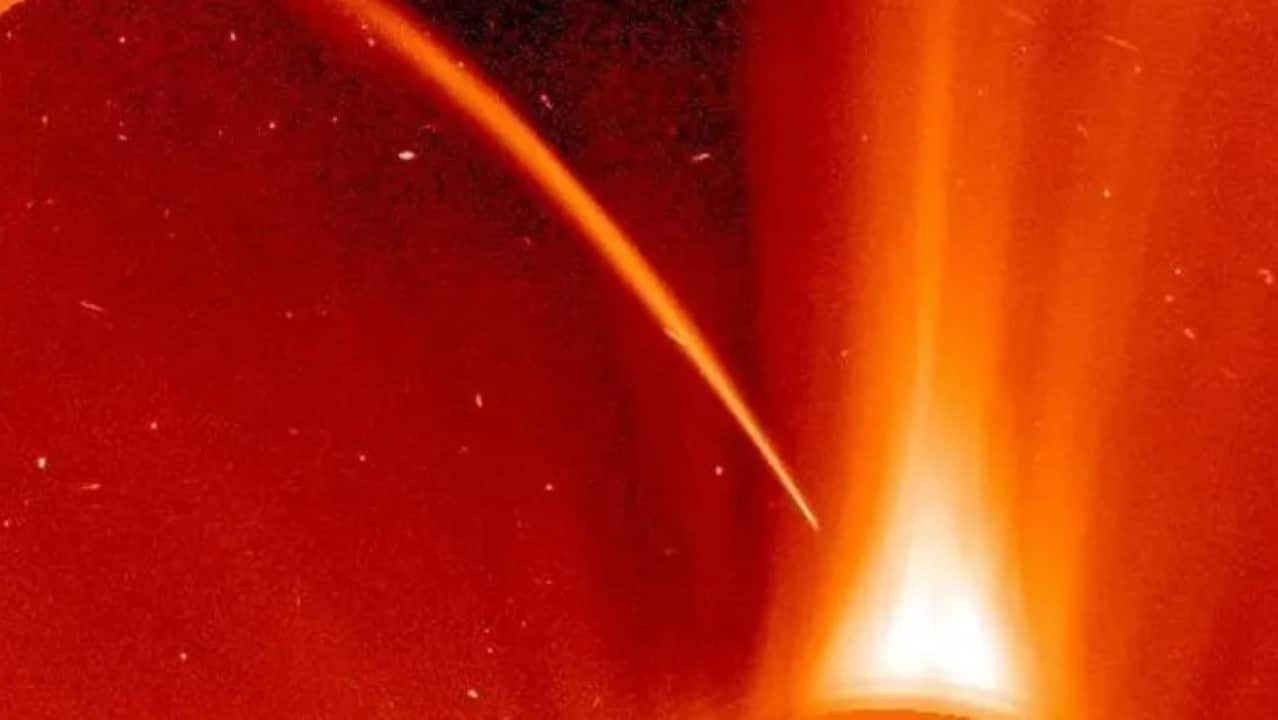
A newly discovered comet, C/2026 A1 (MAPS), has captured the attention of the scientific community with its peculiar orbit and unexpected brightness, promising a rare spectacle on April 4, 2026. can reveal crucial data about its nature.
Although it was initially classified as an Kreutz-type flyby comet, subsequent data raised serious doubts about this categorization. Sua’s orbit of nearly 1,900 years, twice the period of any other known member of the Kreutz group, and its detection at a significantly greater distance from Sol than usual for this type of comet, suggest unusual features.
The intrigue increases with the dramatic and above-prediction brightness of C/2026 A1 (MAPS), currently around magnitude 9.9, with no satisfactory conventional explanation for its intensity at this stage. Este anomalous behavior drives astronomers to investigate the comet’s composition and internal structure with renewed interest.
The opportunity to observe a celestial object under extreme conditions, such as proximity to Sol, is of great value for astronomical research. Tais encounters allow scientists to examine the composition and resilience of celestial bodies, revealing secrets about their formation and evolution.
The relevance of observing grazing comets
The analysis of comets that approach Sol at minimum distances is a powerful tool for astrophysics. The intense heat and extreme gravitational forces act like a cosmic “stress test,” forcing the solid surface of comets to vaporize and exposing their interior. Isso allows scientists to study the object’s primordial composition and structure through detailed observations.
Previous examples, such as the interstellar comet 1I/`Oumuamua, which collides with Sol approximately every 30 years, demonstrate the rarity and importance of these events. Observatórios like the Telescópio Solar Inouye (DKIST) in the Havaí and the Observatório Solar and Heliosférico (SOHO) in space are crucial to capturing these moments, providing unprecedented data.
Studying these celestial visitors helps fill gaps in our understanding of the origins of planetary systems and the diversity of objects that roam the galaxy. Cada new comet, especially those with atypical behaviors, add a valuable piece to the cosmic puzzle, challenging existing models and driving new theories.
Details of the solar approach of C/2026 A1 (MAPS)
Comet C/2026 A1 (MAPS) will make its closest approach to Sol, reaching perihelion, on April 4, 2026. Neste critical moment, it will pass an impressive 161,000 kilometers from the solar surface, equivalent to just 23.1% of the radius of Sol. The maximum speed reached will be 557 kilometers per second, a significant fraction of the speed of light.
From the point of view of Terra, the comet will experience a solar conjunction, disappearing behind Sol at 13:19 UTC and reappearing in front of it at 15:34 UTC, in both cases separated by a small angular distance from the solar center. Este positioning offers a unique opportunity for focused telescopic studies.
Passage through the solar corona, the outer atmosphere of Sol, promises a visual spectacle of cosmic “fireworks” as the object fragments and burns. The observations will allow for an in-depth analysis of the comet’s composition and its ability to withstand extreme solar conditions.
The closest approach to Terra will occur one day later, on April 5, 2026, at 23:56 UTC, when the comet will be 143.8 million kilometers away. Embora this distance is almost the same between Terra and Sol, it is still an opportunity for observations from terrestrial and space instruments.
Anomalies that defy classification
The characteristics of C/2026 A1 (MAPS) are generating intense debate among astronomers. The difficulty in fitting it into the Kreutz family of comets, a group known for its highly eccentric orbits and perihelions very close to Sol, lies in crucial details that distinguish it.
Firstly, its orbital period of almost two millennia is a fact that does not align with the patterns of the Kreutz group, which generally have significantly shorter periods. Essa disparity suggests a different origin or evolution for C/2026 A1 (MAPS), possibly indicating that it is not a fragment of Kreutz’s parent comet, but rather an object with a unique history of its own.
Secondly, the early detection of the comet, 81 days before perihelion and at a distance greater than 2 AU (astronomical units), is another point of divergence. Cometas of type Kreutz are typically detected much closer to Sol, as their activity intensifies dramatically as they get closer. The visibility of C/2026 A1 (MAPS) at this greater distance indicates that it has an unusual size or extraordinary activity, maintaining a brightness that defies conventional predictions for an object of its category.
This runaway brightness raises questions about the composition and internal structure of the comet’s nucleus. Does Poderia contain more volatile materials that sublime over greater distances, or is its structure less dense, facilitating the release of gas and dust? The absence of satisfactory conventional explanations for this luminosity makes it an even more fascinating and enigmatic object of study for science.
The complex relationship with 3I/ATLAS
Despite the recent discovery and anomalies of C/2026 A1 (MAPS), the probability of it having any relationship with the interstellar object 3I/ATLAS is considered low by scientists. 3I/ATLAS, which has intrigued astronomers for its 22 anomalies, including its unusual size and mass, has distinct orbital and physical characteristics that separate it from the newly discovered comet.
Firstly, the estimated diameter of C/2026 A1 (MAPS), of just under 2.4 kilometers, is only comparable to that of 3I/ATLAS, but the similarities end there. The orbital inclination of C/2026 A1 (MAPS) is 144.5 degrees, a considerable difference of 30.6 degrees from the 175.1 degree inclination of 3I/ATLAS. Essa significant difference in inclinations suggests that the two objects followed independent trajectories in space, making it unlikely that one is a fragment of the other, especially considering the implications of an object breaking away from an interstellar hyperbolic orbit into an orbit bound to Sol.
3I/ATLAS remains an enigma with many unanswered questions about its nature and origin, especially after its approach to Júpiter. The difficulty in reconciling its characteristics with standard models of interstellar objects reinforces the need for more data and observations. Cada visitor to our solar system, whether interstellar or from our own cosmic backyard, offers a unique window into understanding the vast and complex tapestry of the universe.
Opportunity for science and public curiosity
The flyby of C/2026 A1 (MAPS) through Sol represents a golden opportunity for the scientific community. Observar What happens when this object burns and fragments under solar heat and pressure could reveal unprecedented details about its chemical composition, density and structural strength. Essas information is vital for refining models of comet formation and evolution.
Furthermore, the anticipation surrounding events like this stimulates the public’s curiosity and passion for science. Global attention turns to the cosmos, reinforcing the importance of astronomical research and investment in space observation technologies. The quest for knowledge about these celestial visitors often inspires new generations of scientists and enthusiasts, demonstrating the intrinsic value of exploration.
The scientific community, in turn, embraces the opportunity to question existing classifications and seek new understandings. The willingness to face anomalies and challenge established models is a pillar of scientific progress, opening doors to discoveries that can redefine our perception of the universe.
Perspectives for future discoveries and the search for truth
The constant discovery of celestial objects with unexpected characteristics, such as C/2026 A1 (MAPS) and 3I/ATLAS, highlights the richness and complexity of the universe. Cada new observation and anomaly serves as a reminder that our knowledge of the cosmos is constantly evolving, and that there is always more to be learned and understood.
Advances in telescope technology and detection methods promise to reveal even more visitors to our cosmic backyard. The ability to “interrogate them under extreme heat”, as in a comet’s close pass by Sol, is an effective strategy for unraveling their mysteries. The future of the astronomy of comets and interstellar objects appears to be full of new revelations as science continues to refine its tools and theories.
These events also foster a broader dialogue about science and the search for truth, encouraging an attitude of openness and intellectual curiosity. The willingness to question the inexplicable and confront initial reactions from the scientific community, as illustrated in several discussions about anomalous objects, is fundamental to the advancement of knowledge. The cosmos continues to offer us enigmas, and the passion for discovery is the engine that drives humanity to unravel them.
