

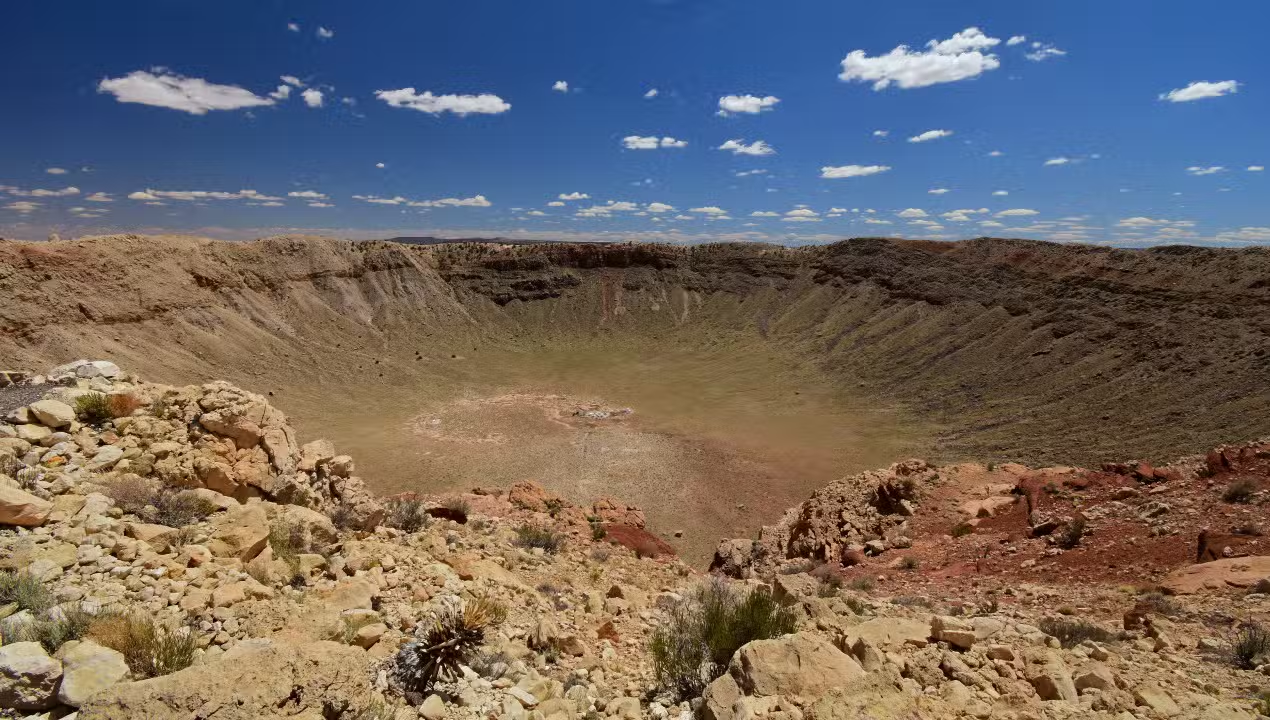
The deep circular scar in the rocky desert of Arizona, known as Cratera of Meteoro, continues to be a focus of intense scientific investigation, even approximately 50,000 years after its formation. Esta impressive geological structure, which extends 213 meters deep, more than 1,219 meters in diameter and 3.9 kilometers in circumference, is considered the best preserved meteorite impact site in the world. Each year, new on-site analyzes and field studies provide crucial data for understanding the cosmic events shaping our planet.
The relevance of Cratera of Meteoro transcends its mere existence as a natural landmark. Ela acts as an open-air laboratory where scientists can observe and analyze the effects of a hypervelocity impact on a scale that no terrestrial experiment can replicate. The site has not only preserved the shape of the crater, but also geological and mineral remains that are direct witnesses to the unimaginable force released at the moment of the collision.
Funding for continued research plays a vital role in expanding knowledge about these phenomena. Bolsas competitive research programs are offered to support studies at known or suspected impact sites around the world. Este investment enables laboratory and computational analyzes of samples and discoveries, generating new data from the exploration of ancient craters around the globe.
A natural laboratory of immense scale
One of the frequent visitors and active researchers at the site is Dan Durda, scientist at Southwest Research Institute (SwRI) at Boulder, Colorado. Ele emphasizes the unique importance of Cratera of Meteoro to science. Its exceptional preservation makes it an unparalleled field of study.
Durda emphasizes that the crater still provides new information every year, which makes continuing studies at the site truly crucial. Constant observation allows the scientific community to refine impact models and better understand the processes that occur when cosmic objects reach Terra, with implications for planetary protection.
Challenges in identifying impacts
Christian Koeberl, of Departamento of Pesquisa of Litosfera of Universidade of Viena, Ele chairs the Barringer Crater Company Scientific Advisory Committee (BCC), which has created scholarships to support students and early career researchers studying Earth impact craters. The objective is to deepen the understanding of these trainings and encourage new talents to follow these essential lines of research.
Cratera Barringer, as it is also known, was one of the first, if not the first, crater on Terra to be recognized as being of impact origin in the early 20th century. Recognizing other impact craters on our planet is a considerable challenge, mainly due to active geological and atmospheric processes that tend to obscure or erase the record of collisions over relatively short periods of time. Erosion, plate tectonics and sedimentation contribute to erasing these marks of time.
Despite limited information on the record of ancient impacts, it is known that impact events have had severe effects on the geological and biological evolution of Terra. An emblematic example is the great impact that marked the transition from the period Cretáceo to the Paleogeno, around 66 million years ago, an event widely associated with the extinction of dinosaurs and other forms of life.
The importance of metamorphic effects
For Koeberl, morphological and geophysical surveys are crucial for recognizing anomalous structural features in the subsurface, which may indicate deeply eroded craters or impact structures completely covered by post-impact sediments. Subsequent detailed investigations involve confirming shock metamorphic effects in minerals and rocks, or the presence of a meteoritic component in these rocks. In nature, these metamorphic shock effects are uniquely characteristic of shock levels associated with hypervelocity impacts, providing an unambiguous signature of a cosmic event.
Research advances and support
Impact craterization is a short-lived, high-energy geological event, creating conditions that surpass those of nuclear explosions. Understanding these phenomena is fundamental not only for planetary geology, but also for astrophysics and evolutionary biology. Estudos of this nature has led to the identification of approximately 200 confirmed impact craters in Terra to date, each contributing unique pieces to the vast puzzle of our geological and cosmic past.
Impact crater studies have gained increasing importance over the years, consolidating themselves as an interdisciplinary effort that unites different areas of knowledge. The global scientific community is committed to encouraging young researchers from around the world to submit funding proposals, ensuring that the next generation of scientists can continue to unlock the secrets held within these stunning planetary scars.
Legacy and future of exploration
Cratera from Meteoro into Arizona stands as an enduring testament to the power of cosmic impacts and a beacon for scientific research. The continued commitment to its exploration not only enriches our knowledge about Terra, but also prepares us to better understand the processes that occur on other celestial bodies and the importance of monitoring nearby objects.