The complexity of operations in space requires continuous, uninterrupted coordination between terrestrial government agencies and crews in orbit. Atualmente, the floating laboratory that orbits Terra, serves as a base for a series of technical and scientific procedures that are absolutely essential for advancing the exploration of the cosmos. Homens and women of different nationalities dedicate their journeys to maintaining critical life support systems, while also conducting tests that directly benefit medicine, biology and engineering on the planet. The routine in the microgravity environment is extremely rigorous, guided by precise schedules that do not allow room for operational failures or logistical delays.
The current expedition team focuses its daily efforts on closely inspecting spacesuits, calibrating state-of-the-art research hardware, and receiving and releasing unmanned cargo vehicles. The daily work reflects the commitment of the nations involved in maintaining habitable, safe and operational infrastructure in one of the most inhospitable environments known to humanity. Cada biological experiment carried out or mechanical adjustment carried out at hundreds of kilometers of altitude provides unprecedented data on the behavior of materials and organisms outside the direct influence of Earth’s gravity, opening the door to unprecedented technological innovations.
In addition to the purely scientific aspect, the complex supply logistics dictate the pace of the missions and the survival of the crew. Preparation for the arrival of new solar panels, the replacement of high-definition cameras for observation and the safe disposal of atmospheric waste are fundamental steps that guarantee the survival of the orbital complex. Precise management of these activities ensures that the outpost continues to operate at maximum capacity during the next research cycles, maintaining the human presence in space in a sustainable and productive way.
Technical preparations for external operations
Incursions outside the pressurized environment represent one of the most risky and technically demanding moments for any professional in space. Therefore, an exhaustive review of safety equipment is a non-negotiable step before opening the vacuum hatches.
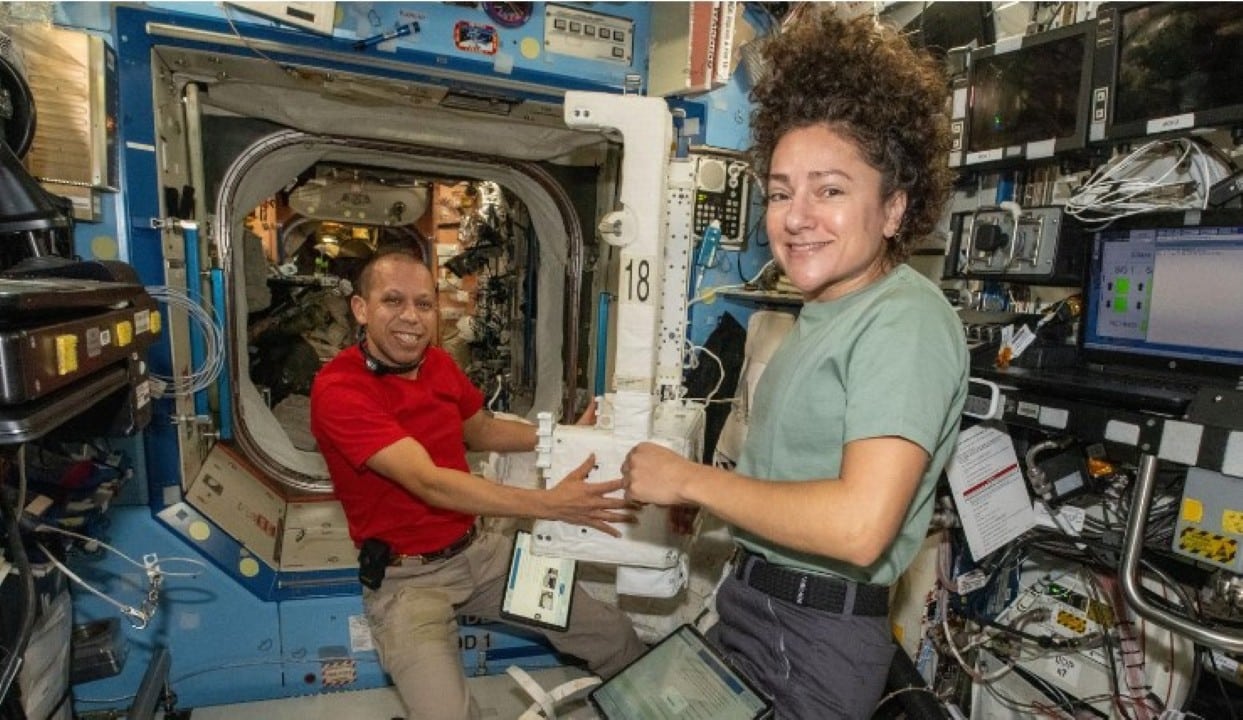
Inside the Destiny laboratory module, NASA flight engineers, Chris Williams and Jessica Meir, conducted a complete check of a jetpack attachable to the spacesuit. Este thruster functions as an absolute emergency resource for the astronaut’s survival.
If a crew member loses physical contact with the metal structure during an extravehicular activity, the device allows for an autonomous and safe return to base. The verification included rigorous testing of the response of the gas thrusters and the integrity of the system’s electrical connections.
The central focus of this preparation is the spacewalk scheduled for March 18th. The goal of the external mission is to install modification kits and route cables in the left sector of the complex, preparing the structural ground for the future installation of new generation solar panels that will be delivered by a SpaceX Dragon capsule.
Orbital refueling and disposal dynamics
The sustainability of the human presence in space depends on a constant and infallible logistical bridge with Terra. Veículos unmanned cargo ships are largely responsible for delivering vital supplies, new research equipment, and later acting as trash incinerators during reentry.
On March 12, the spacecraft Cygnus XL, operated by Northrop Grumman, ended its stay attached to the main structure. The Canadarm2 robotic arm was activated with millimeter precision to release the vehicle, which began a controlled descent trajectory to burn safely over the uninhabited waters of Oceano Pacífico Sul.
Days earlier, on March 6, the same robotic arm released the HTV-X1 cargo ship, belonging to the Japanese space agency JAXA. Diferentemente of the American mission, the Japanese vehicle will remain in free flight for additional weeks to perform autonomous scientific experiments before its definitive and destructive disposal in the Earth’s atmosphere.
Hardware update in the Japanese module
The Kibo module is one of the nerve centers for onboard science, requiring constant updates to its internal machinery to support new and complex international research demands. Astronauts Chris Williams and Jack Hathaway dedicated hours of painstaking work to replacing fundamental components for the continuity of biological studies and Earth observation. Williams focused on exchanging a large centrifuge for a more compact and efficient model within the Saibo rack. Essa structural modification is vital because it optimizes limited physical space and expands the processing capacity of cellular samples in a zero gravity environment, allowing multiple experiments to occur simultaneously without interference.
Simultaneously with this process, Hathaway carried out the modernization of the space station’s image capture system. The engineer replaced an old high-definition video camera with state-of-the-art equipment inside the Kibo’s decompression chamber. Este new optical device will be positioned outside the laboratory to provide enhanced visual transmissions of the Earth’s surface. Além to assist in climate and geological studies, the new camera will help mission control in accurately visually monitoring the approach, alignment and docking of future visiting spacecraft, increasing the safety of space traffic operations.
Advances in monitoring human physiology
Deeply understanding how the human body reacts to prolonged weightlessness is an essential requirement to enable future long-term interplanetary travel. In the European module Columbus, Jessica Meir and ESA engineer Sophie Adenot began the configuration of the complex PhysioTool experiment.
The innovative project uses a network of portable sensors attached directly to the body to record, in real time, heart activity, lung function and brain impulses. Continuous collection of these biomedical parameters builds an invaluable database on the physiological stress faced by crews, helping to formulate new medical treatments.
Ongoing cardiovascular studies
Adaptation of the circulatory system is one of the areas most closely monitored by medical teams on the ground, as the absence of gravity significantly alters the distribution of body fluids, forcing the heart to work differently. The Roscosmos cosmonauts, Sergey Kud-Sverchkov and Sergei Mikaev, completed a cardiac research protocol that spanned seven uninterrupted days of data collection. During the testing period, the pair used high-precision sensors connected to the forehead and the ends of the fingers and toes. The equipment measured subtle variations in peripheral blood flow and transmitted the results via the Bluetooth connection to onboard computer terminals. Processing this information helps map the risks of muscle atrophy and cardiovascular problems, allowing the development of much more effective daily exercise routines and pharmacological countermeasures to protect the cardiovascular health of space explorers.
Infrastructure maintenance and life support
The continued operability of Russian systems requires regular and precise mechanical interventions by the crew. Cosmonaut Andrey Fedyaev performed the replacement of parts of the orbital hydraulic system in the Zarya module and operated the transfer of fluids from the Elektron oxygen generator, located in the Zvezda service module. Esta preventive maintenance task, which included the careful removal of air bubbles from the pipes, is absolutely essential to ensure correct electrolysis and uninterrupted production of breathable air for all inhabitants of the station. In parallel to his engineering duties, Fedyaev worked as a documentary filmmaker, recording his colleagues’ exercise and research routines on video. Enquanto this, Mikaev assumed responsibility for waste management, preparing the spacecraft Progress 92 for its imminent departure. Ele disconnected the interface cables, sealed the docking hatch, and confirmed that the vehicle was ready to act as an orbital incinerator, safely disposing of tons of accumulated trash during atmospheric reentry.
Trajectory adjustments and orbital stabilization
Atmospheric drag, even occurring at extreme altitudes where the air is thin, causes the gradual and constant loss of altitude of any large space infrastructure. Para To correct this natural degradation of orbit and avoid risks, repositioning maneuvers are carried out periodically with the aid of the engines of coupled cargo ships.
On March 12, the thrusters of the Russian cargo ship Progress 93, firmly attached to the rear door of the Zvezda module, were fired for exactly ten minutes and thirty seconds. The controlled engine burn raised the complex’s altitude by 800 meters at apogee and 1.4 kilometers at perigee, stabilizing the orbit at safe operational parameters of 428 by 414 kilometers above sea level.
