

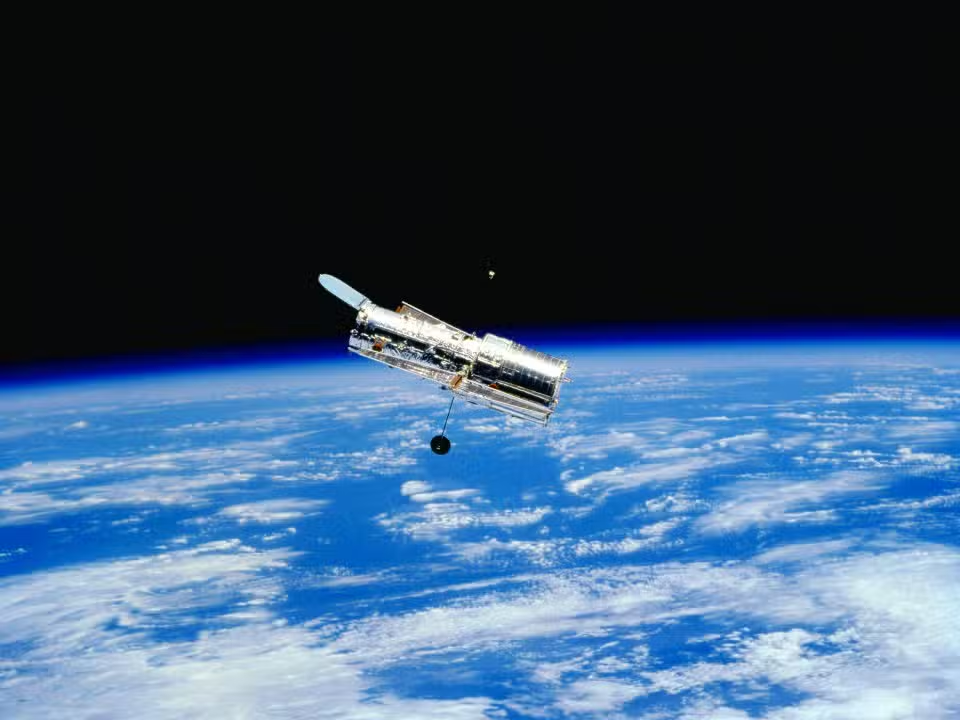
The identification of unusual physical and chemical characteristics in the 3I/ATLAS celestial body mobilizes the international scientific community and questions the basis for the formation of structures in the universe. The cosmic visitor, initially detected by observation instruments at Chile, presents a composition that diverges drastically from the standards established by contemporary astrophysics. The most recent data, captured by high-precision orbital equipment, reveals a massive structure traveling at extreme speed through the solar system, while expelling volatile materials due to direct interaction with radiation emitted by the sun.
Scientific investigation and monitoring of the celestial body
The initial registration of 3I/ATLAS occurred through an asteroid early warning system operated in Chilean territory, which allowed the immediate redirection of the main global observation equipment. From that moment on, the celestial body became the priority focus of terrestrial and orbital observatories, becoming the third interstellar object confirmed to cross the local planetary neighborhood. The most favorable observation window occurred in the final months of last year, a period in which the distance in relation to Terra reached its minimum point.
Resource mobilization involved the use of high-resolution spectrographs and deep infrared cameras to capture photons reflected by the object’s irregular surface. The central objective of this task force is to record as many variables as possible before the structure begins its definitive route back to deep space.
The researchers focused the analyzes on specific aspects of the interstellar visitor’s composition, establishing the following priority study focuses:
– Medição exact effective radius of the nucleus and its structural density.
– Avaliação of the proportion of isotopes and heavy elements on the surface.
– Cálculo of the non-gravitational acceleration generated by the sublimation of materials.
– Verificação of emissions in the radio frequency spectrum to eliminate anomalies.
Calculation of dimensions and structural mass
The images provided by space telescopes made it possible to calculate the effective radius of the nucleus, established at approximately 1.3 kilometers, with a margin of error of 0.2 kilometers. Essa direct measurement eliminates the hypothesis that the object is just a tiny fragment wandering through interstellar space.
Considering a density of 0.5 grams per cubic centimeter, characteristic of cometary formations, the total mass was estimated at 4.6 quadrillion grams. The existence of such a significant volume of matter indicates that the celestial body’s original environment had an exceptional abundance of physical resources.
Isotopic analysis and estimated age of the material
The spectroscopic examinations detected an anomaly in the quantity of isotopes, with emphasis on the proportion of deuterium in relation to hydrogen, which reached the level of 0.95%. Esse index is substantially higher than the values recorded on celestial bodies formed within our planetary system.
Variations in carbon isotopic ratios also exceed limits observed in known protoplanetary disks. Essas specific chemical signatures indicate that the object’s raw material was consolidated in a period estimated between 10 and 12 billion years ago.
Mathematical divergences in galactic distribution
The antiquity of the material suggests a direct connection with primordial stars, which are characterized by having a small fraction of metallic elements. Nesses ancient environments, the proportion of elements heavier than helium corresponds to a minimal portion compared to the solar composition.
The theoretical inconsistency emerges when calculating the mass density necessary in the local universe to justify the number of objects similar to 3I/ATLAS. The availability of heavy elements in these stellar regions reaches about negative 5.4 octillion grams per cubic centimeter.
This index is more than an order of magnitude lower than the amount of matter stipulated by current physical models. Current mathematics cannot explain the existence of such a large population of interstellar bodies with this structural magnitude.
The discrepancy identified by astronomers highlights flaws in contemporary theories about the distribution of matter in Via Láctea. The data conflict requires an in-depth review of the parameters used to understand formation dynamics in distant stellar systems.
Alternatives to resolve the numerical impasse
In an attempt to resolve the incompatibility of calculations, scientists are investigating the hypothesis that the visitor was formed in debris disks located around stars with a high metallicity index. Essa specific condition would provide the material basis necessary for the consolidation of a core with such robust proportions, bypassing the scarcity of heavy elements typical of older stars. Validation of this theory depends on additional observations of planetary systems that have similar chemical characteristics and that can act as nurseries for structures of this magnitude.
Another line of research proposes that the mechanisms responsible for the production and ejection of celestial bodies in deep space operate with much higher efficiency than previously estimated. Fatores as the mass distribution and ejection rate would need to undergo adjustments by at least three orders of magnitude for the observational data to align with theoretical models. The overestimation of the nuclear radius or the population density of these objects also appears as a variable under analysis to balance the astrophysical equations and provide a more accurate overview of celestial mechanics.
Propulsive behavior and acceleration in space
During the phase of closest approach to the sun, the measuring instruments recorded an acceleration in the trajectory of 3I/ATLAS that transcends the exclusive influence of gravitational force. Esse speed gain is driven by the sublimation of volatile materials, such as methanol, which undergo extreme heating under solar radiation and are ejected into the vacuum, acting as natural propellants. The intensity of this phenomenon matches the dynamics of active cometary structures, but it requires a nucleus of extreme density to support the continuous loss of mass without resulting in total disintegration. The formation of collimated jets, which project great distances from the center of the object, illustrates the complexity of the interaction between the rocky surface and the constant pressure exerted by the solar wind throughout the displacement towards the limits of the planetary system.
Radio frequency scanning and technological silence
The period of maximum proximity to Terra made it possible to carry out scans at different frequencies of the electromagnetic spectrum, encompassing the search for radio emissions of artificial origin. Antenas of high sensitivity were directed to the coordinates of the celestial body with the purpose of eliminating any possibility of unnatural origin, resulting in the confirmation of an absolute silence that corroborates the strictly geological nature of the structure.
Escape route and continuity of research
At the current moment, the interstellar visitor continues its route away from the solar system at an accelerated speed, crossing the orbital region of the giant gas planets. The projected trajectory indicates a close passage to the orbit of Júpiter this March, configuring one of the last opportunities to obtain high-resolution images.
The progressive retraction and consequent reduction in reflected sunlight will make observation impractical in the short term, even with the use of the most advanced telescopes currently available. Space agencies continue to monitor the final coordinates as the object dives back into deep space.
Terrestrial laboratories are now directing their efforts to processing the extensive spectroscopic database accumulated during the passage. Complete elucidation of the origin of 3I/ATLAS will depend on the continued improvement of models of galactic chemical evolution over the next few years.