

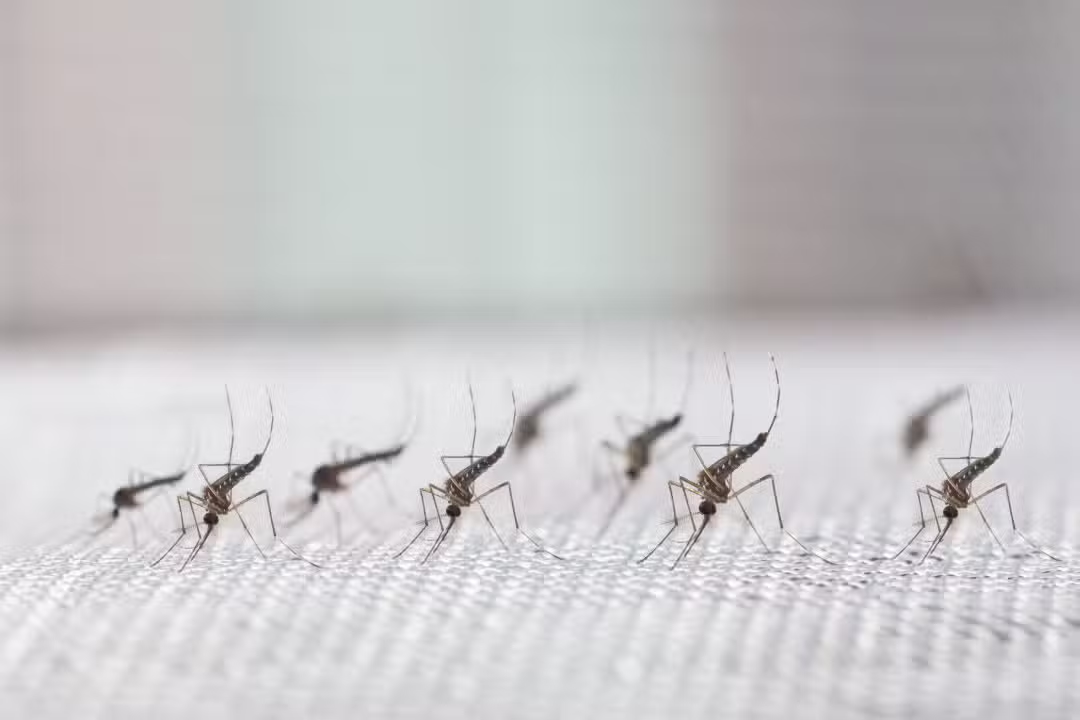
A groundbreaking study, led by Catherine Walton of Universidade of Manchester, in Reino Unido, and published in the scientific journal The research suggests that the evolution of mosquitoes’ preference for human blood occurred in response to the arrival of hominins, offering new clues about the complex history of our ancestors’ dispersal outside of África. Esta innovative approach complements traditional methods, which often face limitations due to the scarcity and decay of archaeological remains in challenging climates.
Mosquitoes, although small and often seen as pests, carry with them a genetic record that can tell the story of their interactions with other species, including our own. Understanding when these insects developed a particular taste for human blood is crucial to charting a more accurate chronology of ancient population movements, especially in regions where the fossil record is fragmented. Esta perspective offers a valuable “biological footprint” for paleoanthropology.
Traditionally, scientists have relied on fossils and ancient DNA to map the human diaspora, but conserving these materials is challenging in hot, humid environments like Sudeste Asiático, where decomposition is accelerated. Research with mosquito DNA presents a promising alternative.
The origin of human preference
Although there are more than 3,500 known mosquito species, it is surprisingly rare for most of them to bite humans. The vast biodiversity of these insects shows a majority preference for other sources of animal blood. However, some specific groups, such as *Anopheles leucosfilus* in Sudeste Asiático, have developed a strong attraction to human blood, an adaptation that intrigues scientists and raises fundamental questions about their origin.
Understanding the timing and conditions under which mosquitoes began to prefer humans is not just a matter of biological curiosity; is vital to public health. The change in the food preferences of these insects has direct implications for the transmission of diseases such as malaria, making research into this evolution a pillar for control and prevention strategies. By uncovering the mechanisms behind this adaptation, it is possible to anticipate and combat future health threats.
Upasana Shamsunder Singh, postdoctoral researcher at The investigation seeks to understand the genetic and environmental triggers that shaped this differentiation.
Methodology and findings in Sudeste Asiático
The research team, with remarkable effort, collected mosquitoes from several locations in Sudeste Asiático between the years 1992 and 2020. Essa long-term collection allowed obtaining a robust sample for genetic analysis. Posteriormente, the DNA of 38 mosquitoes, belonging to 11 different species of the *Leucosfilus* group, was sequenced, providing a detailed database for investigating evolutionary relationships and food preferences.
The most innovative research results came from work on Bornéu, where crucial observations were made on mosquito feeding behavior. The team closely studied how mosquitoes, which breed in rainforest pools of water, approach humans to bite them. Para mosquitoes that prefer monkeys and avoid human proximity, the collection method had to be adapted, requiring patience and observation for several nights in the forest to collect their larvae. Este methodological detail was essential to cover the entire spectrum of behaviors.
The research revealed that malaria-carrying mosquitoes in the region likely evolved to prefer human blood in a period that varied between 2.9 million and 1.6 million years ago. Essa time window coincides with the arrival of hominids, specifically *Homo erectus*, at Sudeste Asiático. The correlation is significant, as it corroborates some existing hypotheses about ancient human migration, suggesting that human presence was a decisive factor in the selective pressure that led to the adaptation of these mosquitoes.
The relevance of the multidisciplinary approach
Reconstructing the history of ancient humans is an immense challenge, given the scarcity of well-preserved physical evidence. Catherine Walton emphasizes that a multidisciplinary approach is fundamental. Information extracted from mosquito DNA, although valuable, has its own limitations, as does data from fossils and the human genome.
The integration and cross-validation of these diverse sources of information are crucial to putting together a more complete and accurate historical puzzle, overcoming the shortcomings of each method individually.
Implications for public health and history
The discovery of how the preference for human blood evolved in *Anopheles leucosfilus* mosquitoes has a direct impact on understanding the transmission routes of malaria. By identifying the genetic and environmental factors that drove this change, researchers can develop more effective strategies for controlling the disease.
This includes creating new prevention and treatment methods that specifically target mosquito species that have adapted to human food, reducing the global burden of malaria, a disease that still affects millions of people annually.
The ancient migration debate and new evidence
The absence of abundant fossils in Sudeste Asiático has fueled a decades-long debate over the chronology of the arrival of ancient humans, such as *Homo erectus*, in the region. Estimates vary significantly, with some researchers suggesting 1.8 million years ago and others pointing to 1.3 million years ago.
Mosquito research, by indicating an adaptation between 2.9 million and 1.6 million years ago in response to the presence of hominids, offers a new pillar of evidence. Essa new biological chronology of insects strengthens hypotheses that date the arrival of *Homo erectus* earlier, filling critical gaps in our knowledge about human dispersal.
Research challenges and the future
The work of reconstructing the deep history of hominins is inherently difficult and requires the combination of multiple disciplines and data sources. Mosquito DNA research is a clear example of how biology can offer unique insights into human prehistory.
Challenges remain in integrating all the information, but the success of this study paves the way for future investigations that could use the ecology and genetics of other species to further illuminate the paths of our ancestors and the complex interactions that shaped both human life and that of other living beings on the planet.