

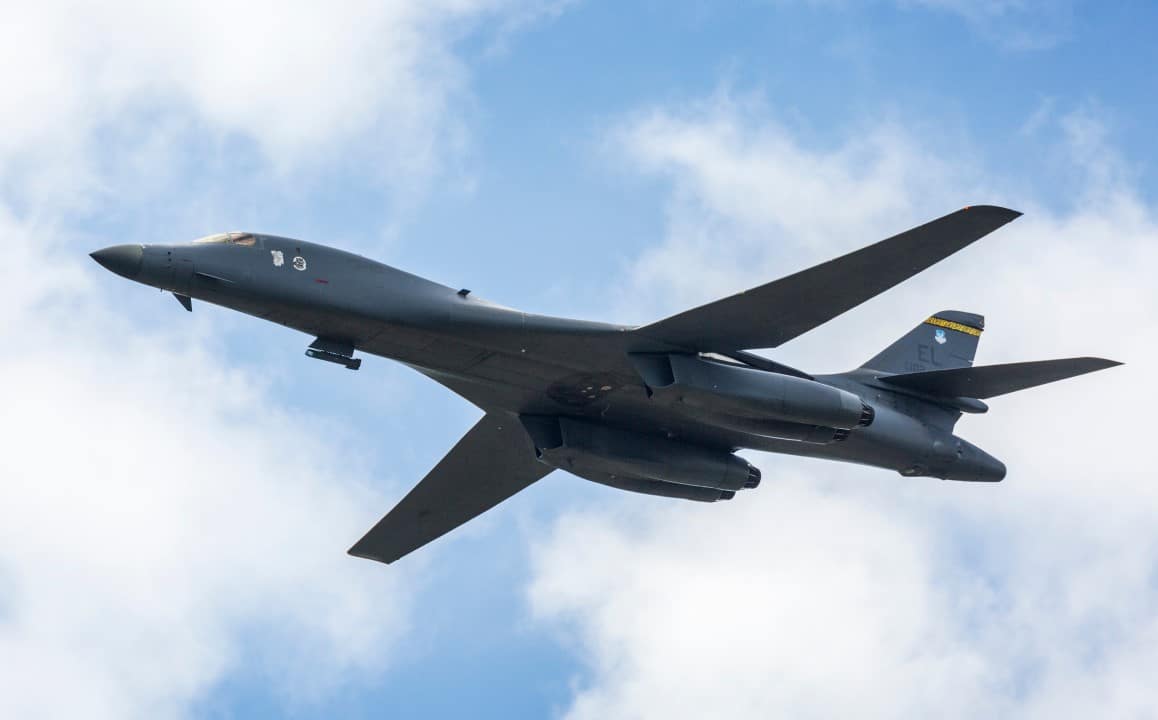
Recent images captured at a British air base showed a B-1 bomber from Força Aérea of the Estados Unidos being loaded with bunker-busting bombs. Este movement, which occurred on the 11th and publicized by news agencies, suggests a preparation by the USA’s Departamento for a possible sending of heavy bombers to Iranian airspace. The aim would be to attack deep underground targets such as missile and drone storage facilities.
The action was registered at Base Aérea Real of Fairford, at Reino Unido, a location that allowed external visibility of the operation. Lançadores missiles were removed from the bomb bay of at least one B-1, reinforcing the change in its arsenal. The nature of the shipment and the choice of location send a clear message about utilizing the United States’ most robust military capabilities.
The focus is on the capability of the Joint Direct Attack (JDAM) missiles, confirmed as the weapon being deployed on the B-1. Enquanto the B-1 can carry air-launched cruise missiles, which operate hundreds of miles away, these weapons are not ideal for penetrating hardened underground facilities, where the Irã is supposed to store ballistic missiles or drones.
Military preparation intensifies global discussions
The deployment of JDAM missiles on B-1 bombers indicates a strategy aimed at destroying underground targets, demanding a specific tactical approach. Para For JDAMs to be effective, the bomber would need to approach within approximately 40 kilometers of the target. Essa proximity requires significant penetration of Iranian airspace.
Despite the complexity and risks involved, the US Departamento of Defesa appears confident in its capabilities. Há a realization that Irã’s air defenses had been virtually neutralized, which would theoretically open the way for such operations. Analyzing this confidence is crucial to understanding the audacity behind the supposed strategy.
Operational challenges and strategic risks
Carrying out airstrikes deep into Iranian territory presents considerable logistical and strategic challenges. Moving aircraft such as the B-1, a heavy bomber, in an environment of potential conflict requires meticulous planning and continuous risk assessment. The US Força Aérea, as per FlightGlobal.com’s 2026 Banco of Dados Mundial of Força Aérea, operates 40 B-1 bombers.
The loss of any of these aircraft over Iranian airspace would represent a significant setback for the Estados Unidos, not only in material terms but also in prestige and operational capability. Este scenario highlights the high stakes involved in any military escalation in the region. The vulnerability of high-value military assets is always a critical factor in defense planning.
The ability to penetrate air defenses is a central element in the viability of attack missions. Embora there is apparent confidence in the neutralization of Iranian defenses, the nature of the aerial combat is unpredictable. Using missiles that require close proximity makes the mission inherently more risky than employing long-range cruise missiles.
Maintaining air superiority in a theater of operations is a constant objective. Suppression of enemy air defenses (SEAD) strategies are key to clearing the way for bombers. The success of such missions depends on the accuracy of intelligence and the effectiveness of electronic warfare operations and countermeasures.
B-1 Capability and the Iranian Arsenal
The B-1 Lancer bomber is known for its ability to carry large loads of weapons, including precision-guided munitions such as JDAMs. Esta aircraft is designed for long-range attack missions and can operate in different scenarios and altitudes. Sua versatility makes it a valuable platform for many types of military engagement.
The Iranian arsenal, in turn, is made up of a variety of ballistic missiles and drones, many of which are developed and stored in fortified underground facilities. Essas installations are designed to resist conventional attacks, which explains the need for specialized weapons such as bunker bombs. Protecting its underground arsenal is a strategic priority for the Irã.
The ability to attack these underground targets is considered crucial to degrading the Irã’s potential for retaliation or power projection in the region. The choice of JDAM reflects an assessment that accuracy and penetration are more important than range in an attack scenario against hardened targets. Essa tactical decision has direct implications on the level of acceptable risk.
JDAM missile technology allows conventional bombs to become “smart” with GPS navigation systems. Isso gives them considerable precision, essential for reaching tunnel entrances or weak points in underground structures. The B-1, by carrying a large number of these bombs, maximizes the potential to destroy multiple targets in a single sortie.
Signaling and veiled diplomacy
The exposure of the B-1 bomber cargo in Fairford is not a merely accidental event. Tal visibility, in a location accessible to the external public, is a form of strategic communication. It is a clear sign that the US military is prepared to use its most powerful weapons, and that the Irã, supposedly, would have few means to stop it.
This show of force can be interpreted as an attempt at deterrence, seeking to influence the decisions and actions of Irã without the need for direct conflict. The message is aimed at both the Iranian government and regional allies and the international community. The intention is to underline the seriousness of American intentions and the ability to project power.
The tactic of “cannon diplomacy” through images and military demonstrations is old, but remains relevant in the current geopolitical scenario. Ela aims to create an environment of psychological and strategic pressure, where the opponent is forced to reevaluate their positions. The ultimate goal is to prevent unwanted escalation, or otherwise justify future actions.
The implications of such signaling extend beyond the parties directly involved. Outros regional and global actors closely observe these manifestations, which can alter balances of power and influence alliances. How this message is received and interpreted could shape the security dynamics at Oriente Médio for a long time.
Regional air defense scenario
Air defense capability is a fundamental pillar of national sovereignty. Irã, over the years, has invested in the development and acquisition of air defense systems, including surface-to-air missiles of varying ranges. However, technological advancement in attack aircraft and missiles represents a constant challenge for any defense system.
The effectiveness of an air defense system is not just based on equipment, but also on the integration of radar, command and control, and the ability to quickly identify and track targets. The complexity of modern airspace requires a sophisticated network to combat advanced threats such as stealth or high-speed bombers.
In conflict scenarios, the first phases often involve suppressing enemy air defenses using electronic warfare and precision strikes against radars and command centers. If the US Departamento of Defesa is confident in neutralizing Iranian defenses, this implies in-depth knowledge of its capabilities and vulnerabilities.
The 40-kilometer proximity required by JDAM missiles still places the bomber within the potential range of certain air defense systems, even if degraded. Isso makes the mission a high-risk operation, where the window of opportunity for an attack and safe withdrawal is critical and extremely limited.
Voltage history and projections
Tensions between the Estados Unidos and the Irã have a long history, marked by economic sanctions, naval incidents in the Golfo Pérsico, and disputes over Iran’s nuclear program. Cada military movement, whether a demonstration of force or a veiled action, is contextualized within this complex and often antagonistic relationship.
The current situation suggests a phase of heightened alert, where rhetoric and military actions intertwine. US force projection can be seen as a response to recent developments in the region, or as an attempt to redefine red lines in the face of Iranian activities perceived as destabilizing. The scenario requires constant vigilance from all actors.
Global arsenal and implications
The 40 B-1 bombers operated by the US Força Aérea represent a significant fraction of its strategic firepower. Essas aircraft are adaptable and can be rapidly deployed to different theaters of operations around the world. The decision to use them for a specific type of mission, such as attacking bunkers, reflects a tactical and strategic priority.
These assets are constantly maintained and updated, ensuring that they remain relevant in the face of new threats. The use of bunker-busting missiles on a platform like the B-1 demonstrates the adaptability of the American air force to meet contemporary challenges, from conventional warfare to the containment of targeted arsenals.
Impact on the security landscape
The possibility of using anti-bunker missiles against the Irã has serious implications for the regional and global security scenario. Qualquer military attack of this nature could trigger a series of reactions, potentially escalating the conflict and further destabilizing an already volatile region. The international community is following developments with concern.
Military actions, even if perceived as limited or tactical, rarely remain isolated. Elas may have unintended consequences, such as the activation of networks of supported groups, or the response of allies and partners. The seriousness of using weapons capable of destroying deeply protected installations signals a very high threshold for action.
The impact extends to the global economy, especially regarding energy supply. The Estreito of Ormuz, a vital route for oil transportation, is located in close proximity to the Irã, and any instability in the region could affect international markets. The responsibility for avoiding unnecessary escalation is shared by all parties involved.
Regional security depends on a delicate balance, where a show of force can both deter and provoke. Utilizing such specific and powerful military capabilities against an adversary with a history of retaliation requires careful analysis of all possible scenarios before any engagement.
International concerns and observation
Governments and international organizations are paying attention to military movements in the region. The Agência Internacional of Energia Atômica (IAEA) and other entities that monitor nuclear proliferation and regional security will likely be watching developments closely. Stability in Oriente Médio is a global concern, and any action that threatens that stability will be subject to scrutiny.
The expectation is that diplomacy will continue to be the main path to resolving tensions, but military preparation serves as a reminder of the complexities and risks inherent in international relations. Transparency, when possible, and effective communication are essential to avoid misunderstandings that could lead to unwanted conflicts.