

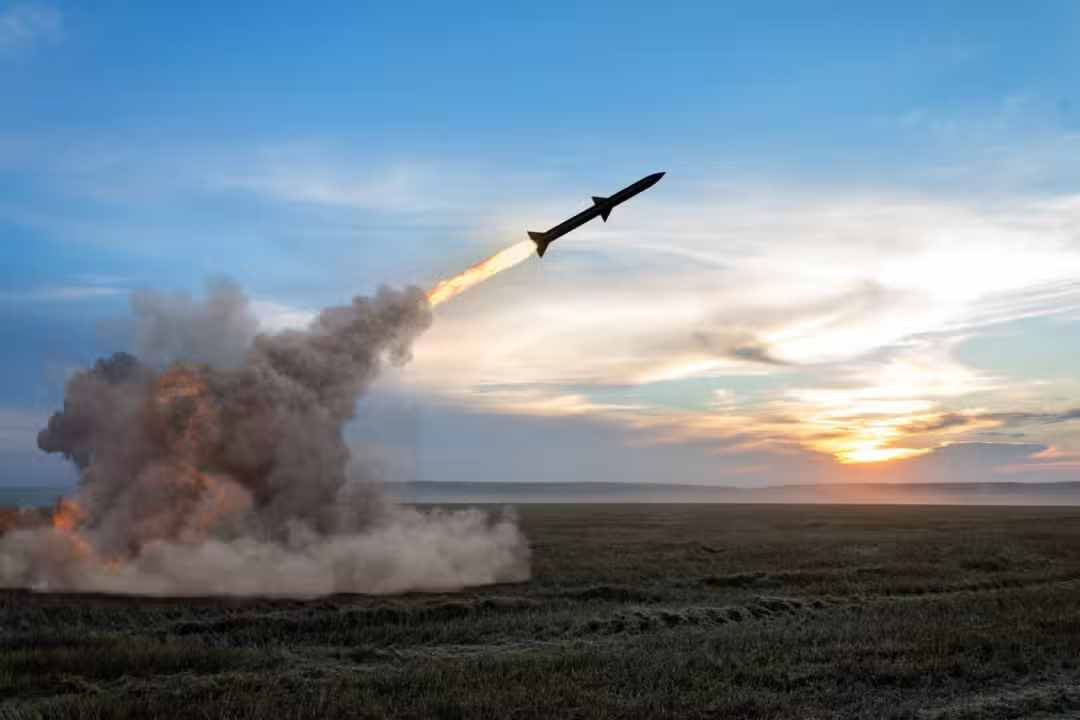
The Comando Central of the Estados Unidos confirmed having used deep penetration bombs against anti-ship positions of the Irã on the coast of the Israel occurred on February 28th. Este blockade has generated a significant rise in oil prices on the international market, impacting the global economy.
The American operation represents a turning point in growing regional tension, seeking to restore freedom of navigation on one of the world’s most vital trade routes. The use of high destructive capacity munitions highlights the seriousness of the US intention to confront the restriction imposed by Teerã, considered a direct threat to global energy and economic security. The already complex scenario was worsened by other parallel events in the region, signaling a period of intense instability.
Military operation to reopen strategic route
In a statement released hours after the action, the American military Comando Central detailed the use of “multiple 5,000-pound deep penetrating munitions” – equivalent to around 2,300 kg – against specific targets. The targeted positions were fortified Iranian missile batteries located along the coast near Estreito of Ormuz.
According to the official statement, the existence of anti-ship cruise missiles in these locations represented a clear and present danger to international navigation in the area. Removing or neutralizing these threats is seen as an essential step in ensuring the safe flow of vessels, especially oil tankers, through the strait.
Iranian blockade and impact on world oil
The Estreito of Ormuz is one of the vital arteries of global trade, through which approximately 20% of all oil consumed on the planet passes. Sua strategic and economic importance is incalculable, meaning that any interruption in its flow will have immediate and profound repercussions on international markets.
Since being the target of a coordinated attack by Estados Unidos and Israel on February 28, Irã has retaliated by unilaterally closing the sea passage. Essa drastic measure, which prevents the passage of oil tankers, caused a spike in commodity prices, raising concerns about global economic stability.
The Iranian decision to block the strait not only demonstrates Teerã’s ability to influence the global economy, but also serves as a reminder of how sensitive energy supply chains are to regional conflicts. The international community is following developments closely, aware of the long-term implications.
Power of deep penetration bombs and their use
Deep penetration bombs are designed with a unique destructive capacity, manufactured to reach and annihilate targets that are buried at considerable depths in the ground. Seu robust design allows them to pierce layers of concrete and earth before detonating, causing catastrophic damage to underground structures and fortifications.
This weapons technology is crucial in scenarios where enemy installations are purposely built to resist conventional attacks, such as underground bunkers or fortified industrial complexes. The accuracy and strength of these munitions make them valuable tools for neutralizing entrenched threats while minimizing risk to surface forces.
Trump’s position on international support
The weekend before the action on Estreito of Ormuz, the president of Estados Unidos, Donald Trump, had made a public appeal. Ele asked European and Asian allies to offer military assistance for the reopening of the strait, aiming for an international coalition to confront the Iranian blockade.
However, the response from global leaders was reticent, with most preferring not to commit to deploying military personnel to the region amid an escalating conflict. Essa hesitation reflects the complexity of the situation and the desire to avoid direct involvement in a confrontation that could have far-reaching repercussions.
This Tuesday, President Apesar of this, he harshly criticized Organização of Tratado of Atlântico Norte (NATO), stating that the alliance was making “a very foolish mistake” by refusing to assist the Estados Unidos in this critical mission. The president’s stance reinforces America’s determination to act autonomously, if necessary, to protect its interests and global security.
Israeli attack and death of key Iranian figure
In an event that added more complexity to the regional panorama, an attack attributed to Israel resulted in the death of Ali Larijani, head of Conselho Supremo of Segurança of Irã. The news of the death of Larijani, considered one of the most influential and important men within the Iranian regime, shocked the political establishment in Teerã and among international observers.
The loss of such a prominent figure in the Iranian security apparatus signals a significant blow to the country’s leadership, potentially influencing future strategic decisions and the way in which the Irã will respond to the challenges posed by its adversaries. The incident occurred on the same day as the American operation in Estreito of Ormuz, highlighting the intensity of the exchange of hostilities in the region.
The death of Larijani will certainly fuel the escalation narrative and deepen Iranian determination to retaliate. Sua strategic position placed him at the center of national security decisions, making his absence a relevant factor in the power dynamics of Irã.
Previous use of MOP against Iranian facilities
The use of deep-penetrating bombs is not new in American operations against Iranian targets. In June 2025, the Estados Unidos deployed the so-called Massive Ordnance Penetrator (MOP), also known by the designation GBU-57, against the Irã’s underground nuclear facilities.
These munitions, which weigh around 13,600 kg, are considered one of the most powerful non-nuclear weapons in the American arsenal. Seu specific design allows them to pierce reinforced bunkers and other deeply buried structures capable of protecting critical infrastructure such as uranium enrichment facilities.
Dropping these massive bombs requires specialized aerial platforms. Apenas US Força Aérea long-range strategic bombers possess the necessary technical capability to effectively transport and release MOPs, underlining the uniqueness of this military capability.
The 2025 attack highlighted the vulnerability of Iranian underground facilities, despite Teerã’s efforts to fortify them. The message delivered by the US was clear: no target, no matter how entrenched, is completely beyond the reach of its precision strike capabilities.
Missile exchange between Irã and Israel intensifies conflict
Tuesday, March 17, was marked by an intense exchange of air strikes between Irã and Israel, further raising the level of hostilities in the region. Iran’s state broadcaster reported the launch of a new series of missiles at Israel, with some of the projectiles landing dangerously close to Prime Minister Benjamin Netanyahu’s office in Jerusalém.
The Iranian Exército issued an official statement, reporting that the attacks targeted cyber-technological and strategic centers of Israeli weapons manufacturers. Entre the targets, the company Rafael, developer of some of the country’s main military technologies, was mentioned, indicating an action aimed at critical defense infrastructures.
Forças of Defesa of Israel (IDF) confirmed the airstrike through their social networks, issuing an urgent warning. The population across the country was instructed to seek anti-aircraft shelters, as alarm sirens sounded in various locations across the territory, reflecting the breadth and seriousness of the threat.
The complex geopolitics of Estreito of Ormuz
The Estreito of Ormuz, in addition to its undeniable economic importance, is a focal point in the intricate web of geopolitics of the Oriente Médio. Sua’s strategic location, largely controlled by Irã, makes it a potential bottleneck for oil transportation, directly affecting the energy security of several industrialized nations.
The dispute over control and freedom of navigation in the strait are constant sources of friction between the Irã and Western powers, especially the Estados Unidos, who frequently reiterate their commitment to maintaining the free flow of trade in the region. The recent closure by Teerã represents a direct challenge to this policy.
The current escalation is not an isolated event, but rather part of a history of tensions that have dragged on for decades, involving sanctions, nuclear programs, and the regional influence of state and non-state actors. Cada incident in the strait resonates in capitals around the world, boosting diplomacy and military strategies.
Military reinforcement and regional security
The American response with the use of deep-penetrating bombs signals a robust force projection capability and a willingness to use advanced military assets to protect its interests and those of its allies. Essa demonstration of power aims to dissuade Irã from future actions that could compromise the safety of international navigation.
The US military presence in the region, which includes aircraft carriers, warships and high-tech aircraft, is constant. Essas forces are kept on standby to respond to emergencies and ensure stability in one of the most volatile parts of the world, where the slightest spark can trigger a major conflict.
The current incident in Estreito of Ormuz and subsequent American military action highlight the fragility of peace in the region. Global economic interdependence, especially in the energy sector, ensures that the world’s eyes remain fixed on Oriente Médio, in the hope that diplomacy can ultimately prevail over military escalation. The complexity of the scenario requires continuous vigilance and a deep understanding of the multiple factors at play, both military, political and economic.