

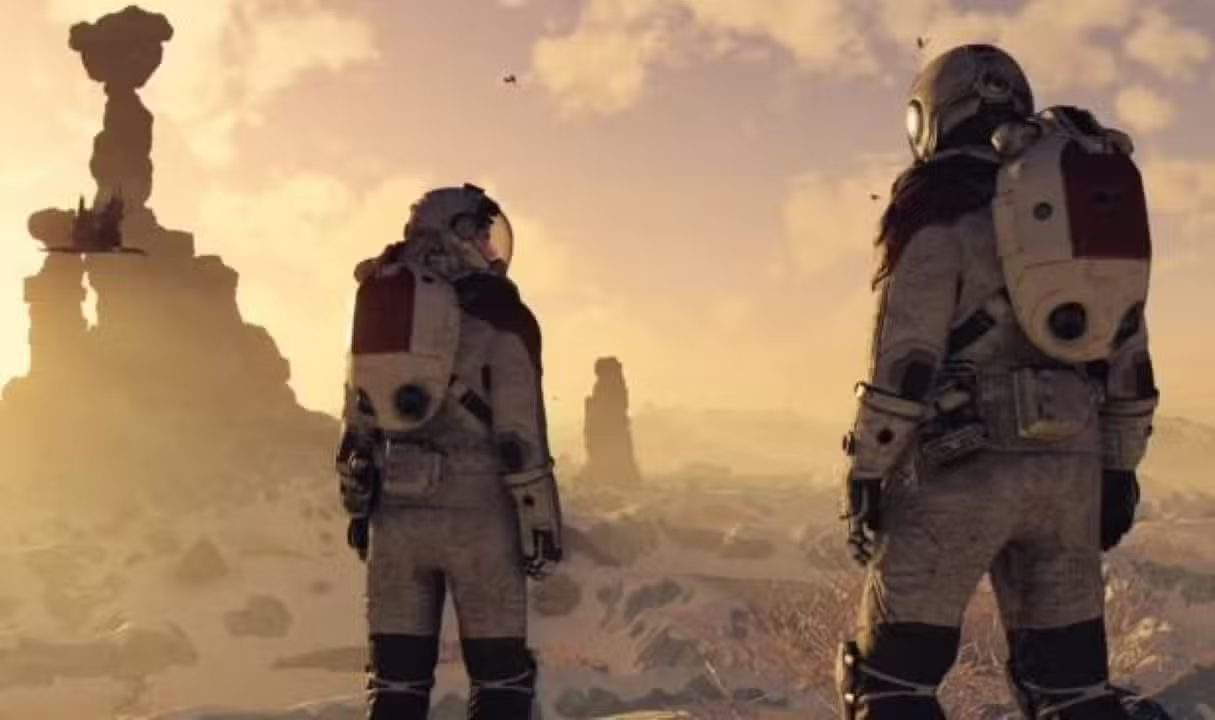
Bethesda Game Studios has announced that it will make additional adjustments to the DLSS 5 implementation in Starfield. The move comes after initial demonstrations of Nvidia’s technology generated criticism from players about the appearance of the characters’ faces. The company reinforced that the final effects are under the full control of the art team and that the option remains optional for users.
Fans highlighted issues with photorealistic lighting and facial details when DLSS 5 was enabled in demo videos. Muitos commented that the results seemed generated by artificial intelligence and did not match the game’s original artistic style. Bethesda’s response came quickly in an official statement.
Bethesda’s official response to player comments
The developer is grateful for the feedback received on the new lighting in DLSS 5. The art team will make refinements to the lighting and final effects so that the visuals meet the desired standards for Starfield. Todo the process remains under the direct supervision of the studio artists.
Players will be able to activate or deactivate the feature according to their preference. Essa flexibility was highlighted as a central point of the implementation. Bethesda emphasized that the objective is to offer the best possible result in each title.
The demo shown represents only an initial version of the technology applied to the game. Additional Ajustes must occur before final release to the public. The focus remains on fidelity to the title’s original 3D content.
DLSS 5 Technical Details Announced by Nvidia
Nvidia presented DLSS 5 during a recent event as a significant advancement in real-time rendering. The technology uses color information and motion vectors from each frame as input to an AI model. The result seeks to generate more sophisticated lighting and materials while maintaining consistency between frames.
The model was trained to understand semantics of complex scenes, including characters, hair, fabric, and skin. Ele analyzes environmental lighting conditions such as front light, back light, and cloudy skies from a single frame. The company described the feature as a milestone comparable to previous advances in AI applied to graphics.
- DLSS 5 evolves from deep learning supersampling released in 2018.
- Later versions incorporated frame generation and reflections.
- The new version adds photorealistic lighting and materials anchored in the original content.
Fan reviews and community reactions
Players who watched demos of Starfield with DLSS 5 enabled expressed dissatisfaction with the characters’ faces. Comentários pointed out that the visuals appeared to be overlaid with an AI filter and did not respect the work of the original artists. Alguns asked the development team to avoid changes that would change the game’s aesthetics.
The discussion extended to other titles shown, such as The Elder Scrolls IV: Oblivion Remastered. The community debated the growing role of AI in games and the limits between technical improvement and preserving artistic style. Bethesda sought to clarify that the resource will not be mandatory.
Todd Howard, director of the studio, had praised the effects of DLSS 5 as incredible in an initial statement. The company’s subsequent response moderated the tone by prioritizing the adjustments requested by the community. Dialogue between developers and players remains open throughout the refinement process.
Optional implementation and artistic control
Bethesda has confirmed that players will be able to choose to enable DLSS 5 at their discretion in Starfield. The manual control option ensures that each user decides whether they want the proposed visual enhancements. Essa approach aims to balance technological innovation with individual preferences.
The technology will not be available in the Xbox Series X/S version of the game. Full Suporte depends on hardware compatible with the capabilities of Nvidia. Futuros titles from Bethesda must also receive DLSS 5 with the same adjustment and optionality guidelines.
The PlayStation 5 version of Starfield is scheduled for release in Spring 2026. Ela coincides with the arrival of new story content and free updates requested by players. Compatibility with DLSS 5 will be evaluated as development progresses.
Evolution of DLSS technology over the years
DLSS emerged in 2018 with a focus on supersampling to improve performance without significant loss of quality. Subsequent Versões expanded capabilities with improved frame generation and reflections. DLSS 5 represents the next step in integrating more advanced AI models for lighting and materials.
Nvidia highlighted that developers maintain detailed artistic control over intensity, color grading and areas where the effect should not be applied. The feature does not work as a simple filter, but processes game data to preserve the creators’ original vision. Essa technical structure allows specific adaptations by studio.
The discussion about the use of AI in games persists among professionals and the community. Alguns creators express concern about replacing human labor while others see the tool as inevitable support for real-time graphics. Bethesda opted for cautious integration with an emphasis on manual refinements.