

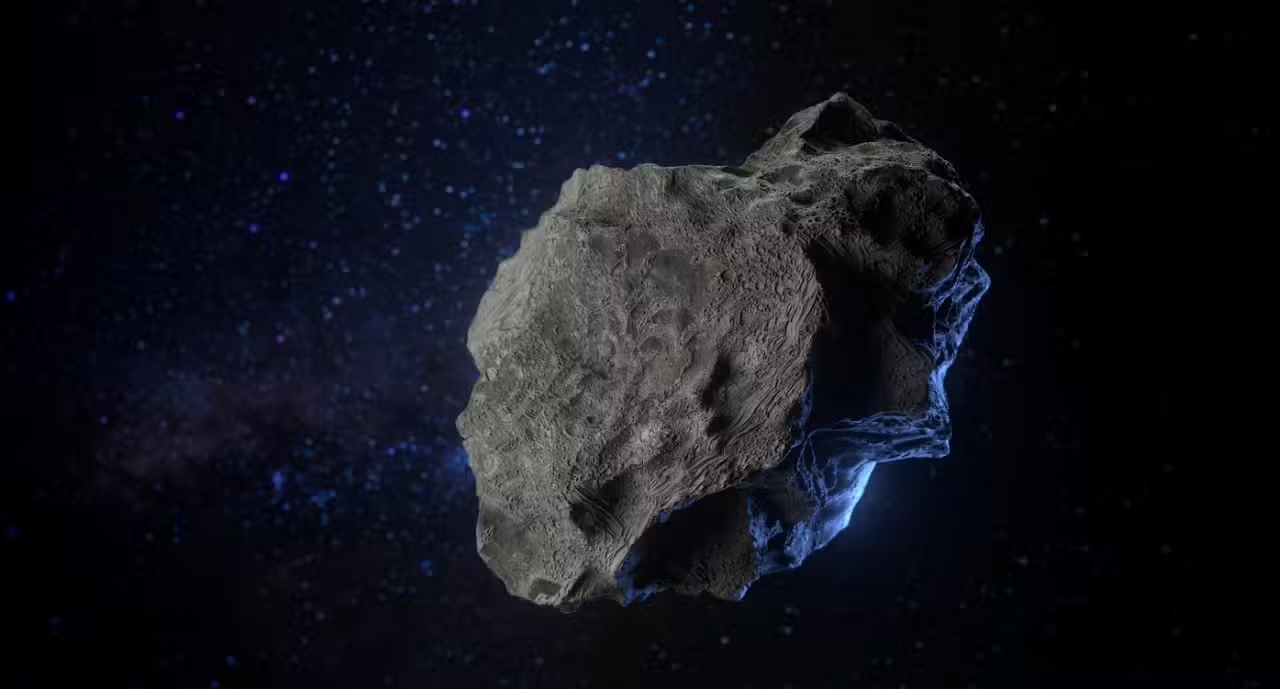
An international team of researchers has carried out an unprecedented structural analysis on the meteorite NWA 7034, known worldwide as Black Beauty, using an advanced combination of X-ray tomography and neutron beams. The technological procedure allowed detailed visualization of the interior of the space rock without the need for cutting or fragmenting the material. Durante through three-dimensional scanning, scientists identified specific internal structures that concentrate a significant amount of ancient water, providing new physical evidence about the neighboring planet’s geological and climatic past.
The study highlighted the presence of clasts rich in hydrogen, mineral elements that indicate direct hydrothermal interactions in the Martian crust that occurred billions of years ago. The analyzed sample contains rock fragments dating back up to 4.48 billion years, which reinforces astrobiological theories that Marte had humid conditions, rivers and possibly oceans in its remote formation period. The data extracted in the laboratory at Terra serves as a direct complement to the information currently being collected by robotic missions on the surface of the red planet.
The space rock presents unique characteristics that differentiate it from other samples already cataloged by space agencies, consolidating itself as a fundamental piece for understanding the evolution of the solar system. Entre the main data collected by the new tomographic analysis, the following structural points stand out:
- The meteorite, which fell in the Saara desert in 2011 and weighs approximately 320 grams, has a rare brecciated composition.
- Hydrogen-rich iron hydroxide clasts occupy around 0.4% of the total volume analyzed by the equipment.
- These small internal fragments concentrate approximately 11% of all the water present in the space sample.
- The general water content detected in Black Beauty reaches 6,000 parts per million, an index considered extremely high for Martian rocks.
Origin and trajectory of the space rock to the Saara desert
The NWA 7034 meteorite was ejected from the surface of Marte after a violent asteroid impact millions of years ago, an event that launched debris from the planet’s crust into outer space. Após a long trajectory orbiting the sun, the fragment crossed the Earth’s atmosphere and landed in the north of África. Sua geological composition includes pieces of rocks of different ages melted by the heat of ancient impacts, forming a regolith breccia that acts as a faithful portrait of the red planet’s superficial and primitive crust. Confirmation of its Martian origin was established through rigorous isotopic analyzes of the gases trapped inside, which correspond exactly to the atmosphere of Marte measured by space probes.
This dark-toned rock earned the nickname Black Beauty due to its intense color and characteristic shine on certain surfaces polished by atmospheric friction. Diferente of other Martian meteorites that are geologically younger, this sample preserves intact materials from the Noachiana era, the oldest period in the history of Marte, strongly associated with potentially habitable climate conditions. The minerals present in the rock’s matrix were altered by ancient chemical processes, bearing clear signatures of prolonged exposure to liquid water before being ejected into the vacuum of space.
Application of non-destructive methods for sample preservation
Neutron tomography has proven to be an especially effective analytical tool for detecting hydrogen in high-density materials, serving as a perfect complement to traditional X-ray tomography. Enquanto X-rays are absorbed by heavy elements such as iron, neutrons interact strongly with light elements, making hydrogen stand out in the images generated by the laboratory’s computers.
The researchers were able to scan a representative slice of the sample without the need for chemical dissolution or invasive mechanical cuts. Essa methodological approach guarantees the preservation of the physical integrity of the rock, allowing the material to remain available for future studies when even more advanced technologies are developed by the next generations of scientists.
Before the application of these joint technologies, meteorite analyzes often resulted in the destruction of priceless parts of space samples. The new imaging protocol allows mapping the exact three-dimensional distribution of elements within the rock matrix, identifying tiny inclusions and revealing water concentrations that would go unnoticed in conventional surface examinations.
Identification of clasts and concentration of water elements
The specific clasts identified during the scan consist largely of hydrogen-rich iron oxyhydroxide. Essas microscopic formations are the direct result of complex chemical reactions that occurred between the original basalt rock and the liquid water that percolated through the Martian subsoil.
Although these structures represent an extremely small volumetric fraction of the meteorite as a whole, they function as true mineral reservoirs. The ability of these clasts to store a disproportionate proportion of the total water present in the sample surprised the team of planetary geologists involved in the mapping.
This high concentration in specific points suggests that the hydrothermal alteration processes in the crust of Marte did not occur homogeneously, but rather in a localized manner. Sistemas of fractures in the rock probably served as channels for hot fluids, creating microenvironments where mineral hydration occurred intensely.
Accurate quantification of the hydrogen associated with these clasts confirmed the vital contribution of these small inclusions to the overall water content of Black Beauty. The data indicates that Martian water preferentially accumulated in certain structural traps, dictating the way minerals oxidized over the millennia.
Three-dimensional mapping of the breccia’s internal reserves
Spatial analysis revealed that hydrogenated clasts occupy very specific geological positions within the regolith breccia matrix. Essa distribution is not random, reflecting ancient impact and sedimentation events on Marte, occurring at a time when liquid water was still actively circulating through the crust before the planet’s global freeze.
Other regions of the same sample show considerably lower levels of hydration, highlighting a strong chemical contrast with the enriched clasts. Essa internal variation provides crucial clues about the heterogeneity of the early Martian crust, showing that different layers of rock interacted with water in different ways depending on their porosity and original chemical composition.
Evidence for hydrothermal activity in the early Martian crust
The concentrated and confirmed presence of water within the Black Beauty meteorite acts as a robust scientific pillar for the hypothesis that Marte experienced prolonged geological phases with an abundance of liquid water, both on its surface and in underground aquifers. The formal identification of hydrothermal activity through these iron oxyhydroxide clasts is of extreme importance for astrobiology, as in Terra, similar hydrothermal systems located on the bottom of the oceans or in volcanic areas are considered potential cradles for the emergence of microbial life. The chemical processes that formed these structures in the meteorite could, theoretically, have provided the energy and nutrients needed to sustain habitable environments on the ancient planet. Além Furthermore, the results obtained in terrestrial laboratories align perfectly with on-site observations carried out by NASA’s Perseverance rover, which is currently exploring the Jezero crater. The robot has documented extensive sedimentary rock formations and dry river deltas that have been profoundly altered by the presence of flowing water. The meteorite tangibly demonstrates that these water reserves and alteration processes were not limited to a single impact basin, but existed in multiple regions of the Martian hemisphere, significantly expanding the scientific community’s understanding of the complex climatic and atmospheric evolution of the Red Planet over its more than four billion year history.
Compositional contrast with other rocks on the red planet
Unlike Martian meteorites classified as shergottites, which are considerably younger igneous rocks, Black Beauty preserves materials from the primordial crust with an exceptionally higher water content. Most other meteorites originating from Marte have much lower water levels, generally recording concentrations below 1,000 parts per million in standard laboratory analyses.
This statistical and chemical difference highlights NWA 7034 as a truly unique representative of early regolith. Comparações with other classes of meteorites, such as nakhlites and chassignites, highlight the drastic variations in water change between different types of Martian rocks, depending on the depth at which they were formed and the time at which they were ejected from the planet.
Relevance of the study for future material return missions
The successful application of non-destructive scanning techniques sets a new methodological precedent for the analysis of rare extraterrestrial materials. Futuras space missions, such as the Mars Sample Return program, which plans to bring samples collected by the Perseverance rover directly to Terra, will benefit immensely from this approach, ensuring that original Martian rocks have their scientific value maximized without suffering physical degradation in terrestrial laboratories.