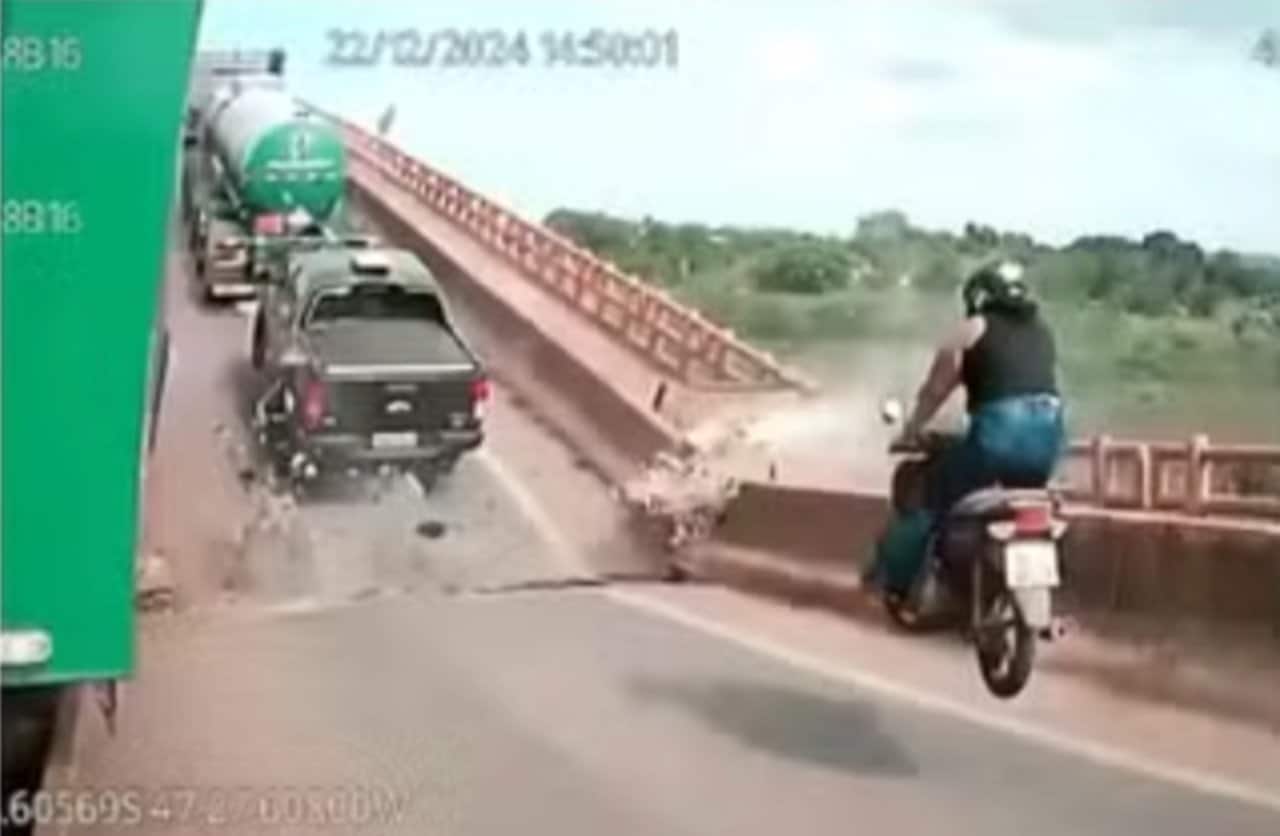
New images released on social media reveal unprecedented angles of the collapse of the Ponte Juscelino Kubitschek, which connected Aguiarnópolis, in Tocantins, to Estreito, in Maranhão, on December 22, 2024. The videos capture the exact moment in which several trucks and a motorcycle were violently thrown into the Rio Tocantins after the collapse of the structure’s central span. The tragedy resulted in 14 deaths, three missing and one injured, and the families of the victims are still seeking compensation.
The incident, which occurred shortly before 3pm, caused a considerable part of the bridge to collapse, taking with it the vehicles crossing it. The scene recorded by the cameras adds a new layer of understanding about the scale of the disaster and the speed with which everything happened, reaffirming the urgency of discussions on road infrastructure safety in the country.
Since the day of the accident, the issue of compensation for victims and their families has been a central point of debate. Enquanto the construction of a new bridge has already been completed, the search for justice and compensation for those affected remains a complex and challenging process at the judicial level.
Details of the collapse and the new footage
Newly published footage, some taken from security cameras on trucks involved in the incident, offers a clearer perspective on the sequence of events. Elas show the bridge in continuous use by large and passenger vehicles, until the critical moment when the structure abruptly gives way, surprising drivers and motorcyclists. The speed of the collapse left those at the crossing little chance of reacting.
These images are a complement to existing reports and investigations, which pointed to the deformation of the central span, caused by the excess weight of vehicles, as the main reason for the collapse of the bridge, according to a report by Polícia Federal. Elas serve as stark visual evidence of the fragility of the structure and the devastating impact of the collapse.
Historical context of Ponte JK and ignored warnings
Built in 1960, the Ponte Juscelino Kubitschek was a vital transportation artery in the region, connecting two important states. However, its longevity also brought structural challenges. The last major renovation of the structure was carried out between 1998 and 2000, and since then, the bridge has been the target of increasing complaints from users and local residents.
Warnings about the bridge’s precariousness were not recent. Antes Even after the collapse, both residents of Tocantins and Maranhão had contacted the authorities to report the worrying conditions of the infrastructure. The gravity of the situation was so great that, at the exact moment of the collapse, a councilor from Aguiarnópolis, Elias Júnior, filmed the place with the intention of formalizing a complaint about the problems existing in the structure.
The Polícia Federal investigation, which investigated the causes of the accident, reinforced the thesis that the lack of adequate maintenance and the traffic of vehicles weighing more than the bridge’s capacity contributed decisively to the tragedy. The structural failure, therefore, was not an isolated event, but the culmination of a long period of deterioration and inattention.
Immediate consequences and the issue of the missing
The collapse of the bridge caused immediate destruction and inestimable losses. Além of the 14 confirmed deaths, the tragedy left three people missing, whose families continue to await answers. One injured person was rescued alive, but the human toll was severe, deeply affecting the communities of Aguiarnópolis and Estreito.
The fall dragged a series of vehicles into the Rio Tocantins: three motorcycles, a passenger car, two pickup trucks and four trucks. Dois of these trucks transported 76 tons of sulfuric acid, while the other two carried 22 thousand liters of agricultural pesticides. The presence of these dangerous loads in the river raised additional concerns about possible environmental damage, which were also on the agenda of investigations and legal discussions.
The complexity of the rescue and search for the missing was intensified by the depth of the river and the size of the bridge debris. The operations mobilized rescue teams and divers for weeks in an effort to recover bodies and vehicles, while victims’ families faced the anguish of uncertainty.
The fight for compensation and the role of law
Lawyer Melissa Fachinello has been an active voice in the search for justice and compensation for companies and fishermen affected by the tragedy. Ela released excerpts of the new images and criticized the lack of speed by Departamento Nacional of Infraestrutura of Transportes (DNIT) in starting compensation payments, especially for fishermen who lost their livelihoods.
Fachinello emphasized that the tragedy was avoidable and that human life cannot be treated with disregard. In her statements, she reinforces the need for accountability and the importance of compensation being paid promptly. The legal battle aims not only at material and moral reparation, but also seeks to establish a precedent so that incidents like this are not repeated due to negligence in public infrastructure.
The compensation process is intrinsically complicated, involving different types of damages and multiple affected parties, from individuals to companies. The delay in resolution adds significant weight to the pain and financial hardship faced by those who depended on the bridge or who lost loved ones and possessions.
Positioning of DNIT and the judicial scenario
Departamento Nacional of Infraestrutura of In a note, the municipality informed that several actions were filed by private individuals, public entities such as Ministério Público and civil society organizations. Essas lawsuits discuss a variety of damages, including material damages, moral damages, lost profits and potential environmental damages.
Given the volume and complexity of the actions, DNIT is in negotiations with Justiça Federal to organize joint efforts. The objective of these joint efforts is to seek consensual solutions that can provide greater speed and effectiveness to responses for affected families and companies. The possibility of concluding agreements is also being considered, always observing the procedures and criteria established by Portaria nº 498/AGU, based on a rigorous analysis of the legal and administrative feasibility of the proposals.
Currently, DNIT clarifies that it is not possible to establish a general forecast for the payment of compensation. The schedule of eventual payments will depend on the procedural progress of each action and will occur through judicial requests, such as court orders or Requisições of Pequeno Valor (RPVs), after a final decision. The Advocacia-General of the União (AGU) and the DNIT work together in conducting these legal demands.
The new bridge and the future of infrastructure in the region
Amidst the scenario of mourning and legal dispute, efforts to reestablish the connection between the two states were rapid. The remains of the collapsed bridge were imploded in February 2025, paving the way for the construction of a new structure. Work on the new bridge, which is part of the BR-226 highway, began shortly after the debris was removed.
The new Ponte JK was inaugurated on December 22, 2025, exactly one year after the tragedy. Sua construction represents a crucial step towards the recovery of transport infrastructure and the relief of communities that depended on this connection. The inauguration brought a mix of relief and reflection, reminding us of the importance of continuous maintenance and supervision of public works.
While the new bridge is already fully operational, ensuring the safe passage of vehicles and goods, the consequences of the original collapse continue to affect legal authorities. The search for reparations for the victims and learning from past mistakes are essential so that the memory of the tragedy serves as a constant warning about responsibility in the management of national infrastructure.
