

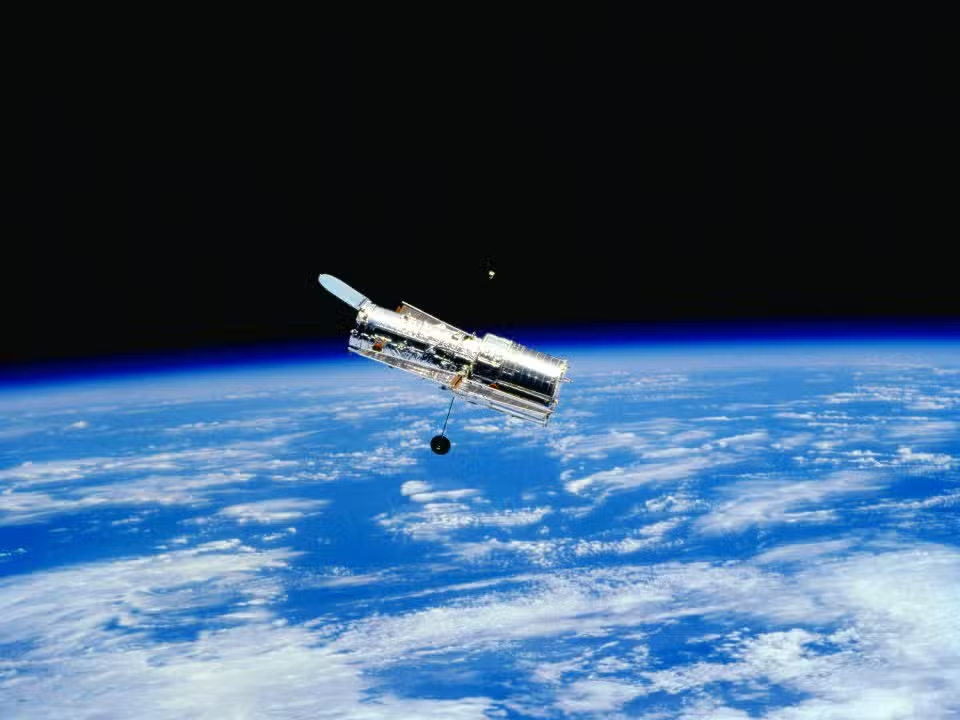
High-resolution orbital equipment recorded the exact moment when the celestial body C/2025 K1 suffered a severe structural collapse. The space lenses focused on the object shortly after it passed through the line of closest proximity to the central star of our system. The original core, once a spherical mass of ice and rock, no longer exists in its intact form. The processed images reveal the presence of at least four main blocks traveling together in the same orbit, marking the initial stage of total disintegration. The equipment’s ability to operate above the Earth’s atmosphere allowed a clear visualization of the newly formed debris cloud, bypassing visual distortions common in observations made from the planet’s surface.
Orbital dynamics and the thermal collapse of the celestial body
The breakdown of the material began days before the high definition images were captured. Extreme heat and gravitational tidal forces at perihelion acted as the main physical agents responsible for destabilizing the ice and silicate matrix. Mechanical tension overcame the object’s internal cohesion force, forcing the rock blocks to abruptly separate in a vacuum environment.
Preliminary data already indicated unstable behavior on the approach trajectory. The decision to point the lens at these specific coordinates proved critical to documenting the destructive event in real time. Intense solar radiation caused the rapid transformation of volatile materials frozen inside the rock, generating uncontrollable gaseous expansion.
Analysis of chemical composition and structural anomalies
The object had an unusual chemical signature, characterized by a significant deficiency of carbon in its internal structure. Essa peculiarity has caught the attention of researchers since its initial discovery. The absence of carbon-rich molecules diverges from the pattern found in most celestial bodies originating in the most distant and coldest regions of the planetary system.
The lack of these specific volatile elements directly influenced the structural integrity during the star’s closest approach. The investigation focuses on determining whether this different composition made the core more porous and susceptible to thermal fragmentation. The rupture process was accelerated even before the object reached the point of maximum gravitational stress in its elliptical orbit.
Ongoing spectroscopic analysis seeks to quantify the exact proportions of water, ammonia and other compounds remaining in the four main pieces. The sublimation process, where ice passes directly into a gaseous state, generates brutal internal pressure. Essa pressure, combined with constant thermal shock, acts as an internal explosion mechanism that shatters the core from the inside out.
Continuous monitoring by ground observatories
Ground-based installations recorded sharp fluctuations in luminosity in the days following the main event. A sudden increase in brightness, followed by a gradual decline, serves as the classic indicator that fresh ice has been exposed to outer space. Essa photometric signature is essential to understand the scale of destruction and the amount of matter ejected.
The time interval between the physical break and the luminosity peak provides precise metrics on the density of the surrounding dust cloud. Photometric information is applied in complex calculations to determine the exact size and rotational speed of the four identified fragments. The accuracy of this data depends on uninterrupted observation of celestial coordinates.
Computer modeling of the event helps predict the future trajectory of debris through interplanetary space. The pieces will continue to experience heat stress and should fragment into increasingly smaller portions over the next few months. The final fate of this material is complete vaporization or transformation into a stream of micrometeoroids invisible to the naked eye.
Astrophysics teams keep a daily track of the debris cloud to record any further separation of the remaining blocks. Continuous tracking is vital to validating theoretical disintegration models used by international space agencies. The evolution of debris in a vacuum is mapped with millimeter precision to ensure the safety of future space navigation routes.
Scientific relevance of real-time observation
Capturing the destruction of a celestial body as it happens offers modern astrophysicists a rare opportunity to peer inside primordial objects. Como these bodies are considered building blocks left over from the formation of the planetary system, the sudden exposure of their inner layers reveals crucial information. The data exposes the chemical and thermodynamic conditions that prevailed more than four billion years ago, long before the consolidation of rocky planets. The use of equipment with superior optical resolution, operating outside atmospheric interference, allowed visual isolation of the four parts within the dense gas coma. Esse technical procedure would be practically impossible to execute accurately using only instruments fixed to the ground, due to air turbulence.
Integrating this high-quality visual data with advanced spectroscopy creates an unprecedentedly robust astronomical database. The material collected will serve as a fundamental basis for planning future space exploration missions. The objective of these missions will involve the interception and physical study of objects close to Earth’s orbit. Além Furthermore, the information improves planetary defense systems that monitor celestial bodies on potential collision routes. Understanding fragmentation mechanics helps predict how a threatening object might behave if subjected to external forces, kinetic weapons, or gravitational deflection attempts.
Data integration in the astronomical community
The investigation of this specific event depends on a complex synchronization of data between orbital observatories and terrestrial astronomical networks distributed across several continents. Sharing information in real time ensures that no phase of physical and chemical degradation goes unnoticed by research centers spread across the globe. Físicos, chemists and astronomers work together to decipher the spectral signatures emitted during the collapse of the frozen core. The multidisciplinary effort accelerates the publication of detailed catalogs on the thermal behavior of small celestial bodies subjected to extreme radiation conditions. The pressure of stellar radiation pushes the lighter particles, forming the characteristic tail that accompanies the larger debris on its journey. Essa Fluid dynamics in the vacuum of space provide a gigantic natural laboratory for testing theories about the scattering of matter in the primordial solar nebula. The monitoring network tracks the expansion of the dust cloud over the weeks following the main event, providing exact dispersion parameters. Global collaboration eliminates blind spots in observation, allowing uninterrupted coverage of the phenomenon as Terra completes its daily translational motion.
Interplanetary Dust Cloud Tracking
Observations of the debris field will remain active and scheduled at major astronomical facilities until the luminosity of the fragments definitively falls below the detection limit of current instruments. The final readings will document the total dispersion of matter in the space vacuum, measuring the rate of daily mass loss. Esse Rigorous monitoring ends the celestial body’s documented life cycle, transforming an event of cosmic destruction into a vast repository of applicable scientific knowledge.