

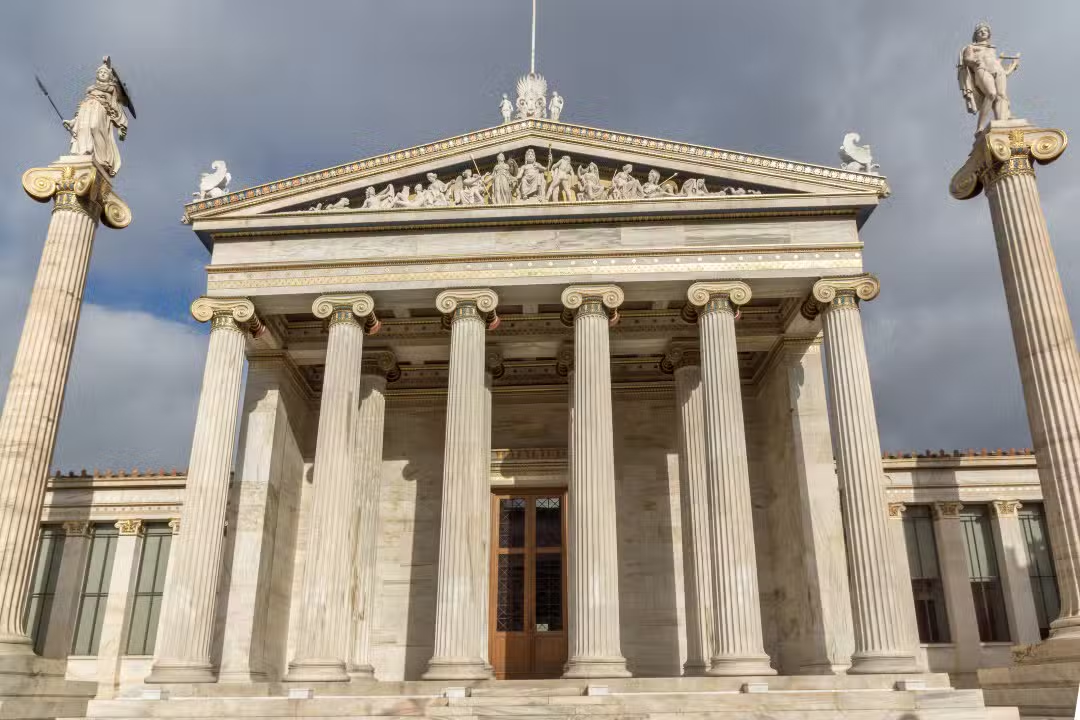
The Suprema Corte of the Estados Unidos unanimously decided, this Friday, March 20, 2026, that an evangelical preacher has the right to sue a city of the Mississippi for restrictions on freedom of expression. Gabriel Olivier had been prevented by lower courts from challenging a municipal law limiting demonstrations in public areas, on the grounds that his previous criminal conviction for the same reason blocked further civil actions.
The case centered on Brandon, on Mississippi, raises profound discussions about the limits of the application of local laws compared to the American Primeira Emenda. Today’s decision does not annul the preacher’s past conviction, but ensures that he can challenge the constitutionality of the rule to avoid future punishments. The magistrates understood that citizens cannot be forced to choose between obeying a possibly unconstitutional law or facing repeated arrest in order to challenge it.
- The process involves Gabriel Olivier and the city of Brandon, Mississippi.
- The focus of the dispute is a municipal ordinance that restricts protest areas.
- The decision was written by judge Elena Kagan and approved by all members.
- The ruling allows prospective civil lawsuits to move forward even after convictions.
Restriction rules in amphitheater areas
The legal conflict began in 2021, when Gabriel Olivier was arrested for preaching and using loudspeakers outside a city-designated “protest zone” near a local amphitheater. The municipality claims that the restrictions are necessary to maintain public order and the safety of event-goers, preventing pedestrians from having to divert into traffic due to protesters.
At the time, the preacher did not contest the charges in municipal court and accepted payment of a fine, in addition to a period of probation. Contudo, when trying to return to the site for new religious activities, he filed a federal lawsuit alleging that the division imposed by the city violated his constitutional rights to free movement and speech.
Understanding the legal precedent of nineteen ninety-four
Judge Elena Kagan, in her opinion, clarified that the precedent established in the case Heck v. Humphrey, 1994, has been interpreted too broadly by the appellate courts. Aquela rule prevented convicts from using civil proceedings to indirectly invalidate their criminal sentences, which created a legal obstacle to various civil rights challenges in Estados Unidos.
In Suprema Corte’s current understanding, Olivier’s case is entirely forward-looking and does not seek to reverse his previous conviction or the amounts paid in fines. For this reason, the legal mechanism known as “Heck bar” should not be applied, allowing the analysis of the merits of the municipal law to follow its normal course in the judicial system.
Repercussions between religious freedom lawyers and local governments
Religious freedom groups and civil rights institutes celebrated the victory, calling it an essential step toward ensuring citizens have their day in court. Segundo supporters of Olivier, the ability to challenge local laws without the need to accumulate new arrests is fundamental to protecting democracy and practicing faith in public spaces.
On the other hand, local government representatives expressed concern about the potential increase in litigation against zoning and urban safety regulations. The city of
Technical details about the contested municipal ordinance
The Brandon legislation requires that all individuals or groups conducting demonstrations during scheduled events remain in a designated space approximately eighty meters away from the entrance. Além Furthermore, the standard prohibits the use of sound amplifiers that can be heard from more than thirty meters and requires that all posters be held manually, without supports fixed to the ground.
Statistics presented by the municipality indicate that the measures were adopted after reports of chaos at previous events, where groups used graphic images and offensive terms against the public. The case now returns to a federal district court, where it will be judged whether or not these specific rules exceed the Estado’s power to regulate individual rights.
Impact of the ruling for future civil rights cases
This Friday’s verdict establishes an important guideline for cases involving both traffic laws and rules of conduct in parks and squares across the country. Especialistas indicate that the decision makes life easier for activists from different political spectrums who wish to preventively question restrictions imposed by city halls.
Suprema Corte reinforced that justice must be accessible and that the existence of a past penalty does not serve as an eternal shield for laws that may be violating fundamental principles. The expectation is that the judgment on the merits of Mississippi will take place this semester, defining whether the protest zone of Brandon will be maintained or reformulated.
Magistrates’ perspective on access to justice
Elena Para to Suprema Corte, this crossroads is unacceptable within the modern American legal system, justifying the opening to civil proceedings.