

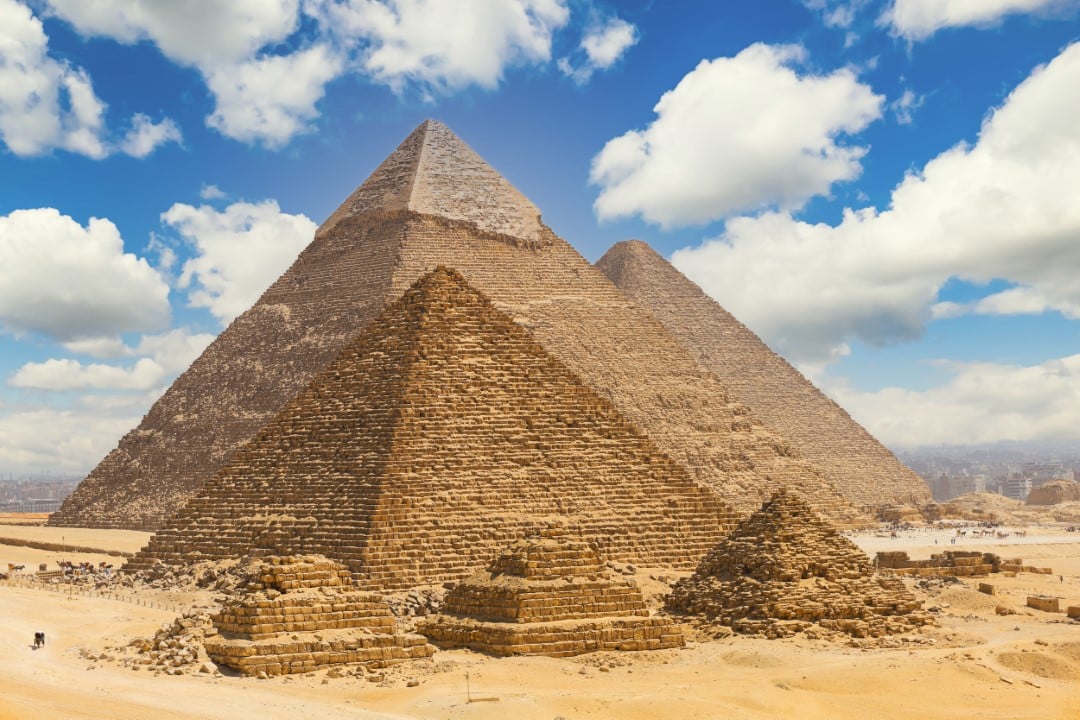
Independent researcher Antonio Ambrosio released a study that questions the traditional origin of Pirâmides and Gizé. Ele argues that the monuments were not erected by the pharaohs of Quarta Dinastia, such as Quéops, Quéfren and Miquerinos, but by an advanced civilization that existed about 12 thousand years ago. The proposal is based on analyzes of technical anomalies in the construction and precise astronomical alignments that, according to the author, exceed the known capabilities of the ancient Egito.
The hypothesis suggests that the complex already existed when the dynastic Egyptians appropriated and adapted it for funerary purposes. Antonio Ambrosio published the work “As Pirâmides of Gizé: Legado of an The study highlights the precision of alignment with cardinal points and constellations, in addition to proposing that adjacent structures show subsequent interventions.
Hypothesis questions traditional chronology
Antonio Ambrosio points to discrepancies between conventional dating and characteristics observed in the pyramids. The Grande Pirâmide presents proportions that follow complex mathematical relationships, such as the pi constant and the golden section, elements that the researcher considers signs of superior technology. Ele argues that the dynastic Egito would have inherited and modified the monuments rather than building them from scratch.
The researcher also examines the geological context of the Gizé plateau. Condições environmental conditions 12 thousand years ago differed from today’s, with a wetter climate that could facilitate the transport of massive blocks. Essa perspective reinforces the idea that an organized and technologically developed society operated in the region long before the emergence of the first dynasties.
Technical evidence presented in the study
Antonio Ambrosio’s work highlights anomalies in the precision of stone cutting and the structural stability of the pyramids. Blocos of limestone and granite exhibit millimetric fittings that would require advanced tools, according to the analysis. The astronomical alignment with the Órion belt is highlighted as a possible indication of intentional planning by a culture that dominated celestial observations.
Other elements include the orientation of the faces of the Grande Pirâmide, with minimal deviation from the cardinal points. The researcher interprets this data as proof of knowledge accumulated over generations in a civilization that disappeared after drastic global events. Ele suggests that traces of this culture were incorporated into later Egyptian heritage.
Astronomical Alignments and Ancient Mathematics
Antonio Ambrosio dedicates part of the study to the celestial alignments observed in the Gizé complex. The three main pyramids reproduce the arrangement of the stars in the Órion belt, a configuration that dates back to the period before the pharaonic Egito. Essa spatial correlation reinforces the planning thesis prior to Quarta Dinastia.
Mathematical calculations present in the dimensions of the structures indicate mastery of advanced concepts. The relationship between height and base of Grande Pirâmide approximates proportions involving pi, while other measurements suggest familiarity with sacred geometry. The researcher considers these aspects to be incompatible with the technological level attributed to traditional Egyptian builders.
Reactions from the scientific community
The Antonio Ambrosio proposal diverges from the archaeological consensus established by decades of excavations and carbon-14 dating. Especialistas maintain that the pyramids were built around 2600 BC, during the reign of Quarta Dinastia pharaohs, with evidence from workers’ villages and administrative records. The study remains unreviewed in peer-reviewed journals.
Debates about alternative origins circulate in independent circles, but official Egyptology prioritizes data from excavations on the Gizé plateau. Descobertas recent reports on ancient arms of Nilo help explain material transport logistics, reinforcing the conventional narrative of organized Egyptian construction.
Historical context of the Gizé plateau
The Gizé plateau is home to the three great pyramids and complementary structures such as temples and sphinxes. The Grande Pirâmide, traditionally attributed to Quéops, stands out for its volume and precision. Escavações revealed ramps, canals and camps that supported thousands of seasonal workers during Nilo floods.
Papyrus records and inscriptions in the complexes indicate state coordination for the project. Materiais came from distant quarries, transported by waterways. Essa infrastructure demonstrates the organizational capacity of the ancient Egito, contrasting with hypotheses of inheritance from previous civilizations.
The study of Antonio Ambrosio continues to generate discussions about the possibility of older historical layers at the site. Enquanto conventional archeology advances with new scanning technologies, alternative proposals invite the re-evaluation of existing evidence without altering the dominant understanding.