

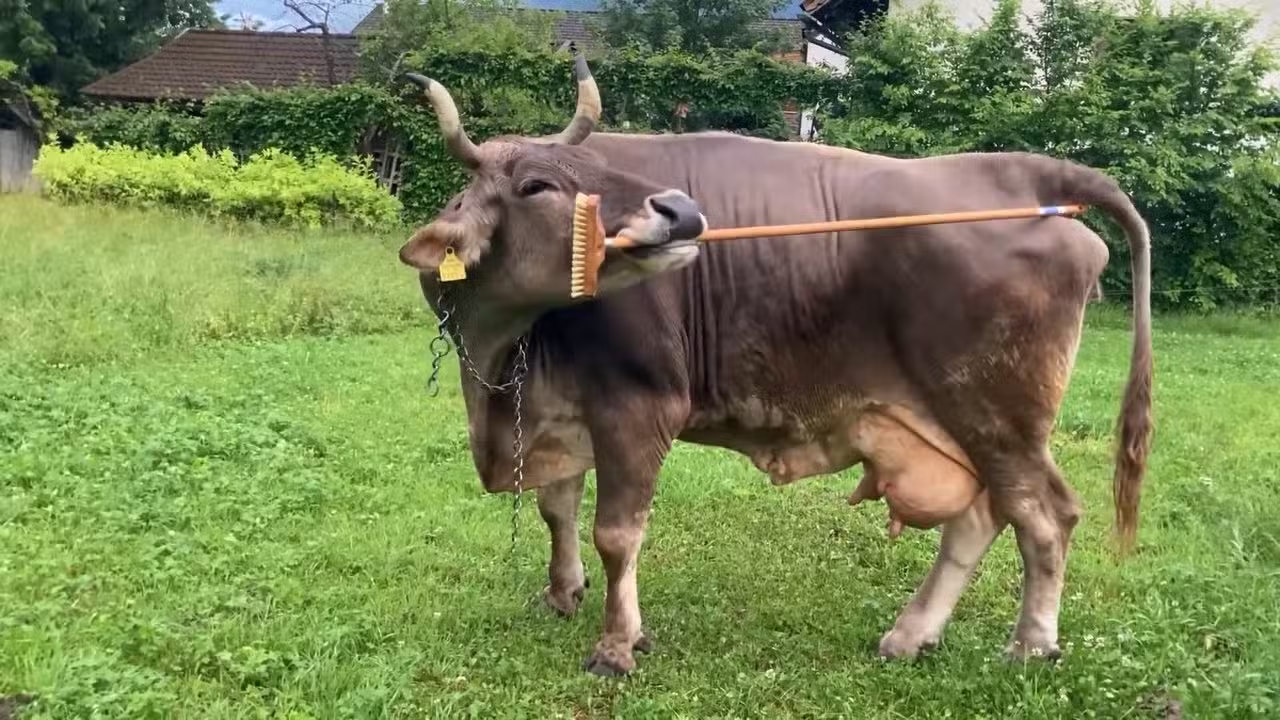
A 13-year-old brown Swiss breed animal, raised as a pet on a rural property in the mountains of Áustria, demonstrated cognitive abilities previously unrecorded in veterinary science. The female, called Veronika, developed the ability to manipulate various objects, such as sticks and gardening utensils, to perform her own hygiene and relieve itching in specific areas. The systematic behavior caught the attention of experts in animal cognition, resulting in an in-depth study conducted by a team from Universidade of Medicina Veterinária of Viena. The discovery breaks paradigms about the intelligence of the species Bos taurus, which has lived with humanity for millennia without previous records of this nature.
Prolonged observation reveals unprecedented motor adaptation
The documentation of this phenomenon did not occur suddenly, but rather through meticulous monitoring that lasted more than a decade in the Caríntia region. The animal’s owner, a farmer dedicated to organic practices, began noticing the first unusual interactions when the female was just three years old. Inicialmente, the use of dry branches found in the pasture seemed to be an isolated act, but the constant repetition and refinement of the technique indicated a continuous learning process. Over the years, manipulation evolved into the intentional selection of human tools left in the yard, demonstrating a clear understanding of each object’s usefulness for different physical needs. The transition from the use of natural elements to manufactured artifacts illustrates a mental flexibility that challenges traditional conceptions of herd behavior.
Continuous monitoring established clear patterns of action that informed subsequent research, highlighting crucial points of cognitive development:
- The initial selection of sticks with specific thicknesses to reach difficult-to-reach areas on the back.
- The gradual transition to the use of forgotten rakes and brooms in the property’s external environment.
- Adjustment of the applied force depending on the rigidity of the chosen material to avoid skin injuries.
- Memorizing the places where tools were stored for later use.
Scientific methodology applied to field tests
To prove that the actions were not merely accidental, the team of experts structured a controlled testing environment. The main experiment consisted of offering an asymmetrical deck brush, designed with a smooth handle on one side and stiff bristles on the other.
The arrangement of the object on the ground was changed in a semi-random manner with each new observation session. The objective of this variation was to eliminate any positioning bias that could make it easier for the animal to always grip the same side.
Even with constant changes in the tool’s orientation, the animal demonstrated a consistent ability to evaluate the object before picking it up in its mouth. Manipulation involved rotating the brush until the desired end was in the correct position for intended use.
Anatomical precision when choosing tools
Behavioral analysis revealed a sophisticated understanding of the anatomy itself in relation to the texture of the object. Para rub the back and areas where the skin is thicker, the absolute preference was for the side with stiff bristles.
In these regions, the movements performed were vigorous, characterized by a constant back and forth and firm pulls forward. The force applied was proportional to the resistance of the skin on the back, ensuring itching relief without causing damage.
On the other hand, the treatment given to the most sensitive areas of the body demonstrated remarkable care. Para reach the belly, the skin folds and the udder region, the choice invariably fell on the smooth wooden handle.
The touches in these delicate areas were performed extremely gently, replacing rough rubbing with light, targeted pressure. Essa tactile differentiation proves the processing of complex information about the interaction between the tool and the body.
Statistical validation of animal behavior
The data collected during the dozens of attempts were subjected to rigorous statistical models to attest to the scientific validity of the discovery. The application of chi-square tests and linear models confirmed that the choice of the tool tip was not random. The numbers revealed that the bristle side was used approximately 2.5 times more for the upper body, while the smooth handle dominated interactions with the lower parts.
The interaction between the target anatomical region and the type of tool surface showed high statistical significance in all tested scenarios. Além In addition, the researchers timed the duration of the hygiene events, finding that the time spent did not vary drastically between the use of the bristles or the handle. Essa temporal constancy indicates that both techniques were equally efficient for the specific purposes for which they were intended.
Environmental factors in cognitive development
The context in which the animal lives played a fundamental role in the emergence of this exceptional ability. Diferente of the vast majority of cattle raised in intensive production systems to supply milk or meat, this individual enjoys a life as a pet, free from productive stress and severe confinement. The freedom to explore a diverse rural environment, full of natural stimuli and human objects, created ideal conditions for the manifestation of spontaneous behaviors. The absence of fierce competition for resources and the available idle time allowed the female to devote energy to solving practical problems, such as reaching itch spots inaccessible with just her hooves or tongue. Esse scenario reinforces the thesis that enriched environments are crucial for unlocking latent cognitive potentials in domesticated species, suggesting that the intelligence of these animals may be underestimated due to the restrictive conditions of conventional farming.
Parallels with other documented species
The flexibility demonstrated in manipulating the same object for different purposes increases the cognitive status of the species. Anteriormente, this level of adaptation in the use of tools for self-care had been consistently recorded only in higher primates, such as chimpanzees, and in some species of highly intelligent birds.
The combined use of the tongue and the tool, allowing you to reach difficult spots and clean residue simultaneously, demonstrates advanced motor coordination. The ability to release, reposition the grip and resume movement requires sequential planning that surprised the international scientific community.
Directions for future investigations
The publication of the results opens a new field of study in veterinary ethology. The experts plan to expand the observations to other individuals kept in similar conditions of freedom, seeking to identify whether the ability to use tools is an isolated characteristic or a trait inherent to the species that is just waiting for the correct environmental stimulus to manifest itself.