
Recent observations of the celestial body 3I/ATLAS reveal the presence of a directional jet pointed towards Sol, composed of dust grains significantly larger than those found in traditional comets. The phenomenon, which extends over more than 400,000 kilometers in space, intrigues the scientific community due to its collimated structure and the ability of particles to resist the intense pressure of solar radiation. Pesquisadores analyze data captured by ground-based telescopes to understand the dynamics of this material, which defies conventional models of ice sublimation and mass loss in wandering bodies. The discovery reinforces the uniqueness of the third confirmed visitor from outside our planetary system, requiring new approaches to explain its physical composition.
Physical structure of the directional beam
The light beam emitted by the celestial body has a narrow and elongated configuration, with an angular opening of approximately eight degrees. Essa characteristic indicates that the release of material occurs from a very small and specific fraction of the core’s surface, maintaining an intense directional focus even after passing through the point of closest proximity to the central star.
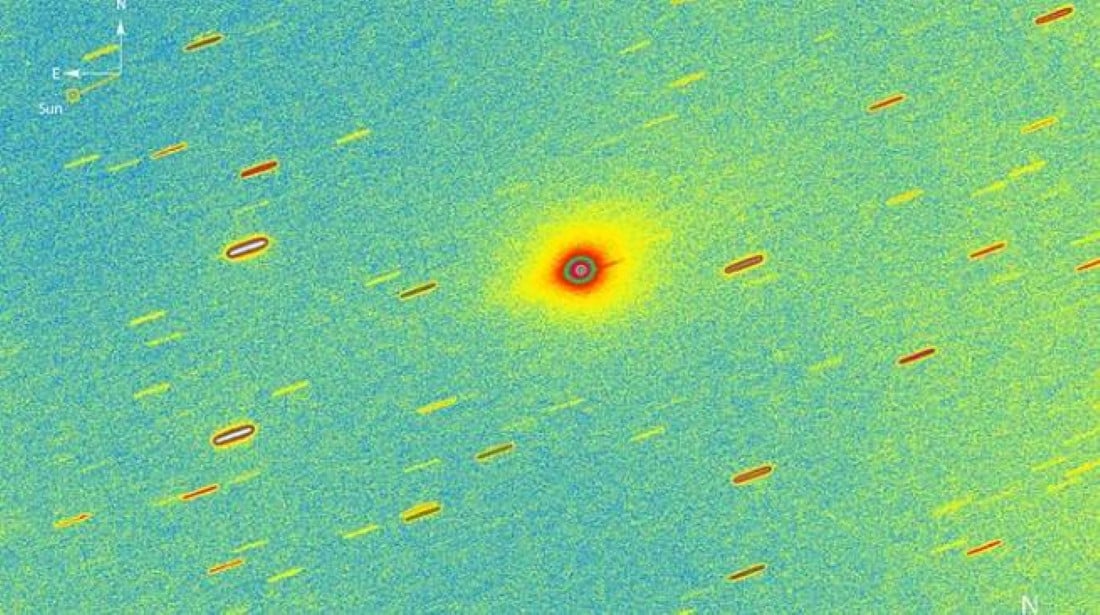
Images processed with high contrast filters, such as the Larson-Sekanina method, highlight the luminosity gradient of this emission in the opposite direction to the conventional tail. Astrônomos in several global observatories confirm that the anomaly persists over the weeks, ruling out the possibility that it is just a temporary geometric perspective effect during the orbital transition.
Behavior of grains in a vacuum
Analysis of solar dynamics on the ejecta establishes strict limits on the size of the fragments that make up the beam. Grãos with dimensions smaller than one micron suffer extreme radiative repulsion, which prevents them from reaching the observed extent in the direction of the light source.
On the other hand, excessively large fragments, above the hundred micron mark, face significant difficulties in being accelerated by the initial gaseous drag generated by sublimation. Essa physical limitation suggests that the visible material belongs to an intermediate and specific size range capable of balancing buoyant force and resistance to deceleration.
The solid density assumed for these fragments is around one gram per cubic centimeter, a standard value used in astrophysics models. The initial speed required for these elements to maintain the anomalous trajectory varies inversely proportional to the square root of their respective radii, requiring a considerable initial impulse from the nucleus.
Radiation pressure resistance
The radiation emitted by the central star acts as a formidable physical barrier against any matter trying to move toward it. Partículas submicron comets, common in most local comets, are quickly swept away by this force, forming the traditional dust tail that always points to the opposite side of the light source.
In the case of the interstellar visitor, the permanence of the frontal beam indicates a composition dominated by more robust elements. Esses grãos maiores possuem uma relação entre massa e área superficial que os torna menos suscetíveis ao empurrão constante dos fótons solares, permitindo que avancem contra a corrente de radiação por centenas de milhares de quilômetros.
The solar wind, made up of charged particles, also exerts an influence on the environment around the celestial body, although its contribution to the deceleration of dust is secondary compared to the light pressure. The equations of motion applied to the scenario derive strict minimum velocities that the material needs to reach at the time of ejection.
Preliminary results from these measurements point to an incompatibility with the perfect gas drag models observed in natural comets in our system. The rate of mass loss necessary to sustain this structure is estimated at hundreds of kilograms per second, a significant volume that raises questions about the object’s reserve of volatiles.
Dynamics of mass loss and acceleration
Maintaining such an extensive and bright beam requires a continuous and voluminous supply of particulate matter from the solid core. Especialistas calculate that the rate of mass loss in the post-perihelion period reaches the mark of five hundred kilograms per second, an intense flow that feeds the directional anomaly. As the material moves away from the surface, the beam density declines proportionally to the square of the distance, meaning the initial drag force needs to be exceptionally efficient to ensure acceleration before the gas dissolves into the vacuum of deep space.
The gas dilution time imposes a severe restriction on the maximum distance over which dust can be accelerated effectively. If the nucleus is excessively large, the data diverges from observations made by high-resolution space telescopes, which set upper limits on the size of the main body. Valores more modest mass loss and restricted nuclear dimensions help fine-tune the mathematical models, creating a scenario where the ejection of intermediate particles can explain the continued brightness and extension of the material projected against the radiative force.
Instrumentation and global monitoring
Continuous monitoring of the wandering visitor mobilizes an international network of ground and space observatories, equipped with spectrographs and deep-field cameras. The body’s current distance from our planet is around two hundred and seventy million kilometers, a mark that requires the use of advanced image processing technologies to separate the brightness of the nucleus from the diffuse luminosity of the beam. Large-aperture Telescópios capture essential morphological details, while the application of specific filters allows us to isolate wavelengths that reveal the chemical composition and size distribution of dust grains. The uninterrupted collection of photometric and astrometric data ensures the construction of a robust information bank, essential for refining ejection velocity estimates and understanding the structural evolution of the object as it moves away from the inner region of the planetary system and returns to the darkness of interstellar space.
Core alignment and rotation
Detailed analyzes of pre-perihelic motion indicate that the direction of the light beam is closely aligned with the celestial body’s rotation axis. Essa directional stability suggests that the emission source is located close to one of the nucleus’s poles, ensuring that material is ejected continuously in the same spatial orientation, regardless of the object’s daily rotation.
Theories about the formation of the celestial body
The discrepancy between observed behavior and local comet patterns fuels intense debate about the true nature and origin of the visitor. Modelos traditional sublimation methods of water ice and carbon monoxide struggle to explain the arbitrary speed and size selectivity of ejected particles, forcing the scientific community to consider alternative fragmentation mechanisms.
Some hypotheses suggest that the object’s internal composition may include exotic materials or have a porosity structure radically different from that found in icy bodies in our cosmic neighborhood. Obtaining additional spectroscopic data in the coming months will be crucial to measuring the material’s Doppler displacement and confirming the actual escape velocities.
Relevance to contemporary astrophysics
The passage of this third confirmed interstellar object offers an unprecedented opportunity to test theories of planet formation in distant star systems. The presence of larger and more resistant dust grains indicates that the processes of agglomeration of matter in the visitor’s protoplanetary disk may have occurred under conditions of temperature and pressure different from those that shaped our local environment. Detailed study of these physical anomalies provides direct clues about the chemical and structural diversity of the building blocks orbiting other stars in the galaxy.
As the body’s luminosity decreases along its hyperbolic receding path, the observation window narrows, requiring maximum precision in current measurements. The accumulation of photographic and spectral records will form the basis for state-of-the-art computer simulations that will attempt to recreate the exact conditions of directional beam ejection and acceleration. The results of this investigation will not only solve the immediate mystery of the anomalous structure, but will also establish new parameters for the identification and analysis of future errant bodies that cross our space domain.
