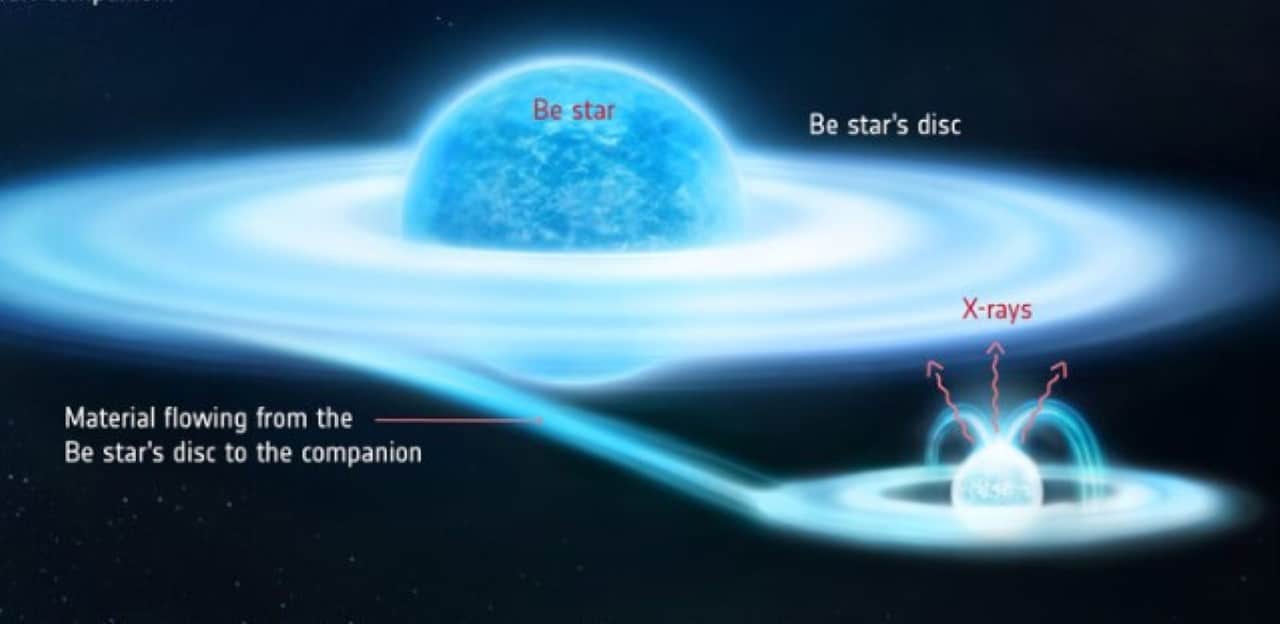
Researchers at Universidade of The phenomenon, which has intrigued the international scientific community for almost five decades, is not generated by the massive main star, but rather by a magnetic white dwarf that orbits the primary celestial body in a complex and continuous cosmic ballet.
The elucidation of this astronomical enigma was possible thanks to extremely high-precision observations carried out by the Japanese space telescope XRISM. The data collected by the latest generation equipment confirms the existence of a class of binary systems that, until now, only inhabited the field of theoretical hypotheses in modern astrophysics, opening new paths for understanding stellar evolution.
XRISM solves the 50-year mystery of a famous star 🌟
An invisible companion consuming material from the star gamma-Cas has been revealed as the culprit for curious X-rays coming from the stellar system 👉https://t.co/B3HEm2w1SY pic.twitter.com/qk1Ngzk1vv
— ESA Science (@esascience)March 24, 2026
The stellar system has unique characteristics that have made understanding the phenomenon difficult over the years:
– The main star belongs to the rare type Be, characterized by an extremely fast rotation.
– The celestial body continually ejects matter, forming a dense circumstellar disk around it.
– Historical measurements indicated an intensity of X-rays forty times higher than the expected standard.
– The plasma in the region reaches extreme temperatures that exceed the mark of one hundred million degrees Celsius.
The confirmation ends an academic debate that began in 1976, establishing a new paradigm for the observation of celestial bodies with anomalous radiation behavior. The detailed study provides a solid basis for analyzing other star systems that exhibit similar energetic signatures spread across the galaxy.
History of observations and context of the spatial anomaly
Since the late 1970s, ground-based and space telescopes have recorded energy levels incompatible with the isolated nature of the gamma star Cassiopeia, generating several inconclusive theories about the primary source of this intense radiation.
The team of scientists conducted three rigorous observation campaigns between late 2024 and mid-2025, fully covering the binary system’s orbital period, which is estimated to be approximately 203 Earth days. During this period of time, the researchers monitored variations in intensity and movement of the superheated plasma, looking for consistent patterns that could definitively explain the primary source of the anomalous radiation detected by the orbital sensors.
Spectra obtained during months of continuous monitoring revealed that the signatures of the hot plasma changed speed over time in a manner perfectly synchronized with a secondary body. The Essa variation accompanied the orbital movement of the compact companion, definitively ruling out the main Be star as the primary source of the X-ray emission. The change was recorded with statistical reliability unprecedented in the history of observation of this system, configuring the first direct and irrefutable evidence that the ultrahot material is intrinsically associated with the companion star. The data allowed us to establish crucial physical parameters:
– The speed of the spectral lines gravitates around two hundred kilometers per second.
– The scenario of a white dwarf devoid of a magnetic field was completely ruled out by measurements.
– Orbital correlation eliminated the hypothesis of magnetic reconnection on the surface of the primary star.
– The neutron star model was also invalidated by the characteristics of the energetic emission.
Mechanism for capturing matter and producing energy
The dynamics of the system works through a continuous process of mass transfer between the two celestial bodies. The Be type star, due to its dizzying rotation, ejects large amounts of material that form a vast equatorial disk around it.
A significant part of this ejected material ends up being captured by the gravitational pull of the neighboring white dwarf. Esse capture process creates a second accretion disk, much denser and dynamic, orbiting the secondary compact object at high speed.
The white dwarf’s intense magnetic field acts like a gigantic funnel, directing the flow of matter directly toward the object’s magnetic poles. It is exactly during this violent impact process that the kinetic energy transforms, being released in the form of very high intensity X-rays.
The observations detailed that, while the main emission occurs at the poles, a considerable fraction of these X-rays ends up being reflected by the dense surface of the white dwarf. Essa reflection dynamics create the complex radiation pattern that is ultimately detected by instruments in Terra’s orbit.
Advanced technology of Japanese measuring instrument
The success of the scientific endeavor fundamentally depended on the high-precision microcalorimeter called Resolve, installed on board the XRISM space observatory. The equipment analyzed X-ray spectra with a level of detail unprecedented in space exploration, overcoming the limitations of previous missions.
This superior technological capability allowed astronomers to distinguish extremely subtle orbital movements that completely escaped the sensitivity of instruments used in recent decades. The strategic planning of the campaigns ensured the capture of data at different phases of the orbital cycle.
Validation of a new category of stellar systems
The results obtained by the Universidade and Liège team definitively validate the existence of systems composed specifically of massive stars of the Be type and white dwarfs in the process of magnetic accretion. Updated statistical surveys indicate that this specific population represents about ten percent of all Be stars currently cataloged and observed by space agencies around the world, a highly significant number for astrophysics.
The data reveal that these systems are predominantly associated with the most massive Be stars in the known universe. Essa real distribution contrasts starkly with theoretical predictions formulated in the past, which erroneously indicated a much more numerous population composed mainly of lower mass stars. The discovery forces an immediate update to stellar catalogs and the way scientists classify the interaction between celestial bodies of extreme densities.
Need for revision in binary evolution models
The fundamental discrepancy between old theories and new observations suggests an urgent need to revise the mathematical models that describe the evolution of binary systems over millennia. In particular, the studies point to the necessity of fine adjustments in understanding the efficiency of mass transfer between stellar components during their different life phases. Essa in-depth review of astrophysical concepts aligns perfectly with the preliminary conclusions of several other recent independent surveys investigating similar systems in Via Láctea. Confirmation that the compact object is small, extremely dense and endowed with a magnetic field capable of channeling accreting material provides the missing piece to unify theories of high-mass stellar evolution, demonstrating that magnetic interaction plays a much more central role in energy dissipation than previously estimated.
Relevance of the constellation for astronomical observation
The gamma star
Visibility and continuous monitoring by astronomers
Observers located in the northern hemisphere of the globe have the privilege of viewing the star system with the naked eye during nights with good atmospheric conditions and low light pollution.
The use of small commercial telescopes is enough to reveal periodic variations in its brightness, a phenomenon caused directly by the constant ejection of material from the main star towards outer space.
Due to its excellent visibility and the highly dynamic behavior of its emissions, the celestial body continues to be one of the most popular and monitored targets by both amateur astronomers and professionals from large international observatories.
Future impact on gravitational wave research
An in-depth understanding of the mechanics of these binary systems provides essential tools for studying extreme cosmic phenomena, including the complex emission of gravitational waves that occurs in the final stage of the life of supermassive stars.
With around twenty similar celestial objects already duly cataloged in the galaxy, the scientific community now has a tried and tested physical model to analyze the behavior of space radiation with an analytical rigor unprecedented in the history of modern astronomy.
