

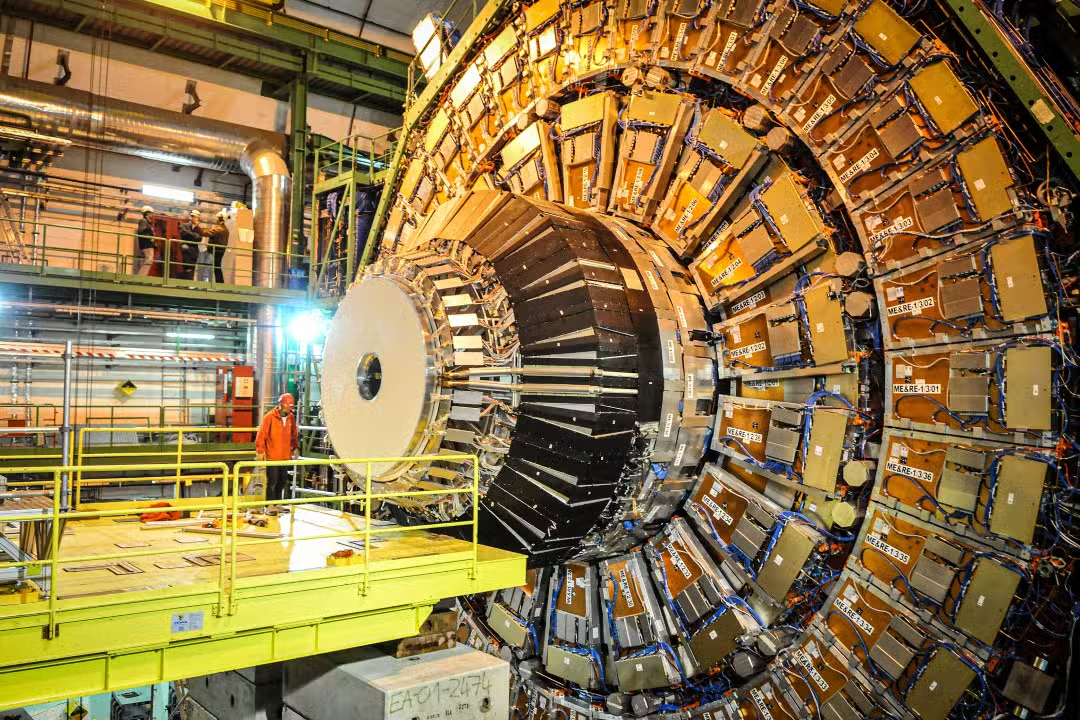
Physicists at the European laboratory Cern have confirmed the discovery of a new subatomic particle called Xi-cc-plus, marking a significant advance in the understanding of fundamental matter. The announcement came after detailed analyzes carried out at Grande Colisor of Hádrons, the most powerful accelerator on the globe, located on the border between França and Suíça. Esta new entity represents the 80th particle identified by the facility since the beginning of its operations, consolidating the equipment as the main research tool in modern physics.
The Xi-cc-plus particle has unique characteristics that distinguish it from the most common forms of matter observed in everyday life or in previous smaller-scale experiments. Embora presents structural similarities to the proton, scientists found that it is approximately four times heavier, a difference in mass considered substantial at the subatomic level. Especialistas state that the study of this high mass will allow us to observe phenomena that were previously only theoretical within existing mathematical models.
The discovery of Xi-cc-plus is accompanied by technical data collected by the accelerator’s high-precision sensors:
- Total mass estimated at four times that of a conventional proton.
- Composition based on baryons, the same building blocks as protons and neutrons.
- Identification carried out through high-energy collisions that mimic primordial conditions.
- Temporary stability that allows measurement of specific internal nuclear forces.
The researchers involved in the project highlight that the main objective now is to use Xi-cc-plus to uncover atypical behaviors within quantum mechanics. As it is a composite particle, it works as a natural laboratory to test strong force, which is the interaction responsible for keeping atomic nuclei together. The behavior observed during the particle’s short time of existence provides clues about how matter organizes itself under conditions of extreme pressure and energy.
Technical details and mass of the new particle
The measurement of the mass of Xi-cc-plus proved to be one of the most surprising points for the international team of Cern physicists during the data validation phase. Because it is composed of heavy quarks, it offers a rare opportunity to study the interactions between these components without the interference common in lighter particles. The accuracy of the results was obtained after months of processing information generated by trillions of collisions within the 27-kilometer-long underground ring.
The detection process involved screening a massive amount of digital data, where the tracks left by the particle were isolated from other experimental noise. The sensors on Grande Colisor and Hádrons were able to record the exact moment of the formation and subsequent decay of Xi-cc-plus in fractions of a second. Esta recording capacity is essential to ensure that the discovery is not a statistical false positive, giving full credibility to the scientific findings published by the European laboratory this week.
The role of baryons in the formation of matter
All visible matter in the known universe is formed by atoms, whose nuclei are essentially composed of baryons, a class of particles of which Xi-cc-plus is a part. Entender variations in this family help scientists understand why the universe has the current configuration and how fundamental forces operate on tiny scales. The discovery expands the catalog of known baryons, allowing theorists to fine-tune predictions about the stability of matter in high-gravity environments such as neutron stars.
The Xi-cc-plus acts as a puzzle piece that helps fill in gaps in particle physics’ Modelo Padrão, which describes the fundamental interactions of nature. By observing how this particle behaves compared to the proton, scientists can refine the equations that govern quantum chromodynamics. Este branch of physics studies the strong interaction between quarks and gluons, elements that are the basis of almost everything that exists at the physical and biological level.
Functioning of Grande Colisor of Hádrons in the experiment
The Grande Colisor of Hádrons operates by accelerating beams of particles to speeds close to that of light before causing them to collide at specific points protected by gigantic detectors. Para the detection of Xi-cc-plus, it was necessary to keep the equipment operating at record energy levels, ensuring that collisions were strong enough to create massive particles. The success of this experiment reaffirms the need for continued investment in large-scale scientific infrastructure to explore new frontiers of knowledge.
Accelerator maintenance involves teams of engineers and technicians who ensure the operation of superconducting magnets cooled to temperatures close to absolute zero. Sem this technical precision, it would be impossible to direct the beams with the accuracy necessary to generate the 80th particle on the Cern list. The infrastructure allows scientists from hundreds of countries to collaborate in real time, analyzing the results that emanate from deep within European soil during the machinery’s operating cycles.
Recent upgrades to the collider’s hardware system have enabled much faster data collection than in previous decades of research. Isso means that rare phenomena, such as the creation of Xi-cc-plus, can be observed more frequently, reducing the margin of error in conclusions presented to the global scientific community. The data processing technology used in Cern also drives innovation in other areas, such as cloud computing and imaging medicine.
The impact of this research extends beyond the walls of the laboratory, influencing the development of new technologies based on quantum properties. A deep understanding of quantum mechanics is what enables, for example, the development of quantum computers and ultra-secure encryption systems. Assim, each new particle discovered represents a step forward in the human ability to manipulate reality at its most elementary level for practical and technological purposes.
Advances in understanding quantum mechanics
Quantum mechanics is often described as counterintuitive, but the observation of Xi-cc-plus provides empirical evidence that helps normalize these complex concepts. Physicists hope that the particle will reveal new aspects about the symmetry between matter and antimatter, one of the greatest mysteries in current science. If Xi-cc-plus behaves differently than predicted, it could indicate the existence of “new physics” beyond what Modelo Padrão can currently explain.
The next steps of the research involve the search for other variants of the same family of particles, which may be even more massive or have different electrical properties. The Cern team is already scheduling new collision sessions to try to replicate the formation of Xi-cc-plus under different energy conditions. Este replication process is vital to confirm the magnetic properties and average lifetime of the particle in a controlled environment.
Continuous scientific research in the European laboratory
The Cern maintains a rigorous schedule of experiments that aim to exhaust all the possibilities offered by the current technological stage of the Grande Colisor and Hádrons. The discovery of the 80th particle is not seen as an end point, but as a catalyst for even deeper questions about the structure of space-time. International collaboration ensures that data is independently peer-reviewed, ensuring that information released to the public is accurate and verifiable.
Prospects for future subatomic detections
With the identification of Xi-cc-plus, the international scientific community turns its eyes to what may still be hidden in the accelerator records. The expectation is that, with new upgrades planned for the coming years, the equipment will be able to detect even rarer and more ephemeral particles. The continuous study of these subatomic entities is what guarantees the evolution of basic science, which serves as the foundation for all applied applications that transform modern society.
The search for fundamental knowledge in Cern demonstrates the capacity for cooperation between nations towards a common goal of discovery. Cada new particle, like the Xi-cc-plus, is a reminder that the universe still holds vast secrets waiting to be revealed by human curiosity and methodological rigor. Work continues around the clock, with physicists around the world analyzing every spark of energy generated in the depths of Europa Central in search of the next big revelation.