

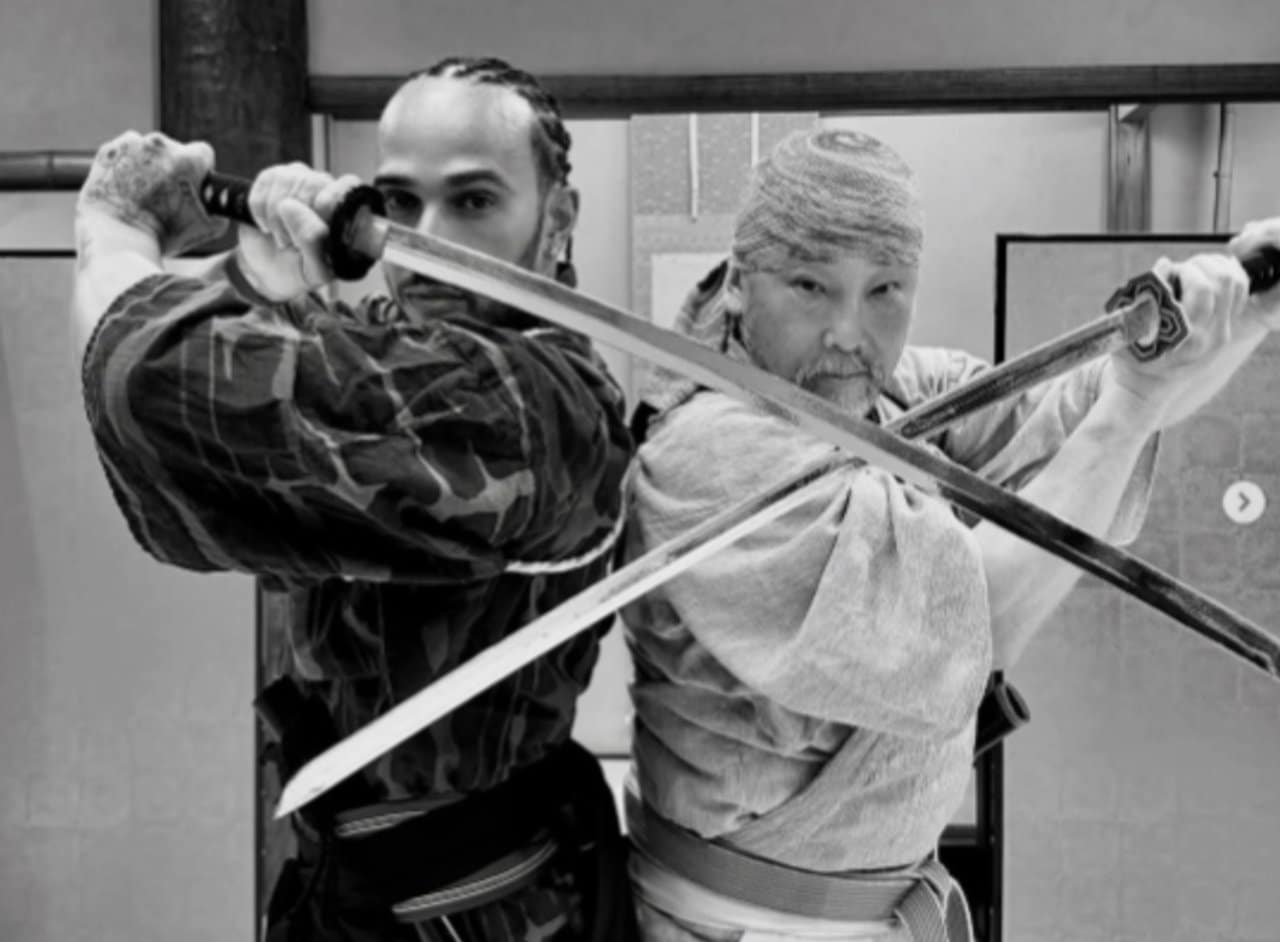
British pilot Lewis Hamilton surprised the public and his followers by participating in an intensive martial arts class with the renowned master Tetsuro Shimaguchi, in Tóquio, this Thursday. The meeting took place on the eve of the official activities of Grande Prêmio of Japão of Fórmula 1, marking a moment of mental and physical preparation for the seven-time world champion. Shimaguchi is known worldwide for being the choreographer of the sword fighting scenes in the film Kill Bill, by director Quentin Tarantino, and applied precision techniques in pilot training.
During the activity, Hamilton wore the traditional kimono and demonstrated unusual skill when handling the katana, the famous samurai sword. The training involved choreographed movements that resemble highly technically complex cinematic sequences. The driver’s preparation for the third stage of the 2026 season combines the search for concentration with immersion in the local traditions of the Asian country.
- The training took place in a traditional dojo in the Japanese capital.
- Lewis Hamilton performed attack and defense movements against two opponents.
- The activity ended with a symbolic blow to knock down the extras.
- Master Tetsuro Shimaguchi praised the discipline and focus of the Ferrari competitor.
Respect and tradition mark the pilot’s experience on the Japão
Lewis Hamilton’s first contact with the Japanese master was guided by the ethical rigor of oriental martial arts. The pilot highlighted that the experience at the dojo carried a deep symbolism, connecting directly with his personal history and the first years of his training as an athlete. Ele followed all etiquette protocols, including the initial bow to the sensei, a gesture he learned as a child.
Practicing with the katana served as an exercise in presence and emotional control, fundamental elements for an elite pilot. Hamilton highlighted that although the focus was on sword technique, the real learning lies in the philosophy of mutual respect. Essa samurai warrior mentality is often cited by the Brit as an inspiration for facing challenges on high-speed tracks.
Karate heritage and overcoming childhood bullying
Lewis Hamilton revealed that his connection with martial arts began long before joining professional motorsport. The pilot trained karate weekly for seven years when he was a child, initially motivated by the need to defend himself from bullying situations in the school environment. Over time, combat sport went from being just a defense tool to becoming a pillar of discipline and humility.
This solid foundation helped the Briton develop the resilience needed to deal with the pressures of motorsport. Hamilton explained that maturity made him understand the beauty of traditional gestures, such as the act of kneeling and bowing before the master. Para him, returning to a dojo in Japão represented the closure of a life cycle that began with the search for security and evolved into global success.
Car meeting in Daikoku and passion for classics
In addition to samurai training, Hamilton’s agenda in Japão included a visit to the legendary car meet in Daikoku, Yokohama. The place is internationally recognized as the main meeting point for enthusiasts and collectors of modified and classic vehicles. The British driver attracted the attention of hundreds of fans when he appeared driving a red Ferrari F40, one of the most iconic models in the history of the Italian automaker.
The F40 model has always been cited by Hamilton as one of his dream vehicles, and its presence at the event reinforced his current bond with the Maranello team. The passage through Daikoku allowed the driver to interact with the street car culture of Japão, which has a unique and vibrant visual identity. Esse moment of relaxation served as a brief break before the start of contractual and technical obligations with the Ferrari team in Suzuka.
Performance in the 2026 season and expectations for Suzuka
Lewis The Briton has demonstrated a solid adaptation to the Ferrari car, achieving consistent results in the first two races of the year. In the season opener, he secured fourth place in the Austrália GP, followed by an important podium in the China GP, where he finished in third place.
The performance in Xangai also included an excellent display in the sprint race, where the seven-time champion was also among the top three. Esses results give the driver confidence to face the challenging Suzuka route, known for its fast curves and high technical demands. Ferrari seeks to reduce the distance to the competition leaders, and Hamilton’s experience on Japanese soil can be a strategic differentiator.
Official Japão GP schedule and local broadcasts
The engines start to roar at Circuito of Suzuka on Thursday night, following the local activity schedule of Federação Internacional of Automobilismo. The first free training session is scheduled for 11:30 pm (Brasília time), repeating the same time for the second training session. Brazilian fans who want to follow the evolution of the cars should pay attention to the broadcasts, which take place on subscription channels and open TV depending on the relevance of the sessions.
In the early hours of Friday to Saturday, the focus turns to defining the starting grid, with the qualifying session scheduled for 03:00. The highlight of the weekend will be the Grande Prêmio of the Japão, with the start scheduled for 2am on Sunday morning, Brasília time. Hamilton and the other competitors will face 53 laps on one of the circuits most loved by drivers due to the complexity of curves such as 130R and the “esses” sector.
- First free training: Thursday at 11:30 pm.
- Second free training: Thursday at 11:30 pm.
- Third free training: Friday at 11:30 pm.
- Official classification: Saturday at 03:00.
- Race (Japão GP): Sunday at 02:00.
Technical changes to energy classification and punishments
For the 2026 Japão GP, the Fórmula 1 organization implemented changes to the energy recharge limit during qualifying laps. The measure aims to make the dispute for pole position more dynamic and balanced between the top teams. Essa reduction in regeneration capacity forces engineers and pilots to better manage the use of electrical power along the Suzuka route, preventing performance from falling in the final sectors of the track.
Hamilton and the Ferrari technical team worked intensively in the simulators to understand the impact of these new rules on fuel and battery consumption. Energy management strategy will be crucial, especially on a circuit where traction exiting slow corners precedes long straights. The fine-tuning of the number 44 car will be crucial to guaranteeing a starting position that allows us to fight for victory or another consecutive podium.
Rivals’ stance and controversies in the Japanese paddock
The atmosphere before the Japão GP was also marked by moments of tension off the track, involving the current champion Max Verstappen. The Dutch pilot starred in a controversial episode when he expelled a journalist from an official press conference in Tóquio. The attitude sparked discussions among members of the specialized media and highlighted the high-pressure atmosphere surrounding the fight for the world title this season.
While competitors deal with external controversies, Lewis Hamilton remains focused on technical preparation and mental balance. The choice of cultural activities and martial arts training demonstrates an attempt by the British to isolate themselves from external noise and focus exclusively on sporting performance. Hamilton’s emotional stability has been one of his strengths in this new phase of his career wearing the colors of the Italian team.
Physical preparation and the impact of martial arts on Fórmula 1
The physical conditioning required by a modern Fórmula 1 car is extreme, with drivers enduring intense lateral forces at every turn. The practice of martial arts, such as that demonstrated by Hamilton in Tóquio, directly helps to strengthen the core and fine motor coordination. The precise movements performed with the katana require a perfect connection between vision and action, exactly what is required when overtaking at more than 300 km/h.
In addition to the physical aspect, samurai training offers a lesson in absolute focus under pressure. In a sport where milliseconds define the winner, the ability to remain calm and technically precise is vital. Hamilton seeks to channel this ancestral Japanese energy to optimize its reactions inside the Ferrari cockpit, aiming to overcome the competition from Red Bull and McLaren at this stage.
Hamilton’s journey in Japão reflects his continuous quest for evolution, both as an athlete and as an individual, respecting local traditions while chasing new records in the history of world motorsport. Anticipation for the race in Suzuka is high, with fans waiting to see whether the Brit’s “samurai mode” will translate into a dominant performance on Japanese tarmac.