

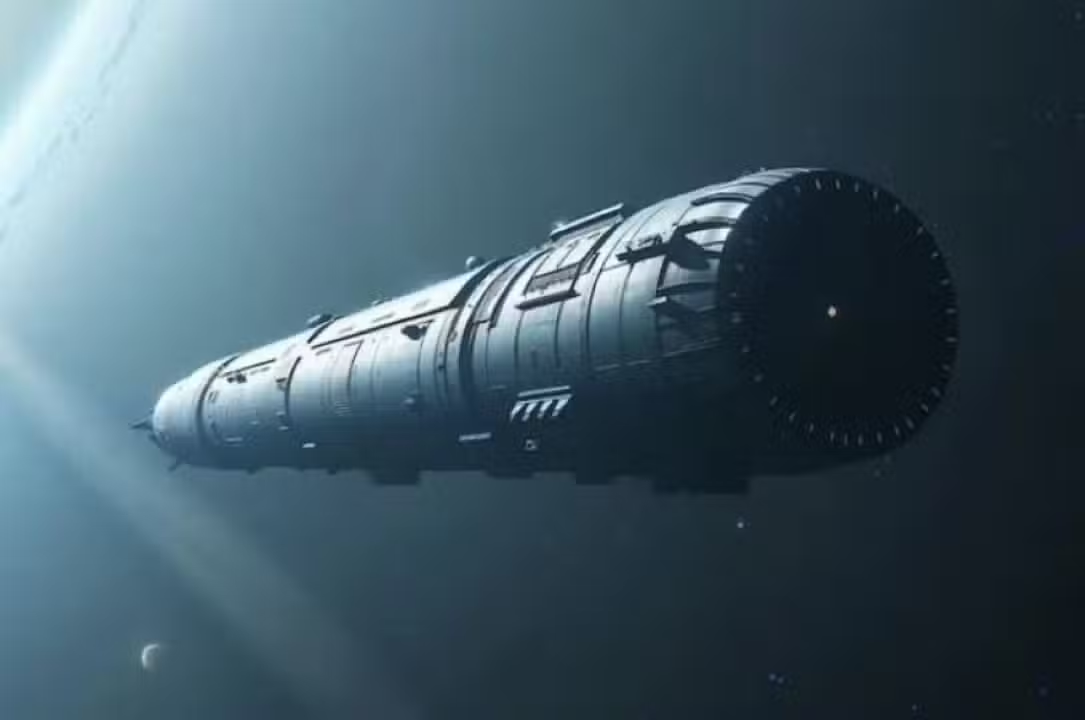
The development of vehicles capable of crossing interstellar distances gains practical contours with the presentation of new aerospace engineering models. A detailed concept proposes the construction of a cylindrical megastructure designed to house thousands of crew members on a four-century crossing towards the Alpha Centauri system. The initiative represents a joint effort by researchers to map the technological and biological needs of a one-way mission, where multiple generations will be born and live entirely in deep space.
The journey targets a rocky exoplanet located in the habitable zone of its host star, offering theoretical conditions for the establishment of a human colony. Planning involves creating a closed and self-sustaining ecosystem, capable of providing vital resources on an uninterrupted basis. Engenheiros and scientists work on the premise of using technologies that are already in the advanced research or initial development phase, avoiding dependence on physical discoveries that have not yet been proven.
The entire operation requires a complete rethinking of social dynamics and resource management in extreme confinement environments. The maintenance of order, the transfer of knowledge and the preservation of the physical and mental health of travelers over hundreds of years form the core concerns of the strategic planning of this cosmic crossing.
Modular architecture and vehicle dimensions
The main structure adopts an elongated shape similar to a cigar, reaching a length of 58 kilometers. The design incorporates multiple concentric cylinders that operate independently, resembling the overlapping shell mechanism. Essa geometric configuration was selected to distribute the extreme mechanical stresses generated during the long acceleration and braking phases in the vacuum of space.
The continuous rotation movement of the internal modules is the mechanism responsible for generating artificial gravity through centrifugal force. The calculations indicate a gravitational simulation equivalent to 0.1 g, an index considered sufficient to mitigate the loss of bone and muscle mass in the crew, without compromising the structural integrity of the external hull.
The total mass of the complex reaches 2.4 billion metric tons, a volume that makes any launch attempt from the Earth’s surface unfeasible. Assembling equipment of this magnitude requires the installation of orbital shipyards, possibly in the Lua orbit, using raw materials extracted and processed directly in the space environment.
Each layer of the cylinder has a specific and irreplaceable function for mission survival. The outermost sections function as sacrificial shields, while the inner rings house the delicate life support systems and living areas.
Propulsion and defense systems against cosmic threats
The displacement of such a significant mass through the interstellar medium depends on engines powered by direct nuclear fusion, using a mixture of deuterium and helium-3. Essa energy matrix offers a higher performance than traditional chemical fuels, allowing the ship to maintain constant acceleration during the first year of the journey until it reaches its ideal cruising speed. The same process will be activated in reverse when approaching the destination, requiring another year of controlled deceleration.
The 400-year journey exposes the vehicle to constant bombardments of cosmic microwave background radiation and impacts from micrometeoroids traveling at extreme speeds. The layered design acts as a physical and electromagnetic barrier, absorbing and dissipating kinetic and radioactive energy before it reaches interior habitats. The integrity of the hull is monitored 24/7 by networks of sensors distributed across the entire length of the fuselage.
Autonomous maintenance and in-house manufacturing
The inability to receive supplies or spare parts from the Terra forces the ship to operate as a completely independent industrial complex. Sistemas in situ manufacturing, based on advanced 3D printing and molecular recycling, allows the manufacturing of any component damaged during travel.
Autonomous robots and artificial intelligence agents perform external inspections and highly complex repairs, reducing the need for dangerous extravehicular activities by human crew. Artificial intelligence also works to manage the mission’s database, ensuring that technical knowledge is not lost with the succession of generations.
Processing space debris captured along the way could serve as a supplemental source of raw materials for the vehicle’s forging and manufacturing systems.
Life dynamics and social organization during the journey
The interior of the complex functions as a planned city, divided into residential sectors, research hubs, industrial areas and vast agricultural areas. The creation of artificial biomes, which include simulated tropical forests and freshwater lakes, fulfills the dual role of producing food on a large scale and maintaining the constant renewal of breathable oxygen.
Demographic management is rigorous, keeping the population stabilized at a maximum limit of 2,400 individuals to avoid the collapse of life support systems. Traditional family structures give way to horizontal and cooperative models of coexistence, designed to maximize efficiency in the distribution of scarce resources and promote social cohesion in a permanently closed environment.
Characteristics of the exoplanet chosen as destination
The crossing target is located approximately 4.24 light years away from our Sistema Solar. The rocky celestial body orbits its star in just 11 Earth days, but is at the exact distance to allow the existence of liquid water on its surface, a determining factor in selecting the destination.
The relative proximity of this star system makes it the most logical candidate for the first attempts at human expansion across the cosmos. Observatórios astronomers continue to collect data on the planet’s atmospheric composition to refine the habitability models that will guide colonizers.
Despite the promising potential, the environment presents severe obstacles, such as the emission of intense stellar flares by the red dwarf that illuminates the system. Mission planning already includes the development of surface infrastructure capable of protecting the pioneers from these radioactive storms shortly after landing.
Evaluation criteria and prominence in the international competition
The detailed concept was the winner of a global competition that brought together experts from diverse disciplines, from astrophysics to social sciences. The proposal prepared by an Italian team surpassed its competitors by presenting a unique level of systemic coherence.
The successful integration between heavy engineering needs and long-term biological requirements was the decisive factor in the award. The project demonstrated theoretical feasibility in managing critical resources.
The technological pillars that support the theoretical feasibility of the mission include:
- Generation of clean and continuous energy through confined nuclear fusion reactors.
- Water and air recycling systems with efficiency close to one hundred percent.
- Artificial governance algorithms to assist in resolving social conflicts.
- Planetary landing modules attached to the main structure for the final phase of the mission.
The model establishes a new benchmark for academic studies on generational spacecraft. The technical documentation generated serves as a database for future simulations of human survival in conditions of absolute isolation in deep space.